
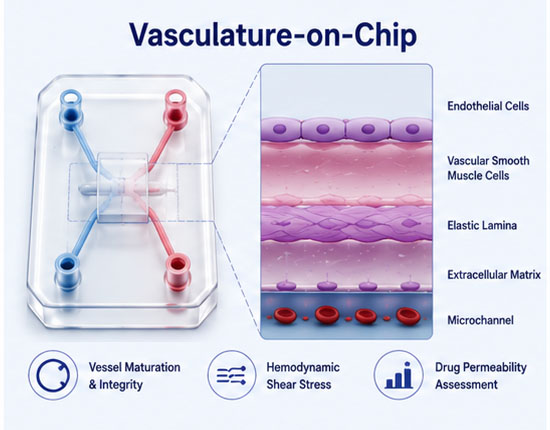
A microphysiological vascular model designed to support endothelial barrier studies, vascular permeability testing, angiogenesis research, inflammation modeling, and vascular drug response evaluation under controlled flow conditions.
- Overview
- Details
- Advantages
- FAQs
Overview
The vascular system plays a central role in nutrient delivery, waste removal, immune cell trafficking, hemostasis, and tissue homeostasis. Vascular endothelial cells form a selective barrier that responds to biochemical signals, mechanical forces, inflammatory stimuli, and drug exposure.
Conventional static endothelial cultures are useful for basic assays, but they often lack key dynamic features of the vascular microenvironment, such as luminal flow, shear stress, barrier polarization, and controlled perfusion. Vasculature-on-Chip provides a perfusable in vitro model for studying endothelial function, vascular permeability, angiogenesis, inflammation, and drug-related vascular responses in a more controlled setting.
What Is Vasculature-on-Chip?
Vasculature-on-Chip is a microfluidic cell culture platform that models selected structural and functional features of blood vessels. The system supports vascular endothelial cells under defined flow conditions and can be adapted for co-culture with pericytes, smooth muscle cells, immune cells, stromal cells, or tissue-specific cells.
This chip-based vascular model can support the study of:
- Endothelial barrier formation and permeability
- Flow- and shear stress-dependent vascular responses
- Angiogenesis and vascular remodeling
- Leukocyte adhesion, migration, and inflammatory activation
- Thrombosis-related or coagulation-associated responses
- Vascular toxicity and drug response evaluation
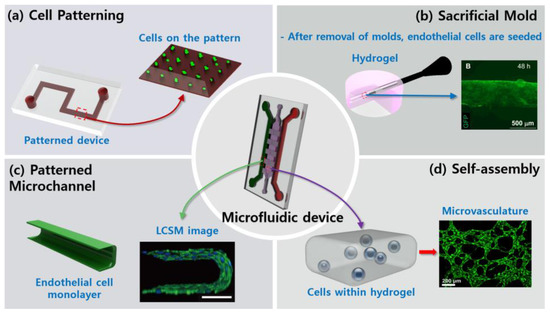 Fig. 1. Schematic representation of a vasculature-on-chip microphysiological platform (Kim
S, Kim W, et al., 2017).
Fig. 1. Schematic representation of a vasculature-on-chip microphysiological platform (Kim
S, Kim W, et al., 2017).
Our Vasculature-on-Chip Platform
Our Vasculature-on-Chip platform provides a dynamic vascular model for endothelial barrier studies, permeability assessment, angiogenesis research, vascular inflammation modeling, and vascular drug response analysis.
Key Features
- Vascular-relevant model: Supports endothelial monolayer formation, barrier function, and vascular cell interactions.
- Controlled perfusion: Enables defined flow, shear stress exposure, compound delivery, and longitudinal sampling.
- Flexible cell options: Compatible with vascular endothelial cells, iPSC-derived endothelial cells, pericytes, smooth muscle cells, immune cells, and tissue-specific co-cultures.
- Customizable formats: Suitable for barrier, angiogenesis, inflammation, thrombosis-related, and vascular toxicity studies.
Validation & Readouts
- Endothelial markers: CD31, VE-cadherin, vWF, eNOS, VEGFR2, and endothelial junction proteins
- Barrier assessment: ZO-1, Occludin, Claudin-5, permeability assays, and transendothelial transport analysis
- Functional endpoints: Angiogenic sprouting, leukocyte adhesion, inflammatory activation, oxidative stress, apoptosis, and vascular remodeling
- Downstream analysis: Live imaging, immunostaining, ELISA, qPCR, flow cytometry, multiplex cytokine assays, RNA-seq, and compound transport analysis
Applications
- Endothelial Barrier Studies: Evaluate barrier integrity, permeability, and junctional organization.
- Angiogenesis Research: Study vascular sprouting, remodeling, and pro- or anti-angiogenic compound responses.
- Vascular Inflammation Modeling: Analyze cytokine-induced activation, leukocyte adhesion, and immune cell transmigration.
- Vascular Toxicity Testing: Assess compound-induced endothelial injury, oxidative stress, and barrier disruption.
- Disease and Drug Response Studies: Model selected aspects of vascular dysfunction, thrombosis-related responses, or tissue-specific vascular interactions.
Why Choose Our Vasculature-on-Chip
- More physiologically relevant than static endothelial culture for selected vascular studies
- Dynamic flow environment for controlled perfusion, shear stress exposure, and time-course sampling
- Supports key vascular functions including barrier formation, permeability, angiogenesis, and inflammatory responses
- Flexible and customizable for different vascular cell types, co-culture systems, flow settings, and assay endpoints
- Compatible with common readouts including imaging, permeability assays, biomarker analysis, molecular assays, and cytokine profiling
- Technical support available for chip setup, model optimization, assay design, and customized workflows
FAQs
Q: What cell types can be used in Vasculature-on-Chip?
The platform can support primary endothelial cells, iPSC-derived endothelial cells, pericytes, smooth muscle cells, immune cells, stromal cells, and selected tissue-specific cells depending on the model design.
Q: Can the platform be used for vascular permeability studies?
Yes. It can be used to assess endothelial barrier integrity, junctional protein expression, permeability to fluorescent tracers or compounds, and barrier disruption after stimulation or drug exposure.
Q: Does the chip support flow and shear stress?
Yes. The chip can be connected to a perfusion system to provide controlled flow and shear stress within defined experimental ranges.
Q: Is this platform suitable for angiogenesis studies?
Yes. Depending on chip configuration and matrix setup, the platform can support analysis of endothelial sprouting, vascular network formation, remodeling, and response to angiogenic regulators.
Q: What assays are compatible with this platform?
Compatible assays include live imaging, immunofluorescence staining, permeability assays, leukocyte adhesion assays, viability assays, ELISA, qPCR, cytokine profiling, RNA-seq, and compound transport analysis.
Advance endothelial barrier research, angiogenesis studies, and vascular drug evaluation with our Vasculature-on-Chip platform.
Contact us today to request product details, pricing, or customized solutions for your study.
Online Inquiry