
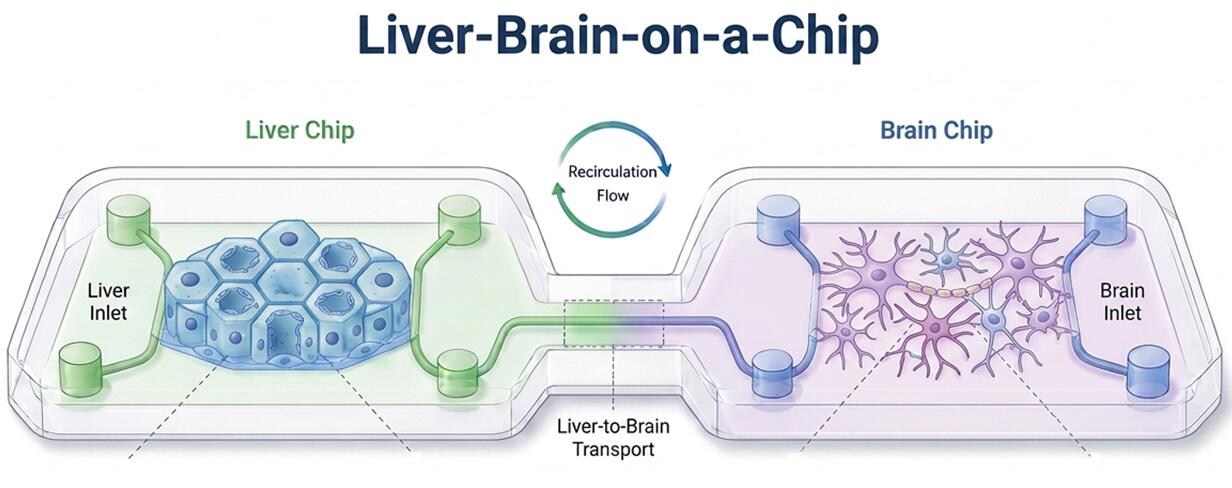
A customizable multi-organ microphysiological platform that links hepatic metabolism with brain-relevant models for studying metabolite-mediated neurotoxicity, blood-brain barrier interactions, and liver-brain crosstalk under controlled microfluidic conditions.
- Overview
- Platform
- Advantages
- FAQs
Overview
The liver and central nervous system are connected through systemic circulation, metabolic regulation, inflammatory mediators, and xenobiotic biotransformation. Many drugs and chemicals are processed by the liver before reaching other tissues, and liver-generated metabolites may differ from parent compounds in activity, permeability, or toxicity. For brain-relevant safety studies, this is particularly important because central nervous system exposure is influenced by both hepatic metabolism and blood-brain barrier function.
Conventional in vitro systems often evaluate liver metabolism, blood-brain barrier transport, or neural toxicity as separate assays. These approaches are useful but may not fully represent sequential exposure, metabolite-driven neurotoxicity, or soluble-factor-mediated liver-brain communication. Animal models provide whole-body physiology, yet species differences in hepatic enzymes, transporter expression, blood-brain barrier properties, and neurotoxicity mechanisms can affect translation to human responses.
Liver-Brain-on-a-Chip is a custom multi-organ microphysiological system that connects a hepatic compartment with brain-relevant compartments, such as a blood-brain barrier module, neural cell culture, or combined neurovascular model. The platform enables controlled investigation of how liver metabolism influences brain exposure and how brain-relevant cells respond to parent compounds, metabolites, inflammatory signals, or disease-associated stressors.
What Is Liver-Brain-on-a-Chip?
Liver-Brain-on-a-Chip is a microengineered platform that integrates functional liver models with brain-relevant tissue models in a connected fluidic environment. Depending on the research objective, the system can be configured to include:
- A hepatic module for metabolism, detoxification, and liver response assessment
- A blood-brain barrier module for permeability and transport-related studies
- Neural cell compartments containing neurons, astrocytes, microglia-like cells, or brain organoid-derived models
- Controlled microfluidic transfer of drugs, metabolites, cytokines, nutrients, and soluble mediators
- Time-course sampling for parent compound depletion, metabolite formation, barrier response, and neural endpoints
This platform is particularly useful for studies where hepatic metabolism may alter central nervous system exposure or toxicity. It can support mechanistic neurotoxicity research, metabolite profiling, blood-brain barrier interaction studies, and selected liver-brain axis disease models. As a custom system, the chip configuration, cell sources, flow conditions, exposure strategy, and analytical endpoints can be tailored to the project.
Our Liver-Brain-on-a-Chip Platform
Our custom Liver-Brain-on-a-Chip platform connects liver models with blood-brain barrier and/or neural modules in a controlled microfluidic system, supporting metabolism-linked CNS safety and mechanism studies.
Key Features
- Custom liver-brain configuration: Supports liver-to-BBB, liver-to-neural, or liver-BBB-neural designs.
- Controlled inter-organ flow: Enables defined transfer of compounds, metabolites, and soluble factors.
- Functional hepatic module: Allows assessment of metabolism, viability, and liver-specific biomarkers.
- Brain-relevant modules: Can include endothelial barrier models, astrocytes, neurons, microglia-like cells, or organoid-derived systems.
- Compatible readouts: Supports imaging, permeability assays, qPCR, ELISA, LC-MS/MS, cytotoxicity testing, and selected neural function-related assays.
The system uses separated but fluidically connected compartments to maintain tissue-relevant culture conditions while enabling controlled liver-brain communication.
- Liver module: Evaluated for morphology, viability, albumin secretion, urea production, and CYP activity.
- BBB module: Assessed for barrier integrity, tight junction marker expression, and permeability performance where included.
- Neural module: Evaluated for cell viability, morphology, marker expression, and selected stress or function-related endpoints.
- Quality control: Includes sterility, chip integrity, leakage testing, cell viability, flow stability, and endpoint-specific assay validation.
Applications
The platform can be customized for metabolism-linked brain exposure and neurotoxicity studies, including:
- Metabolite-mediated neurotoxicity: Evaluate brain-relevant responses after hepatic biotransformation of test compounds.
- Blood-brain barrier studies: Assess permeability, barrier disruption, and transporter-related effects depending on model design.
- CNS safety assessment: Study neural viability, stress responses, inflammation-related changes, or selected functional readouts.
- Liver-brain axis modeling: Investigate selected mechanisms involving inflammatory mediators, metabolic stress, or liver-derived soluble factors.
- Drug and chemical evaluation: Support early-stage assessment of parent compounds and metabolites with brain-relevant endpoints.
Why Choose Our Liver-Brain-on-a-Chip
- Integrated metabolism-CNS exposure model for studying how hepatic processing may influence brain-relevant responses.
- Customizable chip architecture with optional BBB, neural, immune-associated, or organoid-derived components.
- Dynamic microfluidic environment enabling controlled compound transfer, soluble factor exchange, and time-dependent sampling.
- Flexible cell sourcing including primary hepatocytes, iPSC-derived hepatic cells, brain endothelial cells, astrocytes, neurons, microglia-like cells, and brain organoid-derived models.
- Adaptable endpoints for metabolism, permeability, barrier integrity, neurotoxicity, inflammation, oxidative stress, and tissue-specific biomarker analysis.
FAQs
Q: When should a BBB module be included in a Liver-Brain-on-a-Chip study?
A BBB module is recommended when the study focuses on CNS exposure, permeability, transporter-related questions, or barrier disruption. If the main goal is to examine direct effects of liver-generated metabolites on neural cells, a liver-neural configuration without a dedicated BBB module may be sufficient.
Q: Can the system distinguish parent compound effects from metabolite effects?
The system can be designed to compare parent compound exposure, liver-conditioned exposure, and metabolite-enriched samples. Analytical methods such as LC-MS/MS are typically used to quantify parent compound depletion and metabolite formation, while brain-relevant endpoints are measured in parallel.
Q: What are the limitations of this custom platform?
Liver-Brain-on-a-Chip models reproduce selected aspects of liver-brain interaction, but they do not represent the full complexity of the human body or the entire central nervous system. Study design, cell maturity, barrier performance, media compatibility, and endpoint selection should be carefully matched to the research question.
Q: How is culture medium compatibility handled between liver and brain models?
Medium compatibility is evaluated during custom design. Options may include optimized shared medium, compartment-specific media with controlled exchange, or staged exposure workflows. The selected approach depends on cell types, assay duration, hepatic function requirements, and brain-relevant endpoint sensitivity.
Q: What endpoints can be measured in a Liver-Brain-on-a-Chip study?
Common endpoints include hepatic viability, albumin secretion, urea production, CYP activity, parent compound and metabolite quantification, BBB permeability, tight junction marker expression, neural viability, neuronal or glial marker expression, inflammatory cytokines, oxidative stress markers, mitochondrial stress indicators, gene expression, immunostaining, and cytotoxicity biomarkers such as LDH.
Advance metabolism-linked CNS exposure and neurotoxicity studies with a customized Liver-Brain-on-a-Chip platform.
Contact us today to discuss chip configuration, BBB and neural model options, exposure design, analytical endpoints, and tailored study solutions.
Online Inquiry