
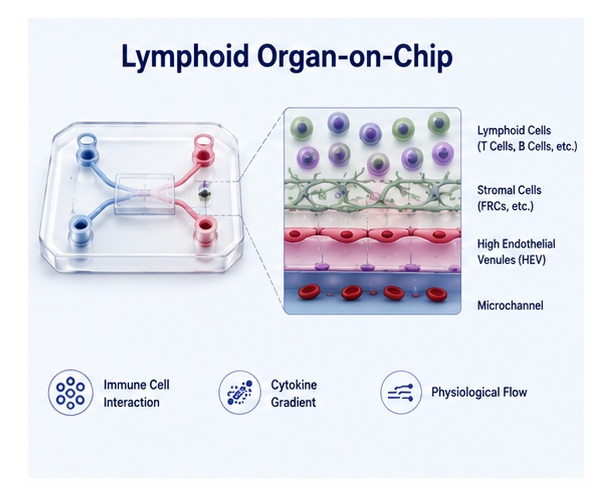
A dynamic microphysiological lymphoid tissue model designed to support immune activation studies, vaccine evaluation, immunotoxicity assessment, antibody response modeling, and immune disease research under controlled microenvironmental conditions.
- Overview
- Details
- Advantages
- FAQs
Overview
Lymphoid organs are central hubs of the immune system where immune cells interact, become activated, proliferate, differentiate, and coordinate adaptive immune responses. Secondary lymphoid tissues such as lymph nodes, spleen, and mucosa-associated lymphoid tissues provide highly organized microenvironments that regulate antigen presentation, T cell and B cell activation, germinal center-like reactions, cytokine signaling, and immune memory formation.
Traditional immune cell culture systems often fail to reproduce the complex spatial organization, cell-cell communication, chemokine gradients, extracellular matrix cues, and dynamic fluid transport observed in lymphoid tissues. These limitations can reduce the predictive value of in vitro assays for vaccine development, immunotherapy evaluation, infection studies, immune toxicity testing, and inflammatory disease modeling.
Lymphoid Organ-on-Chip provides a perfusable and compartmentalized in vitro platform that recreates key functional features of lymphoid tissue microenvironments. By integrating immune cells, stromal components, controlled perfusion, and customizable stimulation conditions, this model enables more physiologically relevant analysis of immune activation, immune regulation, antigen-specific responses, and immune-mediated pathology.
What Is Lymphoid Organ-on-Chip?
Lymphoid Organ-on-Chip is a microfluidic cell culture platform designed to model important structural and functional aspects of human lymphoid tissues. The system can support immune cell recruitment, antigen exposure, immune cell crosstalk, cytokine secretion, lymphocyte activation, and differentiation-related responses in a controlled microphysiological environment.
This chip-based lymphoid model can support the study of:
- Antigen presentation and dendritic cell-mediated T cell activation
- B cell activation, differentiation, and antibody production
- T cell proliferation, polarization, exhaustion, and memory-like responses
- Germinal center-like immune reactions and lymphoid follicle-associated processes
- Cytokine and chemokine signaling in immune microenvironments
- Vaccine candidate evaluation and adjuvant screening
- Immunotoxicity, immune suppression, and immune stimulation assessment
- Immune disease modeling, including inflammation, autoimmunity, and infection-related immune responses
- Real-time imaging, longitudinal sampling, and downstream molecular analysis
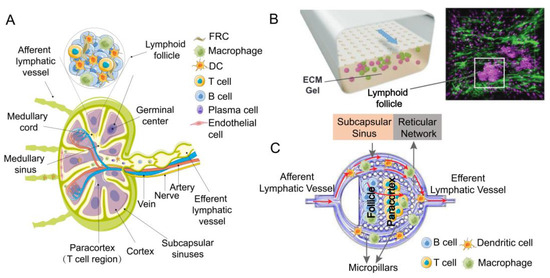 Fig. 1. Two-channel lymph node organ-on-a-chip model (Wang Q, Yang Y, et al.,
2024).
Fig. 1. Two-channel lymph node organ-on-a-chip model (Wang Q, Yang Y, et al.,
2024).
Our Lymphoid Organ-on-Chip Platform
Our Lymphoid Organ-on-Chip platform provides a dynamic microphysiological model for studying lymphoid tissue function, immune activation, vaccine responses, immunotoxicity, and immune disease mechanisms under controlled flow conditions.
Key Features
- Lymphoid-like microenvironment: Supports immune cell interaction, activation, proliferation, and cytokine signaling.
- Controlled perfusion: Enables dynamic medium flow, soluble factor exchange, and longitudinal sampling.
- Flexible cell options: Compatible with PBMCs, T cells, B cells, dendritic cells, macrophages, NK cells, stromal cells, and donor- or patient-derived immune cells.
- Customizable stimulation: Supports antigens, vaccine candidates, adjuvants, cytokines, biologics, immune modulators, and inflammatory stimuli.
Validation & Readouts
- Immune phenotyping: T cell, B cell, dendritic cell, macrophage, NK cell, activation, and checkpoint markers
- Functional assays: Antigen presentation, lymphocyte activation, proliferation, antibody secretion, cytokine release, and cytotoxicity
- Immunotoxicity endpoints: Cell viability, immune suppression, immune activation, apoptosis, and inflammatory responses
- Downstream analysis: Imaging, flow cytometry, ELISA, multiplex cytokine assays, qPCR, RNA-seq, single-cell analysis, and proteomics
Applications
- Vaccine Evaluation: Assess antigen presentation, adjuvant activity, cytokine responses, and antibody production.
- Immunotherapy Research: Study biologics, immune checkpoint modulators, cytokine therapies, and immune-stimulating agents.
- Immunotoxicity Testing: Evaluate immune suppression, immune activation, and cytokine release risk.
- Immune Disease Modeling: Model inflammation, autoimmunity, chronic immune activation, and infection-related immune responses.
- Personalized Immunology: Use donor- or patient-derived immune cells for individualized immune response profiling.
Why Choose Our Lymphoid Organ-on-Chip
- Physiologically relevant immune model that better reflects lymphoid tissue interactions than static immune cell culture
- Dynamic perfusion system for controlled flow, soluble factor exchange, and longitudinal sampling
- Flexible cell compatibility with PBMCs, immune cell subsets, stromal cells, and donor- or patient-derived samples
- Customizable experimental design for vaccine testing, immunotoxicity, immunotherapy, inflammation, and immune disease studies
- Multiple compatible readouts including imaging, flow cytometry, cytokine assays, antibody detection, qPCR, RNA-seq, and single-cell analysis
- Technical support available for chip setup, cell selection, protocol design, assay optimization, and customized workflows
FAQs
Q: What cell types can be used in Lymphoid Organ-on-Chip?
The platform can support PBMCs, T cells, B cells, dendritic cells, monocytes, macrophages, NK cells, lymphoid stromal cells, and donor- or patient-derived immune cells depending on the experimental objective and model configuration.
Q: Can this platform be used for vaccine evaluation?
Yes. Lymphoid Organ-on-Chip can be used to evaluate antigen presentation, adjuvant effects, T cell activation, B cell responses, cytokine production, and antibody secretion. It is suitable for early-stage vaccine candidate screening and immune response characterization.
Q: Can Lymphoid Organ-on-Chip model antigen-specific immune responses?
Yes. Depending on cell source, antigen format, and assay design, the platform can be configured to study antigen uptake, dendritic cell maturation, T cell priming, lymphocyte proliferation, cytokine secretion, and antigen-specific antibody responses.
Q: Is the platform suitable for immunotoxicity testing?
Yes. The model can be used to assess immune suppression, immune overstimulation, inflammatory cytokine release, immune cell viability, activation marker changes, and compound-induced alterations in immune function.
Q: Can patient-derived immune cells be used?
Yes. Patient-derived or donor-specific immune cells can be incorporated when available, enabling personalized immune response studies, donor variability analysis, and disease-relevant immune modeling.
Q: What assays are compatible with this platform?
Compatible assays include live imaging, immunofluorescence staining, flow cytometry, cell viability assays, proliferation assays, ELISA, multiplex cytokine analysis, qPCR, RNA-seq, single-cell sequencing, antibody detection assays, and proteomic analysis.
Advance vaccine development, immunotoxicity assessment, and immune disease research with our human-relevant Lymphoid Organ-on-Chip platform.
Contact us today to request product details, pricing, or customized solutions for your immunology study.
Online Inquiry