
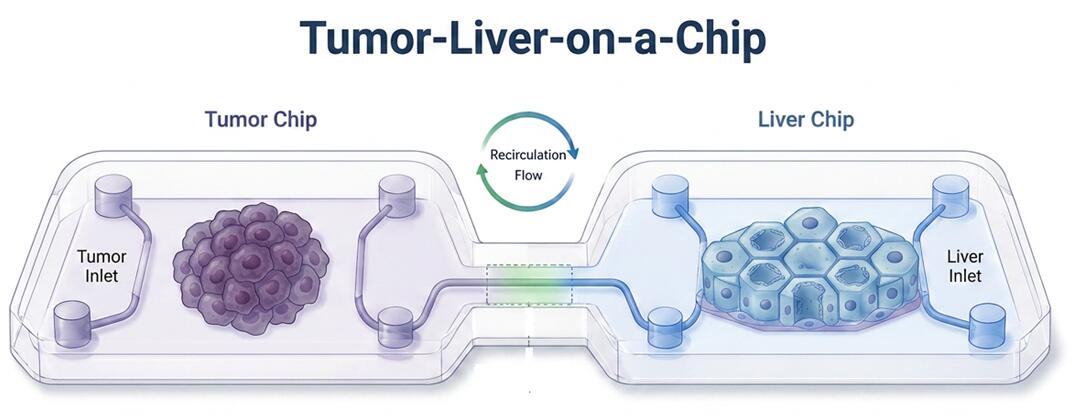
A customizable multi-organ microphysiological platform that integrates 3D tumor models with hepatic tissue models to investigate anticancer drug metabolism, metabolism-dependent tumor response, hepatotoxicity, and selected tumor-liver interactions under controlled microfluidic perfusion.
- Overview
- Platform
- Advantages
- FAQs
Overview
Oncology drug development requires evaluation of both antitumor efficacy and organ safety. The liver is the primary site of xenobiotic metabolism and plays a central role in drug biotransformation, detoxification, and systemic drug exposure. Hepatic metabolism may activate prodrugs, reduce exposure to active parent compounds, or generate metabolites with distinct pharmacological or toxicological properties. For anticancer agents, these metabolism-dependent processes can substantially influence therapeutic efficacy, off-target toxicity, and overall treatment outcomes.
Conventional in vitro tumor models are widely used to investigate cancer cell viability, proliferation, apoptosis, invasion, and drug response. However, tumor-only systems generally lack hepatic metabolism and therefore cannot simultaneously evaluate metabolism-dependent efficacy and drug-induced liver injury. Conversely, liver-only models provide valuable information on metabolism and hepatotoxicity but cannot capture tumor-specific responses. Although animal models offer systemic physiological context, interspecies differences in tumor biology, hepatic enzyme activity, immune regulation, and drug disposition may limit translation to human oncology.
Tumor-Liver-on-a-Chip is a customizable multi-organ microphysiological system (MPS) that integrates tumor and hepatic tissue models through controlled microfluidic perfusion. The platform enables researchers to investigate how hepatic metabolism modifies anticancer drug exposure, how liver-generated metabolites influence tumor response, and how tumor-derived soluble factors affect hepatic physiology and function within a dynamic multicellular environment.
Unlike conventional two-dimensional tumor cultures, tumor microphysiological models can incorporate three-dimensional architecture, extracellular matrix components, nutrient and oxygen gradients, and selected stromal or immune-associated cells. These features better recapitulate aspects of the tumor microenvironment that influence drug penetration, cell survival, proliferation, apoptosis, hypoxia-associated signaling, and treatment resistance.
What Is Tumor-Liver-on-a-Chip?
Tumor-Liver-on-a-Chip is a microengineered platform that integrates a tumor compartment with a hepatic compartment under controlled microfluidic perfusion. The tumor module may be configured using established cancer cell lines, 3D tumor spheroids, patient-derived tumor organoids (PDOs), matrix-embedded tumor microtissues, or other clinically relevant tumor models. The hepatic module may incorporate primary hepatocytes, hepatic co-culture systems, iPSC-derived hepatocyte-like cells, or liver organoids depending on the study objectives.
The platform is designed to address two major questions in oncology research: how hepatic metabolism alters anticancer drug exposure and efficacy, and how reciprocal biochemical communication between tumor and hepatic tissues influences treatment response, toxicity, and disease-associated signaling.
Key design elements may include:
- Compartmentalized tumor and hepatic culture chambers connected by controlled microfluidic perfusion
- Three-dimensional tumor models including spheroids, organoids, or ECM-supported tumor microtissues
- Controlled microfluidic transport of therapeutic compounds, metabolites, cytokines, and other soluble signaling molecules
- Assessment of hepatic metabolism, detoxification capacity, and liver function-related endpoints
- Tumor viability, spheroid growth, apoptosis, proliferation, invasion-associated behavior, and drug response evaluation
- Optional incorporation of endothelial, stromal, or immune-associated components for selected mechanistic studies
As a customizable microphysiological platform, Tumor-Liver-on-a-Chip can be adapted for prodrug activation studies, metabolism-dependent efficacy evaluation, therapeutic window assessment, hepatotoxicity profiling, early-stage liver metastasis-related research, and tumor microenvironment investigations. The platform is intended to complement, rather than replace, conventional in vitro, in vivo, and clinical studies.
Our Tumor-Liver-on-a-Chip Platform
Our customizable Tumor-Liver-on-a-Chip platform integrates tumor and hepatic tissue models within a controlled microfluidic environment, enabling simultaneous evaluation of anticancer drug efficacy, hepatic metabolism, and liver safety.
Key Features
- Flexible platform design: Supports sequential or recirculating perfusion with configurable tumor-to-liver, liver-to-tumor, or bidirectional communication.
- Physiological microenvironment: Continuous perfusion provides dynamic molecular transport and more physiologically relevant tissue interactions than static culture.
- Broad model compatibility: Supports tumor spheroids, organoids, primary hepatocytes, hepatic co-cultures, and iPSC-derived hepatic cells.
- Integrated analysis: Simultaneously evaluates tumor efficacy, hepatic metabolism, and liver toxicity within a single interconnected platform.
- Multiple analytical endpoints: Compatible with live imaging, immunostaining, qPCR, ELISA, LC-MS/MS, cytokine analysis, and cytotoxicity assays.
System Design & Validation
- Tumor module: Assessment of viability, morphology, spheroid growth, apoptosis, proliferation, and therapeutic response.
- Hepatic module: Evaluation of albumin secretion, urea production, CYP activity, viability, and liver injury biomarkers.
- Flow configuration: Configurable for metabolism-first, tumor-to-liver signaling, or bidirectional communication studies.
- Quality control: Includes chip integrity, sterility, leakage testing, flow-rate verification, perfusion stability, and cell viability assessment.
Applications
- Metabolism-dependent anticancer drug evaluation
- Prodrug activation studies
- Therapeutic window assessment
- Drug-induced liver injury (DILI) studies
- Early-stage tumor-liver interaction and metastasis-related mechanism studies
- Combination therapy evaluation
Why Choose Our Tumor-Liver-on-a-Chip
- Integrated tumor efficacy and liver safety assessment within a single microphysiological system.
- Physiologically relevant 3D culture using spheroids, organoids, or customized tissue models.
- Dynamic microfluidic perfusion supporting continuous molecular transport and inter-organ communication.
- Flexible study configuration for metabolism, efficacy, hepatotoxicity, and mechanism studies.
- Broad compatibility with primary cells, organoids, and iPSC-derived hepatic models.
- Comprehensive analytical readouts covering imaging, molecular biology, metabolism, and functional biomarkers.
FAQs
Q: Which tumor models are supported?
The tumor compartment can be customized using cancer cell lines, tumor spheroids, patient-derived organoids (PDOs), or other 3D tumor models, depending on your research objectives and sample availability.
Q: Can the platform evaluate metabolism-dependent drug activity?
Yes. The hepatic compartment can metabolize test compounds before or during tumor exposure, enabling studies of prodrug activation, metabolite-mediated efficacy, and metabolism-related toxicity.
Q: Which liver models can be incorporated?
The hepatic module may include primary human hepatocytes, hepatic co-culture systems, iPSC-derived hepatocyte-like cells, or liver organoids, depending on the experimental design.
Q: Can tumor efficacy and liver toxicity be assessed simultaneously?
Yes. The interconnected platform supports parallel evaluation of tumor response together with hepatic function and liver toxicity-related endpoints, allowing a more comprehensive assessment of drug performance.
Q: Is the platform suitable for immuno-oncology studies?
Selected immune or stromal components, such as macrophages, endothelial cells, fibroblasts, or Kupffer cells, can be incorporated for customized mechanistic studies where appropriate.
Q: What analytical methods are supported?
The platform is compatible with live-cell imaging, fluorescence microscopy, immunostaining, qPCR, ELISA, LC-MS/MS, cytokine analysis, and other endpoint-specific assays.
Build Your Customized Tumor-Liver-on-a-Chip Model
We provide flexible Tumor-Liver-on-a-Chip solutions tailored to your oncology research needs, from model design and cell selection to assay development and endpoint analysis.
Contact our experts to discuss your project and develop a customized multi-organ microphysiological system for oncology drug discovery and translational research.
Online Inquiry