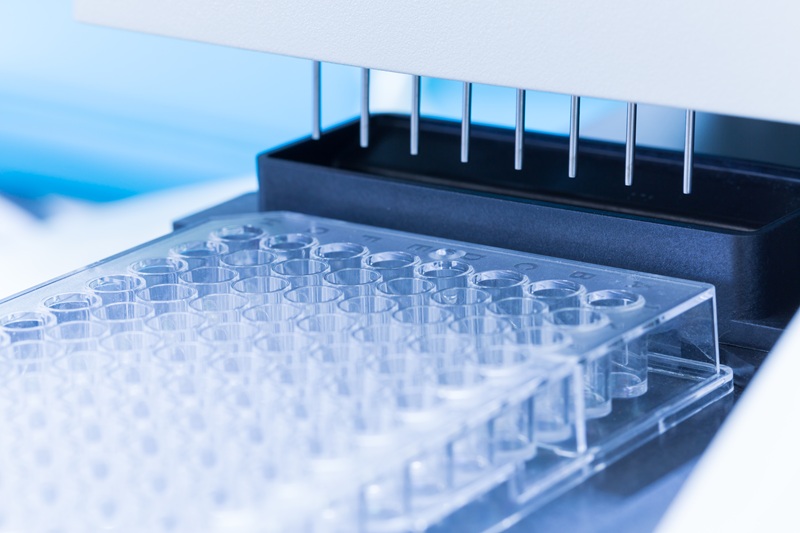
Accurately predict oral bioavailability with Creative Bioarray's Intestinal Models for Drug Absorption. Moving beyond standard static Caco-2 monolayers, our models incorporate 3D villi structures, physiological mucus layers, and fluidic shear stress to evaluate intestinal permeability, transporter interactions, and complex formulation dynamics.
- Introduction
- Service Details
- Workflow
- Features
- FAQs
Simulating the Human Gut Barrier for Precision Pharmacokinetics
Oral delivery remains the preferred route for drug administration, yet predicting human intestinal absorption accurately is highly challenging. Traditional static Caco-2 models lack crucial components such as mucin-secreting goblet cells, microvilli architecture, and mechanical peristalsis-like forces, often resulting in skewed permeability data for poorly soluble drugs or large molecules.
Creative Bioarray's Intestinal-on-a-Chip and gut organoid platforms recreate the physiological complexities of the human gastrointestinal tract. By co-culturing enterocytes with goblet and Paneth cells under dynamic flow, we achieve authentic tight junctions and in vivo-like TEER values, providing a robust platform for evaluating fraction absorbed (Fa), transporter-mediated efflux, and the permeation of novel lipid nanoparticles (LNPs).
Intestinal Absorption Services
Our customized gut models serve a wide array of oral drug development needs.
1. Intestinal Permeability Assessment (Papp)
- Accurate determination of apparent permeability (Papp) across a bio-relevant mucosal barrier.
- Predictive modeling for both highly soluble and poorly soluble BCS class drugs.
- Evaluation of paracellular and transcellular absorption routes.
| Model Type | Key Features | Key Applications |
| Dynamic Caco-2/HT29-MTX Chip | Co-culture with mucus secretion, flow-induced villi | Small molecule Papp, bioequivalence, food-effect simulation |
| Primary Gut Organoid Monolayers | Patient-derived primary intestinal stem cells | Transporter studies, precision medicine, GI-toxicity |
2. Efflux & Uptake Transporter Assays
- Quantification of P-glycoprotein (P-gp), BCRP, and MRP2 mediated efflux to assess absorption limitations.
- Study of active uptake mechanisms via PEPT1 and OATP transporters.
- Identification of transporter-based Drug-Drug Interactions (DDIs) in the gut.
Technical Platform and Detection Methods
Instrumentation:
- Dual-channel microfluidic chips
- Continuous TEER monitoring systems
Key Reagents:
- Primary intestinal stem cells
- Fluorescent paracellular tracers (Lucifer Yellow, FITC-Dextran)
Analysis Methods:
- LC-MS/MS for compound quantification
- Immunofluorescence of Tight Junctions (ZO-1, Claudins)
- Mucus layer thickness profiling
Service Workflow
Our streamlined workflow ensures clarity, quality, and client engagement at every step:
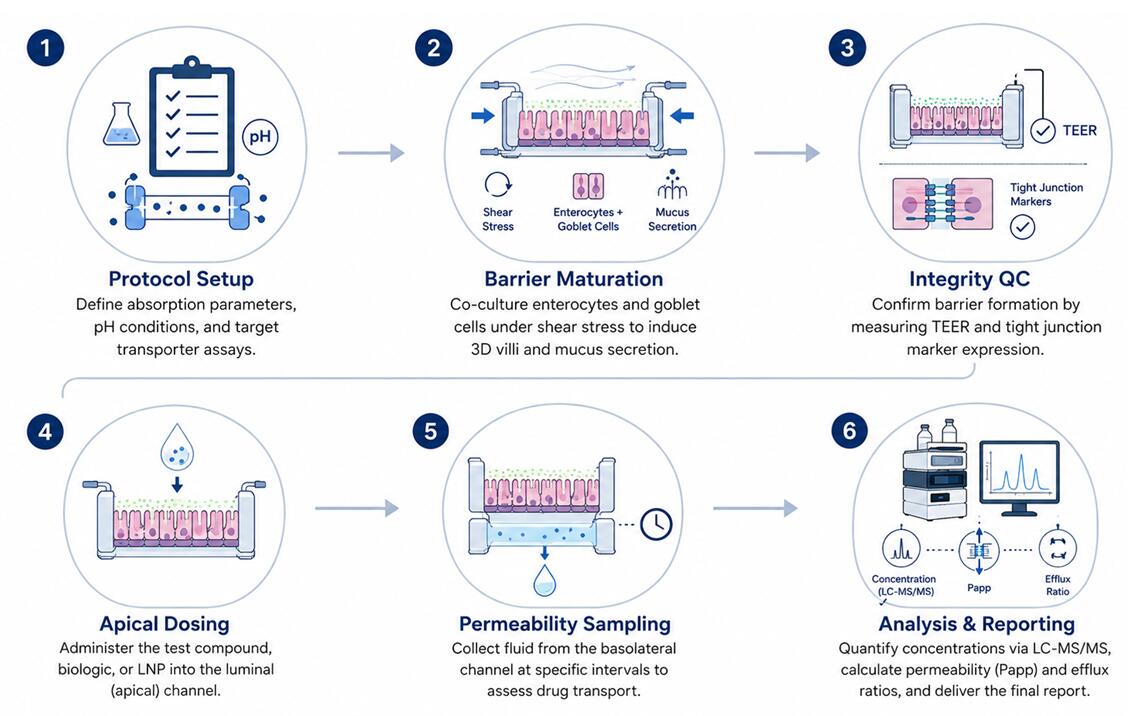 Tight junction integrity is verified prior to all dosing experiments.
Why Choose Our Intestinal Models
- Presence of a true physiological mucus layer, essential for evaluating hydrophobic drugs.
- Flow-induced 3D villi formation increases surface area, mimicking the actual human jejunum.
- In vivo-like TEER values prevent the artificial restriction of drug permeation seen in static Caco-2 plates.
- Capability to model microbiome interactions for advanced prodrug studies.
Need Technical Assistance?
Navigating BCS Class III and IV compounds requires robust models. We customize our gut-on-a-chip setups to accommodate specific gastric pH changes, bile acid concentrations, and formulation excipients.
FAQs
How do you model the intestinal mucus layer?
We co-culture enterocytes with mucus-secreting goblet cells (e.g., HT29-MTX). Under continuous fluidic flow, a stable, physiological mucin layer forms, which is essential for evaluating the diffusion of hydrophobic drugs and nanoparticles.
Can you evaluate large molecules or oral peptides?
Yes, the physiological tight junctions and native-like surface area in our chips allow for highly accurate permeability assessments of macromolecules and permeation enhancers.
Can you simulate fed versus fasted states?
Yes. By adjusting the composition of the apical media—including modifying bile acid concentrations (e.g., FaSSIF or FeSSIF buffers) and pH levels—we can model how food intake affects compound solubility and absorption.
Is it possible to integrate microbiome components?
We can establish defined aerobic/anaerobic interfaces within the apical channel to co-culture specific commensal bacterial strains. This enables the study of microbe-mediated prodrug activation and drug metabolism.
Plan Your Intestinal Absorption Study
Contact our scientific team to discuss protocol parameters, including gastric pH variations, bile acid concentrations, and specific transporter assays relevant to your compound.
Online Inquiry