
Creative Bioarray provides specialized Nephrotoxicity Research Services utilizing advanced organ-on-a-chip and organoid technologies. By accurately recapitulating human renal physiology, our predictive models help researchers identify drug-induced kidney injury (DIKI) earlier, optimize drug clearance profiles, and significantly reduce late-stage clinical attrition.
- Introduction
- Service Details
- Workflow
- Features
- FAQs
Understanding Drug-Induced Kidney Injury (DIKI)
The kidney receives approximately 20-25% of the resting cardiac output, making it disproportionately exposed to systemic xenobiotics and circulating drugs. This high exposure, coupled with the active secretion and concentration of compounds within the tubular lumen, renders the renal system exceptionally vulnerable to drug-induced kidney injury (DIKI). In clinical settings, DIKI accounts for a significant percentage of acute kidney injury (AKI) cases and remains a primary driver of late-stage pharmaceutical attrition.
Traditional preclinical models, such as static 2D cell cultures and rodent studies, repeatedly fail to accurately predict human renal toxicity. This translational gap is largely due to pronounced species-specific differences in drug transporter expression (e.g., OATs, OCTs, MRPs) and the lack of physiological biomechanical cues. In standard static microplates, human renal epithelial cells rapidly lose their polarization, primary cilia, and critical brush-border enzymes, rendering them functionally inadequate for precise clearance and toxicity profiling.
To overcome these fundamental limitations, Creative Bioarray employs state-of-the-art microphysiological systems (MPS) and 3D organoids. Our Kidney-on-a-Chip platforms precisely emulate the dynamic microenvironment of the human nephron by introducing continuous luminal fluidic flow and highly controlled shear stress. This mechanobiological stimulation restores proper epithelial polarization, tight junction formation, and robust apical and basolateral transporter localization. By providing a truly human-relevant physiological context, our platforms enable researchers to deeply interrogate nephrotoxic mechanisms, localized tubular injury, and complex renal pharmacokinetics with unprecedented predictive accuracy.
Targeted Nephrotoxicity Solutions
Our research services are specifically structured around the critical functional units of the kidney, ensuring highly targeted evaluations of how your compounds interact with renal tissue:
1. Proximal Tubule Toxicity & Transporter Function
- Focus on the proximal tubule, the most common site for drug-induced kidney injury, to evaluate localized cellular stress and viability.
- Assess the activity of essential apical and basolateral drug transporters (e.g., OAT1/3, OCT2, P-gp, MRPs) to understand active secretion and drug-drug interactions.
- Monitor reabsorption capabilities and the intracellular accumulation of nephrotoxic compounds.
2. Glomerular Filtration & Barrier Integrity
- Model the glomerular filtration barrier using co-cultures of human podocytes and glomerular endothelial cells.
- Investigate drug-induced alterations in barrier permeability and structural damage to podocyte foot processes.
- Perform targeted assays to measure the leakage of large molecular weight proteins, effectively mimicking clinical proteinuria in vitro.
3. Biomarker Release & Mechanistic Profiling
- Measure the release of highly sensitive, translationally relevant biomarkers of acute kidney injury (AKI) prior to observable cell death.
- Quantify markers such as Kidney Injury Molecule-1 (KIM-1), Neutrophil Gelatinase-Associated Lipocalin (NGAL), and Clusterin.
- Investigate underlying toxic mechanisms, including mitochondrial dysfunction, oxidative stress, and inflammatory cytokine secretion.
Technical Platform and Analytical Approaches
We utilize advanced technologies to ensure reliable and highly predictive data:
Instrumentation:
- Microfluidic kidney-on-a-chip systems
- Automated high-throughput screening platforms
- Live-cell imaging for dynamic observation
Key Reagents:
- Specialized primary renal cell culture media
- Standardized extracellular matrix (ECM) scaffolds
- Validated clinical AKI biomarker panels
Analysis Techniques:
- Barrier function assays (TEER, fluorescent tracer clearance)
- Biomarker quantification via multiplex ELISA/qPCR
- High-content imaging for morphological profiling
Our Efficient Service Workflow
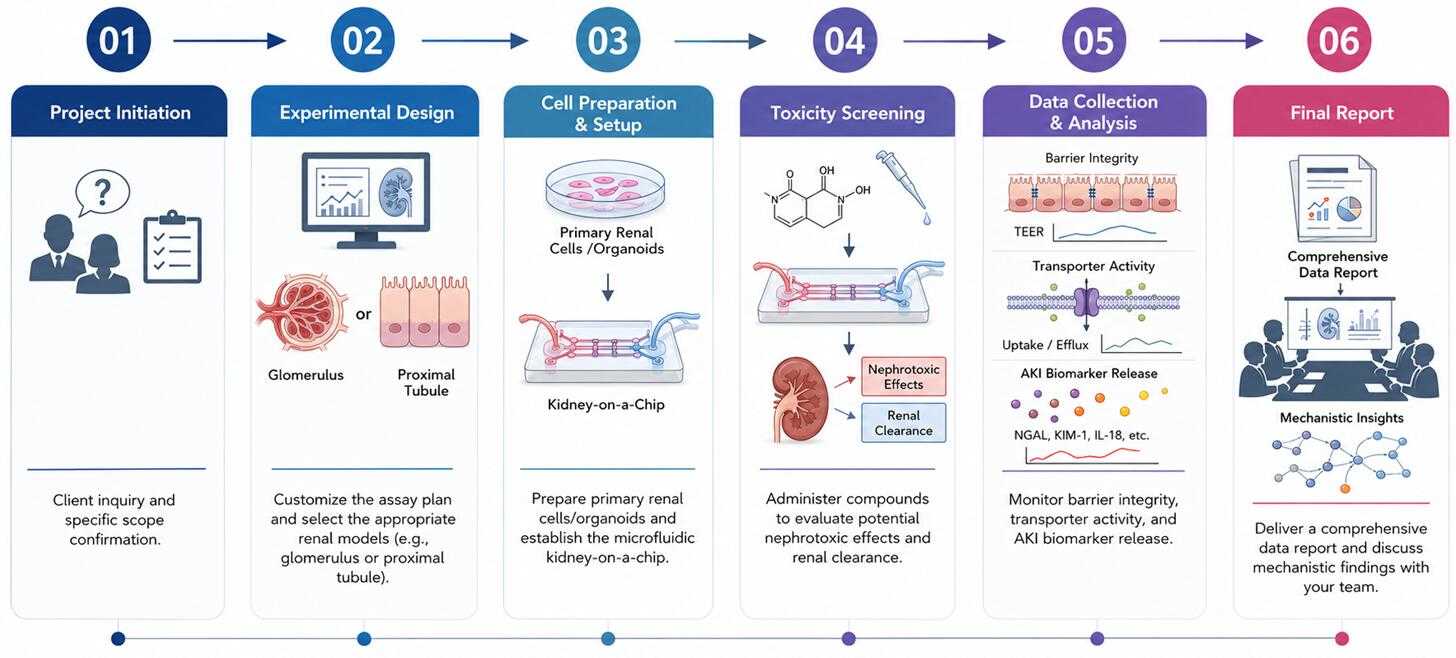
Our 6-step workflow is designed for clarity, rigorous quality control, and consistent client alignment:
Why Choose Creative Bioarray for Nephrotoxicity Research?
- Dynamic models that incorporate fluidic shear stress to closely replicate the human nephron environment.
- Sensitive detection of early-stage kidney injury utilizing clinically relevant predictive biomarkers.
- Tailored experimental designs designed to interrogate specific drug clearance pathways and transporter interactions.
- Transparent, timely communication and dedicated scientific support throughout the project lifecycle.
Ready to Refine Your Nephrotoxicity Assessments?
At Creative Bioarray, we are deeply committed to advancing the safety profile of your therapeutic candidates. Our scientific team is ready to help you select the most appropriate renal models and endpoints for your specific research goals. Let’s collaborate to navigate the complexities of renal drug safety with confidence.
FAQs
Which specific functional parts of the kidney can you model?
We primarily focus on modeling the proximal tubule and the glomerulus, as these are the critical regions for drug clearance and the most common sites for drug-induced kidney injury (DIKI). We utilize highly characterized human primary cells to ensure physiological relevance.
Do your platforms incorporate fluidic shear stress?
Yes. Continuous fluid flow is absolutely critical for the proper polarization of renal epithelial cells and the expression of functional transporters. Our microfluidic systems reliably replicate the physiological shear stress found naturally within the human nephron.
What specific biomarkers do you measure to assess kidney toxicity?
Beyond standard cell viability metrics, we evaluate sensitive, predictive biomarkers for Acute Kidney Injury (AKI) such as KIM-1, NGAL, and Clusterin. These markers allow for the detection of cellular stress and sub-lethal injury much earlier than conventional assays.
Can you evaluate renal drug transporters and drug-drug interactions (DDIs)?
Absolutely. Because our models maintain cellular polarization and appropriate shear stress, they robustly express key renal transporters (such as OAT1/3, OCT2, and P-gp). This makes them ideal for investigating active tubular secretion, renal clearance, and potential transporter-mediated DDIs.
Transform Your Renal Safety Pharmacology Today
Our dedicated team at Creative Bioarray is equipped to help you overcome the hurdles of preclinical nephrotoxicity testing. Reach out for a consultation, and let’s work together to bring safer, more effective therapeutics to the clinic.
Online Inquiry