
Advanced organoid and organ-on-a-chip platforms for immunotherapy evaluation, enabling functional analysis of immune cell activity, tumor-immune interactions, and patient-specific treatment response prediction in physiologically relevant human models.
- Overview
- Platform
- Service
- Application
- Workflow
- FAQs
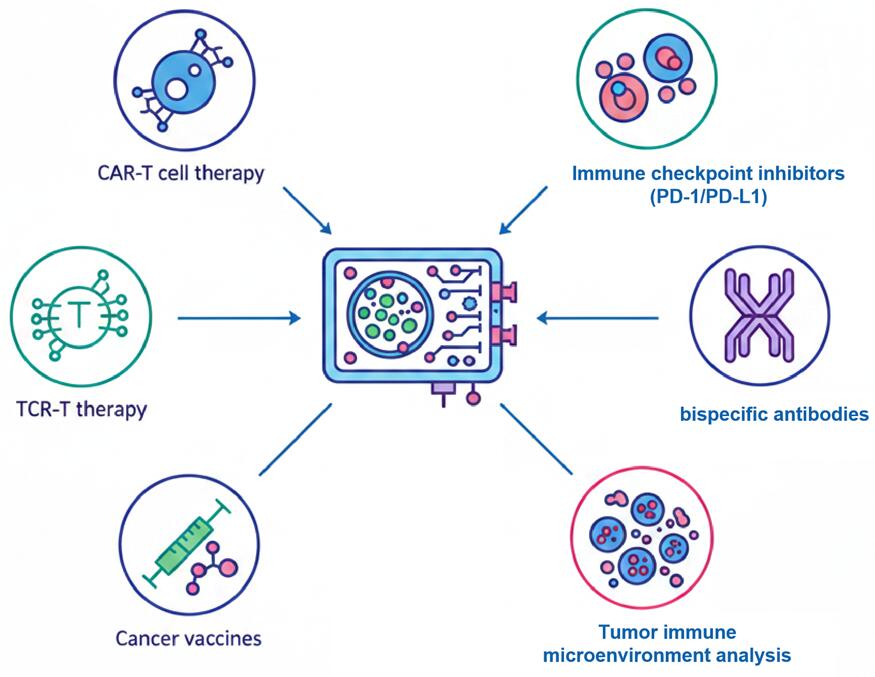
Immunotherapy has revolutionized the treatment landscape of cancer, autoimmune illnesses and chronic inflammatory diseases. Modalities such as immune checkpoint inhibitors, CAR-T and TCR-T cell treatments, bispecific antibodies and therapeutic vaccines are based on intricate and dynamic interactions between immune cells, target tissues and the tumour microenvironment (TME). However, traditional in vitro experiments and animal models usually cannot fully recapitulate the complexity of the human immune system and the heterogeneity of individual patients.
Patient-derived organoids and organ-on-a-chip systems are sophisticated human-relevant platforms for the assessment of immunotherapy. Organoids preserve genetic, histological and functional features of natural tissues and organ-on-a-chip technologies including perfusion flow, immune cell trafficking and multicellular spatial organization. These methods allow for more accurate measurements of immune activation, cytotoxicity, immunological infiltration, cytokine release and mechanisms of therapeutic resistance and are helping translational immuno-oncology investigations and drug development.
Comparison of Immunotherapy Evaluation Models
| Model Type | Immune Interaction Modeling | Human Relevance | Microenvironment Complexity | Suitability for Immunotherapy Studies |
| 2D Cell Culture | Low | Moderate | Low | Suitable for preliminary cytotoxicity screening only. |
| Animal Models | Moderate | Limited due to species differences | High | Widely used but limited translational predictability. |
| PBMC Co-culture Assays | Moderate | Moderate | Limited | Suitable for short-term immune activation and killing assays. |
| Patient-Derived Organoids | High | High | Moderate–High | Enables patient-specific immunotherapy response prediction and resistance profiling. |
| Organ-on-a-Chip | Very High | High | Very High | Recapitulates dynamic immune trafficking and tumor-immune interactions under physiological flow. |
Our Immunotherapy Assessment Platforms
We provide physiologically relevant organoid and organ-on-a-chip platforms engineered to model tumor-immune microenvironments and evaluate immune-based therapies under controlled, human-relevant conditions.
Key Features:
- Patient-derived organoids representing diverse tumor and normal tissue types
- Immune-competent co-culture systems including T cells, NK cells, macrophages, and dendritic cells
- Functional evaluation of CAR-T, TCR-T, checkpoint inhibitors, and bispecific antibodies
- Microfluidic organ-on-a-chip systems enabling perfusion-driven immune cell recruitment and infiltration
- Real-time monitoring of immune-mediated cytotoxicity and tumor cell killing
- Multiplex cytokine profiling and immune activation readouts
- Scalable formats suitable for preclinical screening and translational research
Immunotherapy Research Services
Leveraging advanced organoid and organ-on-a-chip technologies, we provide comprehensive immuno-oncology research services to support drug discovery, mechanism elucidation, and translational validation.
- Immune Cell-Mediated Cytotoxicity Assays (T cells, NK cells)
- CAR-T and TCR-T Functional Potency and Killing Assays
- Immune Checkpoint Blockade Efficacy Studies (PD-1/PD-L1, CTLA-4)
- Tumor-Immune Co-culture and Spheroid Killing Assays
- Immune Cell Infiltration and Migration Analysis under flow conditions
- Cytokine Release Syndrome (CRS)-related Profiling
- Immune Escape and Resistance Mechanism Studies
- Biomarker Discovery for Immunotherapy Response Prediction
These services enable data-driven candidate selection, mechanism-of-action (MoA) studies, and preclinical validation of next-generation immunotherapies.
Core Applications in Immunotherapy Assessment
Patient-Derived Organoids
- Personalized Immunotherapy Screening: Evaluation of patient-specific responses to checkpoint inhibitors and adoptive cell therapies.
- Tumor-Immune Microenvironment Modeling: Reconstruction of native-like immune-tumor interactions for functional assessment.
- Resistance Mechanism Profiling: Identification of immune evasion pathways and therapy resistance signatures.
- Predictive Biomarker Discovery: Supporting identification of response-associated molecular markers.
Organ-on-a-Chip Systems
- Dynamic Immune Cell Trafficking Models: Simulation of circulation, adhesion, and infiltration under physiological flow.
- Real-Time Immune Activation Monitoring: Quantitative assessment of cytokine release and inflammatory signaling.
- Immunotherapy Safety Profiling: Evaluation of off-target immune toxicity and tissue-specific adverse effects.
- Combination Therapy Evaluation: Assessment of synergistic effects between immunotherapy and chemo/radiotherapy or targeted agents.
Workflow
Sample Collection
Patient tissues, tumor samples, or immune cells are collected and processed under optimized conditions.
Model Establishment
Patient-derived organoids or organ-on-a-chip systems are generated to recapitulate native tissue architecture.
Immune Integration
Immune cells or immunotherapeutic agents are introduced into the system for functional assessment.
Functional Readout
Immune activation, cytotoxicity, infiltration, and cytokine responses are quantitatively analyzed.
Data Integration
Multi-dimensional datasets are integrated for efficacy interpretation and translational decision-making.
FAQs
Which immunotherapy modalities can be evaluated?
Our platforms support evaluation of checkpoint inhibitors, CAR-T and TCR-T therapies, bispecific antibodies, cancer vaccines, and other immune-modulating biologics.
Can immune cells be incorporated into organoid systems?
Sure. Depending on the study design, we enable flexible co-culture methods such as T cells, NK cells, macrophages, dendritic cells and patient-derived PBMCs.
What are the benefits of organ-on-a-chip systems?
These create dynamic flow conditions, attract immune cells and better mimic in vivo responses with physiologically meaningful tumor-immune interactions.
Can these platforms be used for safety evaluation?
Yes. They support immune-related toxicity assessment, cytokine release profiling, and off-target effect evaluation during preclinical studies.
Do you offer customized study design?
Yes. We provide tailored immunotherapy study designs based on tumor type, immune system composition, therapeutic modality, and research objectives.
Online Inquiry