

Evaluate inhaled drug absorption and toxicity using microfluidic lung-on-a-chip systems. Culturing respiratory epithelial cells at an Air-Liquid Interface (ALI) enables direct aerosol dosing, mucociliary clearance assessment, and accurate pulmonary pharmacokinetics for novel respiratory therapies.
- Service Details
- Workflow
- Features
- FAQs
Inhalation Drug Delivery & Toxicity Services
1. Aerosol Permeability & Absorption Services
- Physiological Dosing: Direct apical application of dry powders (DPIs), aerosols (MDIs), and nebulized droplets onto the Air-Liquid Interface.
- Transepithelial Transport: Measurement of apparent permeability (Papp) from the airway (apical) to the systemic circulation (basolateral) compartment.
- Bioavailability Prediction: Pharmacokinetic profiling to determine the systemic exposure and pulmonary retention of small molecules and biologics.
2. Formulation Disposition & Clearance Services
- Mucociliary Clearance: Evaluation of active particle clearance rates and ciliary beat frequency (CBF) to determine formulation residence time.
- Drug-Mucus Interactions: Assessment of formulation penetration through the physiological mucus layer, crucial for Lipid Nanoparticles (LNPs) and macromolecules.
- Macrophage Uptake: Co-culture with alveolar macrophages to evaluate phagocytosis and intracellular drug accumulation.
3. Inhalation Toxicity & Inflammation Services
- Barrier Integrity Assessment: Continuous monitoring of Transendothelial Electrical Resistance (TEER) to detect tight junction disruption caused by APIs or excipients.
- Cytotoxicity & Safety: Evaluation of cell viability and membrane damage (e.g., LDH release) following acute or chronic aerosol exposure.
- Inflammatory Profiling: Quantification of pro-inflammatory cytokines and chemokines (e.g., IL-6, IL-8, TNF-α) secreted into the circulation.
Analytical Endpoints and Platform Specifications
Instrumentation:
- ALI microfluidic controllers
- Aerosol deposition modules (Cloud/Nebulizer)
Key Reagents:
- Primary human alveolar/bronchial cells
- Pulmonary microvascular endothelial cells
Analysis Methods:
- LC-MS/MS for absorption kinetics
- Ciliary beat frequency (CBF) imaging
- Cytokine multiplex assays
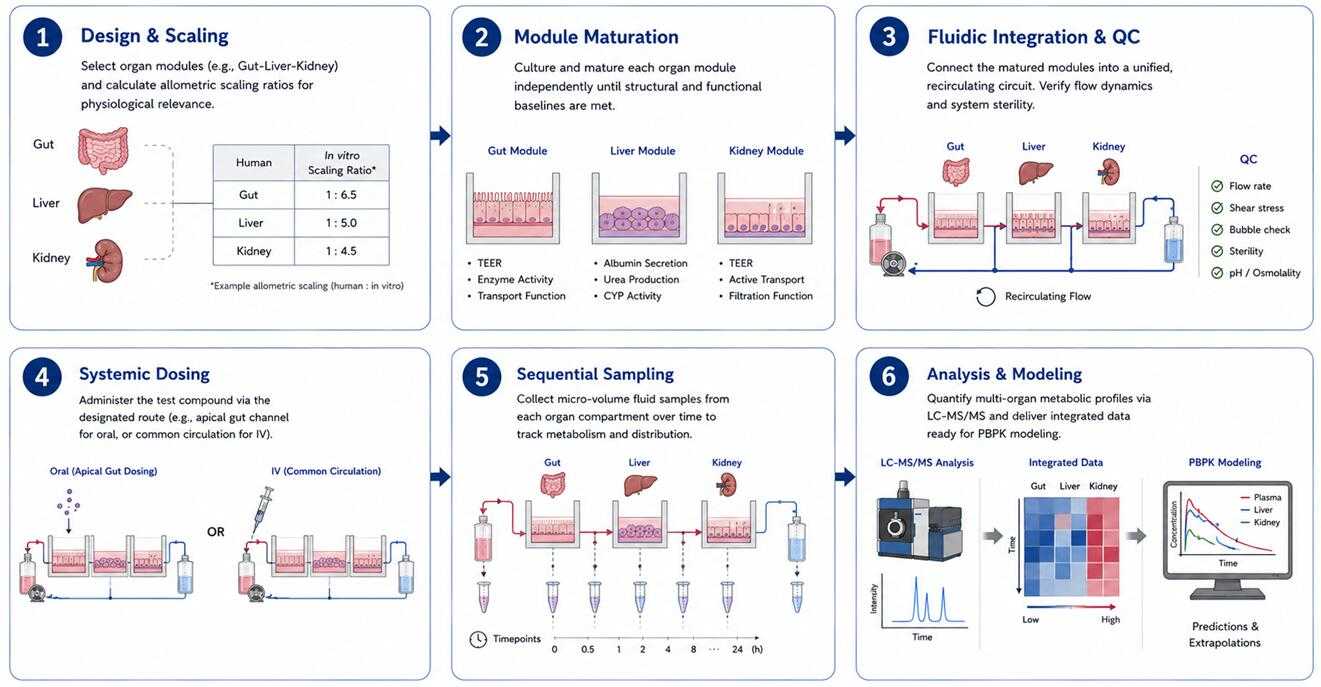
Service Workflow
Scientific Advantages of the Platform
- Air-Liquid Interface (ALI) ensures test compounds retain their aerosolized physicochemical properties during exposure.
- Co-culture with endothelial and immune cells captures physiological barrier functions and complex inflammatory responses.
- Avoids the solubility and diffusion artifacts typically encountered in traditional submerged transwell assays.
FAQs
How is the Air-Liquid Interface (ALI) established?
Primary respiratory epithelial cells are seeded on a porous membrane. Once a confluent monolayer forms, the apical culture media is removed. The cells are subsequently nourished exclusively from the basal channel, which mimics the physiological air-blood barrier and induces differentiation into ciliated and goblet cells.
Can you test dry powder formulations directly?
Yes. The ALI configuration allows us to introduce dry powder inhalers (DPIs) and metered-dose inhalers (MDIs) directly onto the apical surface of the cells using specialized deposition modules, avoiding the need to pre-dissolve the drug in liquid media.
Do you model the alveolar or bronchial regions?
We model both, depending on your research goal. We utilize primary bronchial epithelial cells to evaluate upper airway deposition and mucociliary clearance, and primary alveolar cells to assess deep-lung systemic absorption and gas exchange region toxicities.
Can immune responses be evaluated in this model?
Yes. We can incorporate resident alveolar macrophages into the apical compartment or circulate peripheral blood mononuclear cells (PBMCs) in the basal channel to study immune-mediated drug disposition and inflammatory cytokine cascades.
Initiate Your Inhalation Drug Study
Consult with our scientific team to define dosing methods, cell sources, and endpoints for your pulmonary assays. We provide structured protocols tailored to your study design.
Online Inquiry