
Investigate systemic pharmacokinetics utilizing interconnected multi-organ microphysiological systems. By fluidically coupling tissue modules based on allometric scaling, this platform facilitates the study of inter-organ crosstalk, multi-compartmental kinetics, and metabolite-driven secondary toxicities.
- Introduction
- Service Details
- Workflow
- Features
- FAQs
Systemic PK/PD via Connected Microphysiological Systems
Single-organ assays operate in isolation, lacking the systemic interplay necessary to observe sequential drug absorption, hepatic extraction, and renal clearance. This absence of inter-organ crosstalk limits the accuracy of systemic pharmacokinetic (PK) and pharmacodynamic (PD) predictions.
Creative Bioarray’s Multi-Organ-on-a-Chip platform links modular organ compartments (e.g., gut, liver, kidney) via a recirculating microfluidic network. Utilizing allometric scaling principles, organ cellularity, compartment volumes, and fluid flow rates are calibrated to reflect human physiological ratios. This interconnected approach generates robust multi-compartmental kinetic data suitable for In Vitro to In Vivo Extrapolation (IVIVE).
Integrated ADME Services
1. First-Pass Metabolism Evaluation Services
- Gut-Liver Coupling: Integration of intestinal barriers with hepatic modules to quantify pre-systemic drug extraction.
- Metabolic Differentiation: Distinguishing between gut-wall metabolism and hepatic clearance mechanisms following oral administration simulations.
- Bioavailability Calculation: Accurate measurement of the fraction absorbed (Fa) and hepatic extraction ratio (ER).
2. Multi-Compartmental PK Profiling Services
- Systemic Tracking: Continuous monitoring of parent compound depletion and metabolite distribution across separate organ compartments.
- PBPK Data Generation: Production of empirical kinetic data sets (Cmax, Tmax, AUC) to inform and validate Physiologically Based Pharmacokinetic (PBPK) models.
- Clearance Pathway Identification: Determining the primary routes of elimination in an integrated system (e.g., hepatic vs. renal clearance).
3. Metabolite-Driven Toxicity & Crosstalk Services
- Hepatic-Cardiac Axis: Assessing cardiotoxicity or arrhythmias induced by downstream reactive metabolites generated in the liver.
- Hepatic-Renal Axis: Evaluating the active tubular secretion mechanisms and potential nephrotoxicity of biotransformed compounds.
- Target vs. Off-Target Effects: Verifying therapeutic efficacy in disease models while simultaneously monitoring systemic off-target toxicities.
Analytical Endpoints and Platform Specifications
Instrumentation:
- Multi-module microfluidic mainboards
- Automated fluidic routing controllers
Model Configurations:
- Dual-Organ (e.g., Gut-Liver)
- Tri-Organ (e.g., Gut-Liver-Kidney)
Analysis Methods:
- LC-MS/MS multi-compartment profiling
- Multiplex biomarker quantification
- Cross-module TEER monitoring
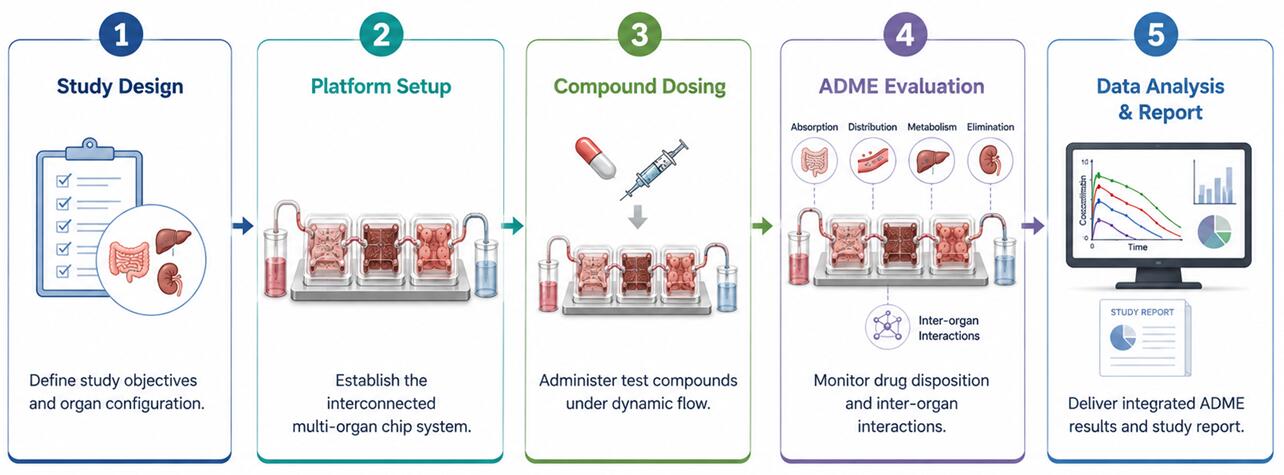
Service Workflow
Scientific Advantages of the Platform
- Application of physiological scaling ensures mathematically robust volume-to-flow ratios for accurate IVIVE.
- Enables the observation of secondary pharmacological effects driven by inter-organ fluidic communication.
- Supports longitudinal sampling from multiple compartments without compromising system sterility or fluidic balance.
FAQs
How do you scale different organs in the multi-organ chip?
We apply allometric scaling principles. Cell seeding densities, compartment volumes, and inter-compartmental flow rates are mathematically scaled based on human organ masses and regional cardiac output fractions to maintain physiological relevance.
Can this multi-compartmental data be used for IVIVE?
Yes, the platform is specifically engineered to generate robust kinetic parameters that can be directly integrated into Physiologically Based Pharmacokinetic (PBPK) modeling software for In Vitro to In Vivo Extrapolation (IVIVE).
Can I customize which organ modules are connected?
Depending on the scientific objective, configurations can be tailored to dual-organ setups (e.g., Gut-Liver for absorption studies) or complex tri-organ setups (e.g., Liver-Heart-Kidney for systemic toxicity tracking).
How is the drug administered in the multi-organ setup?
Administration routes are flexible. Compounds can be dosed into the apical channel of the gut module to simulate oral administration, or introduced directly into the recirculating common media channel to mimic intravenous delivery.
Explore Integrated Systemic PK/PD Solutions
Our scientific staff is available to discuss custom organ configurations, allometric scaling parameters, and multi-omics readouts tailored to your specific compound.
Online Inquiry