
Unlock the power of human-relevant in vitro models with Creative Bioarray's Multi-Organ-on-a-Chip Development Services. Microphysiological systems are engineered to model multi-organ interactions enabling precise pharmacokinetics, accurate toxicity testing and ADME evaluations. Work with our team of experts to expedite drug development with predictive, reliable and fully customizable organ chips.
- Introduction
- Service Details
- Workflow
- Features
- FAQs
Human-Relevant Multi-Organ Chip Solutions for Drug Development Challenges
Traditional in vitro cell culture and animal models have become less predictive of human-specific responses causing late failures in drug development, high attrition rates, and significant animal welfare issues. With the advancement in microphysiological systems, Multi-Organ-on-a-Chip (MOoC) has emerged to study multicellular interactions by combining two or more organs on a single microfluidic device. Human cells from different tissues such as liver, heart, kidney, intestine and more can be encapsulated in these devices that are designed to recapitulate inter-organ crosstalk, dynamic flow and microenvironments found in vivo.
Creative Bioarray's Multi-Organ-on-a-Chip offerings utilize this innovative technology to offer researchers and pharmaceutical companies accessible, scalable, and predictive in vitro platforms. From drug absorption to metabolism and distribution, our systems allow for accurate assessments of pharmacokinetics and toxicology before costly failures in drug development occur. Our Human-Multi-Organ chips provide translational relevance to your studies by closely mimicking human physiology.
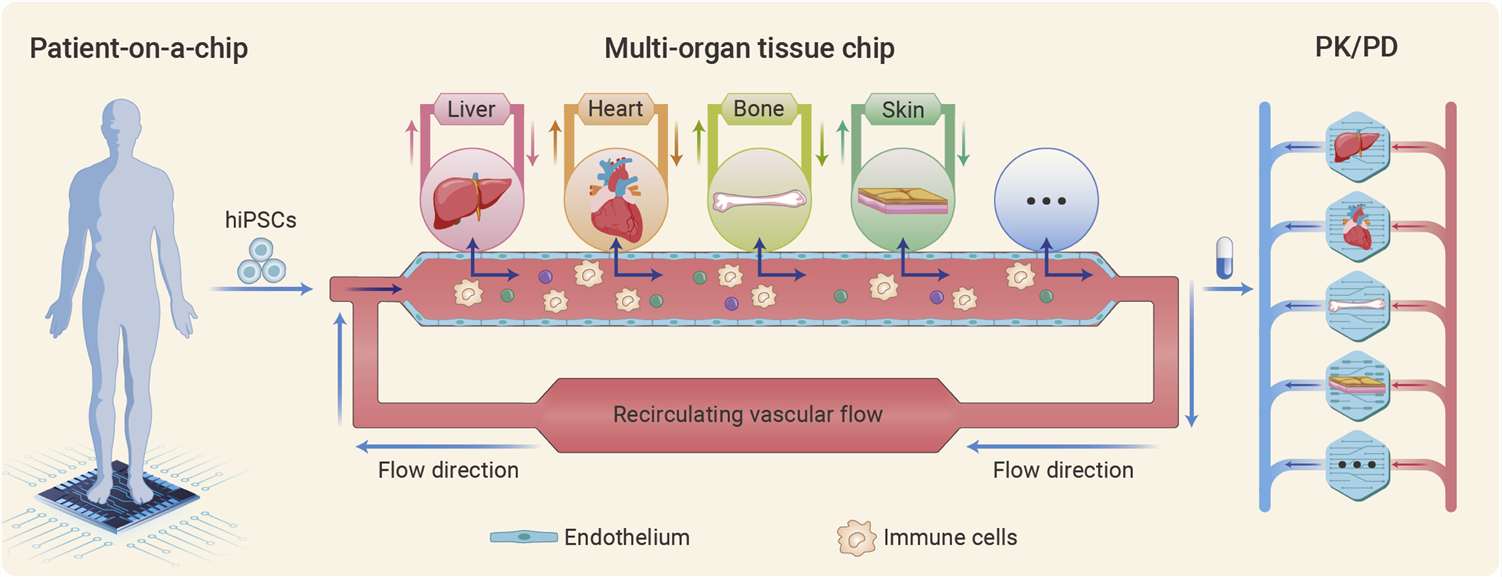 Fig. 1. Multi-organ tissue chip system (Saiding Q, Ma J, et al., 2022).
Multi-Organ-on-a-Chip Services
Creative Bioarray's Multi-Organ-on-a-Chip Development Services are structured to provide comprehensive, human-relevant solutions for drug discovery and translational research. Our service is divided into three core modules:
1. Multi-Organ Model Development
- Integration of liver, heart, kidney, intestine, and other organ modules within a single microfluidic platform.
- Supports realistic modeling of drug absorption, metabolism, and systemic distribution.
- Enables human-relevant pharmacokinetic and toxicology assessments that reduce dependence on animal models.
| Chip Type | Organ Composition | Key Applications / Use Cases |
| Dual-Organ Chips | Liver-Intestine | Oral drug absorption, first-pass metabolism, gut-liver interaction studies |
| Liver-Kidney | Drug clearance, renal toxicity, metabolite elimination | |
| Liver-Heart | Cardiotoxicity of metabolites, cardiac safety assessment | |
| Tumor-Immune-Liver | Tumor immunotherapy screening, liver-mediated drug metabolism | |
| Tri-Organ Chips | Gut-Liver-Kidney | Integrated ADME assessment, systemic PK/PD |
| Liver-Heart-Brain | Neurotoxicity and cardiotoxicity assessment, CNS-drug interaction | |
| Liver-Heart-Kidney | Multi-organ toxicity and drug-drug interaction studies | |
| Liver-Lung-Kidney | Pulmonary drug exposure, systemic toxicity, metabolic clearance | |
| Custom Multi-Organ Configurations | Flexible combinations | Disease modeling, patient-specific studies, translational research |
2. Pharmacokinetics, ADME, and Toxicity Evaluation
- Simultaneous assessment of drug absorption, distribution, metabolism, and excretion (ADME) across interconnected organ systems.
- Sensitive detection of organ-specific toxicity using functional endpoints, biomarker expression, and metabolite analysis.
- Facilitates early identification of safety risks, optimization of dosing, and prediction of drug-drug interactions.
- Provides actionable data that support regulatory submissions and clinical decision-making.
3. Disease Modeling and Translational Research
- Incorporation of patient-derived or genetically engineered cells to replicate disease-specific phenotypes.
- Supports studies in cardiovascular, hepatic, renal, gastrointestinal, and metabolic disorders.
- Enables evaluation of therapeutic responses, mechanistic insights, and preclinical validation of novel treatments.
- Delivers a flexible, scalable, and customizable platform tailored to each client's research objectives.
Technical Platform and Detection Methods
We employ state-of-the-art instruments and reagents to ensure high-quality, reproducible results:
Instrumentation:
- Advanced microfluidic systems
- Automated fluidic control platforms
- Real-time imaging modules
Key Reagents
- Standardized ECM scaffolds
- Organotypic culture media
- Validated biomarker panels.
Analysis Methods:
- Functional endpoints
- Biomarker quantification,
- Transcriptomics
- Metabolomics
Service Workflow
Our streamlined workflow ensures clarity, quality, and client engagement at every step:
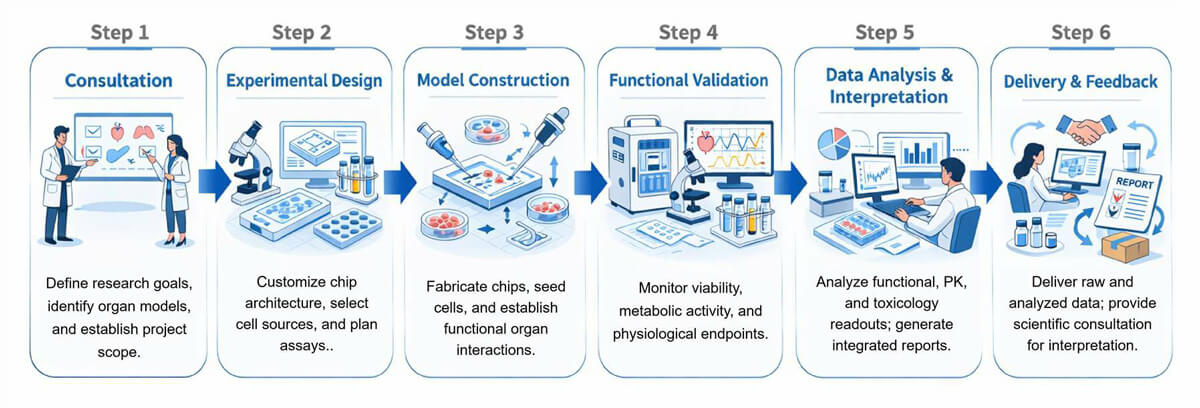 Each stage includes rigorous QC checkpoints and client review opportunities to ensure alignment with research objectives.
Why Choose Creative Bioarray's Multi-Organ-on-a-Chip Services
- Model human physiology with connected organ modules for systemic PK, drug metabolism and toxicity
- Employ literature established and validated MOC models and readouts
- Integrate multiomics data packages with biological interpretation and consultation
- Streamlined workflow for rapid 4-8 weeks delivery with client updates every step of the way
Need Technical Assistance? We've Got You Covered.
Each project is different. That is why we offer consultations to help you choose organ modules, assays, and detectable endpoints that are best suited for your study. Creative Bioarray can work with your cell types, primary human samples, and specialized libraries.
FAQs
How many cells do I need to send?
We typically need 1–5 million viable cells per organ. Exact cell number recommendations will be based on the organ complexity and desired readouts.
How long will it take to receive my results?
From consultation to data delivery, most projects are completed within 4–8 weeks, depending on complexity.
How reliable are the pharmacokinetic and toxicity predictions?
Our multi-organ systems are validated against clinical data and literature benchmarks, providing high predictive accuracy for human PK and organ-specific toxicities.
Can the system be scaled for multiple compounds or dose ranges?
Yes, our platforms are fully scalable, supporting multiplexed assays for high-throughput screening and dose-response studies.
See How Multi-Organ Chips Can Help Your Drug Discovery Program
Don't leave your decisions to chance. Let our team of experts show you how Multi-Organ-on-a-Chip Development Services can help your program make prioritization decisions faster, mitigate risk, and support translational research efforts. You'll receive a response within 24 hours.
Online Inquiry