Enable advanced neuroscience research with brain organoids and neurovascular organ-on-a-chip platforms for disease modeling, neurotoxicity assessment, and translational drug discovery.
- Overview
- Platform
- Service
- Application
- Workflow
- FAQs
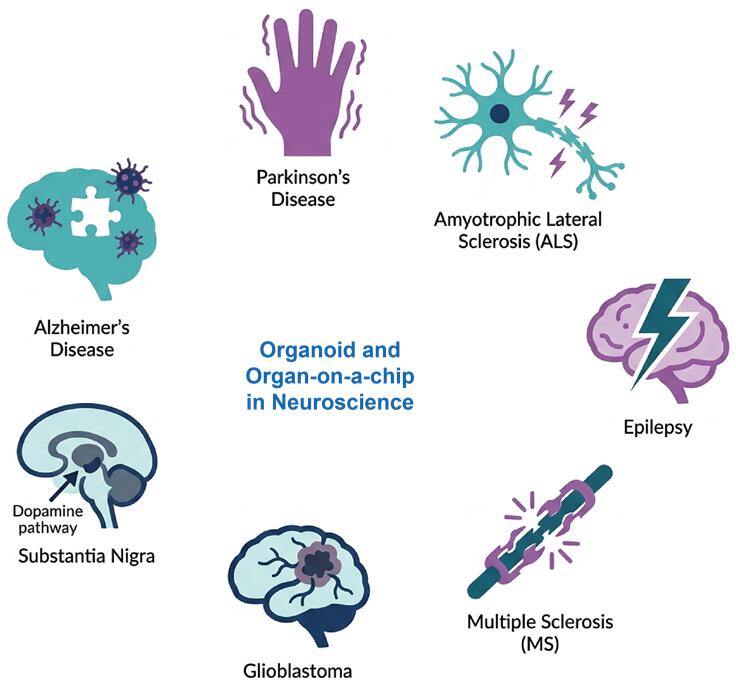
The human nervous system is marked by incredible cellular diversity, sophisticated neuronal circuitry and closely regulated connections between neurones, glial cells, vasculature and immune components. Neurological illnesses, such as Alzheimer’s disease, Parkinson’s disease, epilepsy, autism spectrum disorders and glioblastoma, have complex multifactorial pathogenic pathways that are challenging to fully reproduce by conventional in vitro or animal models. Species-specific variations and the limited physiological relevance of traditional systems are still key hurdles in neuroscience research and CNS drug development.
Organoids and organ-on-a-chip technologies offer next-generation human-relevant neuroscience models with more structural and functional complexity. Brain organoids can recapitulate key aspects of neural development, regional specification, synaptic maturation, and disease-associated phenotypes. Neurovascular and blood-brain barrier (BBB)-on-a-chip systems enable dynamic modelling of tissue interfaces, fluid flow, and cell-cell communication under physiologically relevant conditions. These enhanced platforms enable mechanistic investigations, neurotoxicity testing, biomarker discovery and translational evaluation of potential therapeutics for neurological illnesses.
Comparison of Neuroscience Research Models
| Model Type | Neural Complexity | Human Relevance | Throughput | Physiological Relevance |
| 2D Neural Cultures | Low | Moderate | Very High | Limited; lacks 3D neural architecture and mature connectivity. |
| Animal Models | High | Limited (Species differences) | Low | Useful for systemic studies but not fully predictive of human CNS biology. |
| Primary Neural Cells | Moderate | High | Medium | Limited lifespan and donor-dependent variability. |
| Brain Organoids | High | Highest | Medium-High | Recapitulates neural organization, development, and disease phenotypes. |
| Neuro Organ-on-a-Chip | Highest | Highest | Medium | Models BBB function, perfusion, neuroimmune interactions, and dynamic signaling. |
Our Neuroscience Organoid and Organ-on-a-Chip Platforms
We provide advanced neuroscience-focused organoid and organ-on-a-chip systems to support neurological disease modeling, CNS drug development, and neurobiology research.
Key Features:
- Human iPSC-derived and patient-derived brain organoid models
- Support for cortical, midbrain, hippocampal, and retinal organoids
- Integrated blood-brain barrier (BBB)-on-a-chip systems
- Multi-cellular co-culture models including neurons, astrocytes, microglia, and endothelial cells
- Electrophysiological and functional neural activity assessment
- Dynamic perfusion and neurovascular interaction modeling
Neuroscience Research and Drug Discovery Services
Based on our advanced neuro-organoid and organ-chip platforms, we offer integrated neuroscience research services including:
- Neurological Disease Modeling
- Neurotoxicity and Safety Evaluation
- Blood-Brain Barrier Penetration Studies
- Neuroinflammation and Neuroimmune Interaction Assays
- Electrophysiology and Functional Neural Analysis
- CNS Drug Screening and Translational Research
Our services are designed to provide human-relevant insights into neurological disease mechanisms and improve the translational success of CNS therapeutic development.
Core Applications in Neuroscience
Brain Organoid Applications
- Neurodevelopmental Disorder Modeling: Studying neural differentiation, cortical organization, and developmental abnormalities associated with autism spectrum disorders and genetic neurological diseases.
- Neurodegenerative Disease Research: Modeling pathological hallmarks such as amyloid aggregation, tau pathology, dopaminergic neuron degeneration, and synaptic dysfunction in Alzheimer’s and Parkinson’s disease.
- Patient-Specific Precision Neuroscience: Evaluating disease heterogeneity and therapeutic response using patient-derived iPSC organoid systems.
Organ-on-a-Chip Applications
- Blood-Brain Barrier Modeling: Investigating CNS drug transport, permeability, and barrier integrity under physiologically relevant flow conditions.
- Neuroimmune Interaction Studies: Simulating interactions between neurons, microglia, astrocytes, and immune mediators during neuroinflammation and neurodegeneration.
- Neural Circuit and Synaptic Function Analysis: Monitoring electrophysiological activity and neuronal connectivity in dynamic microengineered environments.
Workflow
Cell Source Preparation
Human iPSCs, patient-derived samples, or neural progenitor cells are prepared for model establishment.
Neural Model Generation
Brain organoids or neurovascular chip systems are established under optimized differentiation conditions.
Functional Characterization
Neural identity, maturation, and functional activity are validated using molecular and electrophysiological assays.
Experimental Evaluation
Drug treatment, neurotoxicity studies, BBB assays, or disease-specific analyses are performed.
Data & Reporting
Integrated analysis provides actionable insights into disease mechanisms, neural function, and therapeutic response.
FAQs
What types of neuroscience models do you provide?
We offer a broad range of neuroscience platforms, including:
- Brain organoids
- Midbrain and cortical organoids
- Retinal organoids
- Blood-brain barrier (BBB)-on-a-chip systems
- Neurovascular and neuroimmune co-culture platforms
Can your platforms model neurodegenerative diseases?
Yes. Our organoid and organ-chip systems are widely used to study Alzheimer’s disease, Parkinson’s disease, ALS, Huntington’s disease, and other neurodegenerative disorders under human-relevant conditions.
Do you support blood-brain barrier permeability studies?
Absolutely. Our BBB-on-a-chip platforms support evaluation of CNS drug transport, permeability, barrier integrity, and neurovascular interactions under dynamic flow conditions.
Can electrophysiological activity be analyzed in your neural models?
Yes. We support functional neural characterization using electrophysiological recording platforms and neural activity assays to assess synaptic function and network maturation.
Do you offer customized neuroscience study designs?
Yes. We provide customized experimental workflows tailored to specific neurological diseases, therapeutic modalities, and translational research objectives.
Online Inquiry