
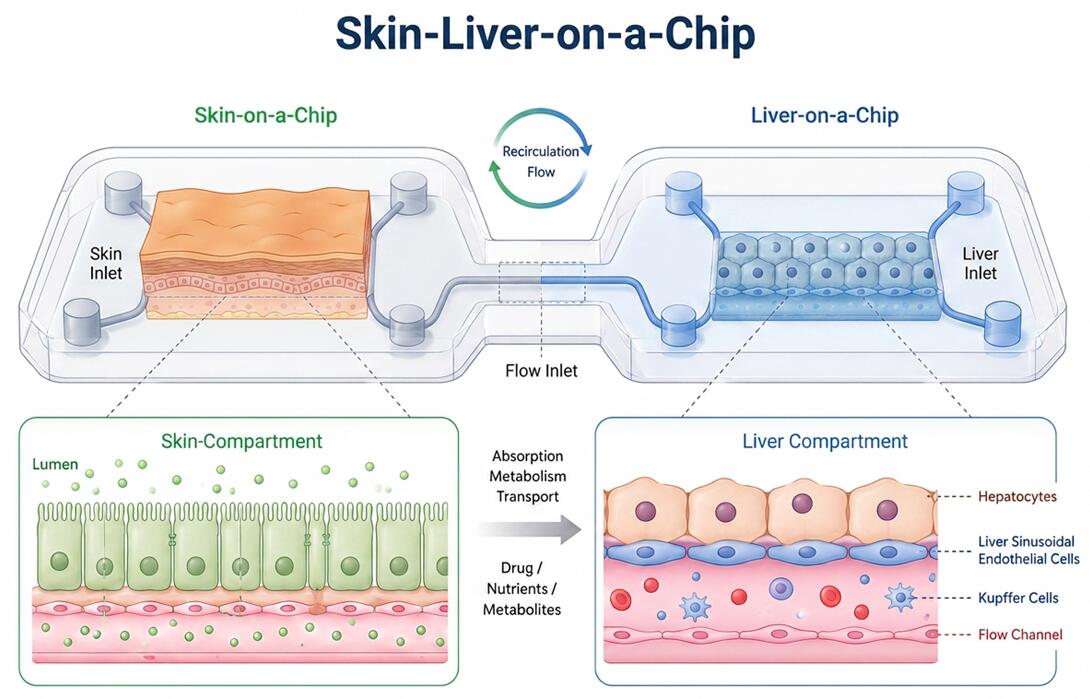
A connected multi-organ microphysiological platform designed to model dermal exposure, transdermal absorption, hepatic metabolism, and systemic toxicity-relevant responses under controlled microfluidic conditions.
- Overview
- Platform
- Advantages
- FAQs
Overview
The skin is the body's primary protective barrier and an important route of exposure for topical drugs, cosmetics, personal care products, industrial chemicals, and environmental compounds. After penetrating the skin barrier, certain substances may enter systemic circulation and undergo hepatic metabolism, which can alter their activity, clearance, or toxicity profile.
Conventional in vitro skin models are widely used to evaluate irritation, corrosion, sensitization-related mechanisms, and percutaneous absorption. However, skin-only systems cannot fully represent the downstream metabolic contribution of the liver. Conversely, liver-only models do not account for the barrier function and absorption kinetics of skin exposure. Animal models may provide whole-body context, but interspecies differences in skin structure, permeability, immune responses, and metabolism can limit human predictivity.
Skin-Liver-on-a-Chip is a multi-organ microphysiological system that connects a skin compartment with a hepatic compartment through controlled microfluidic flow. This approach enables researchers to investigate how topically applied compounds cross the skin barrier, reach the liver, undergo biotransformation, and influence liver or skin responses in a more integrated human-relevant model.
What Is Skin-Liver-on-a-Chip?
Skin-Liver-on-a-Chip is a microengineered platform that combines a reconstructed skin model or skin-cell-based culture with a functional liver module in a fluidically connected system. The platform is designed to recapitulate key aspects of the skin-liver exposure axis, including:
- Compartmentalized skin and liver culture chambers
- Controlled microfluidic communication between skin and hepatic modules
- Skin barrier function relevant to topical exposure and compound penetration
- Hepatic metabolism and detoxification capacity for absorbed substances
- Analysis of parent compounds, metabolites, inflammatory mediators, and toxicity biomarkers
By linking dermal absorption with downstream hepatic processing, the system provides a useful platform for topical drug development, transdermal delivery assessment, cosmetic safety studies, chemical exposure evaluation, and mechanistic toxicology research.
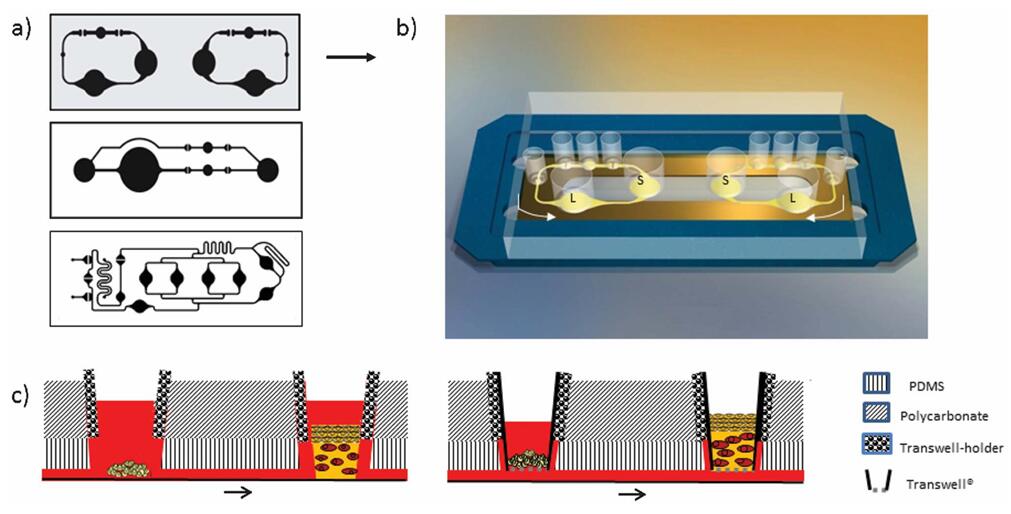 Fig. 1. The microfluidic MOC device of skin and liver (S means skin, L means liver) (Wagner
I, et al., 2013).
Fig. 1. The microfluidic MOC device of skin and liver (S means skin, L means liver) (Wagner
I, et al., 2013).
Our Skin-Liver-on-a-Chip Platform
Our Skin-Liver-on-a-Chip platform connects a skin barrier model with a functional liver module in a controlled microfluidic system, supporting dermal absorption, hepatic metabolism, and toxicity-related studies.
Key Features
- Integrated skin-liver model: Links dermal exposure with downstream hepatic response.
- Controlled microfluidic flow: Enables defined transfer of absorbed compounds and soluble factors.
- Skin barrier assessment: Supports evaluation of permeability, integrity, and topical exposure response.
- Functional liver module: Allows metabolism, viability, and liver-specific biomarker analysis.
- Analytical compatibility: Suitable for imaging, ELISA, qPCR, LC-MS/MS, and cytotoxicity assays.
System Design & Validation
The system uses separated skin and liver compartments connected by controlled flow, allowing tissue-specific culture while maintaining inter-organ communication.
- Skin module: Evaluated for morphology, viability, and barrier integrity.
- Liver module: Assessed for hepatic function, metabolic activity, and viability.
- Flow control: Supports time-course sampling and defined compound transfer.
- Quality control: Includes sterility, chip integrity, leakage testing, and flow stability.
Applications
The platform can be applied to dermal exposure and systemic response studies, including:
- Topical drug evaluation: Study skin penetration and downstream liver exposure.
- Transdermal delivery: Assess compound transport and hepatic metabolism.
- Cosmetic safety testing: Evaluate skin response and liver-relevant effects of absorbed ingredients.
- Chemical exposure assessment: Investigate dermal absorption and biotransformation.
- Mechanistic toxicology: Analyze links between barrier disruption, inflammation, metabolism, and toxicity.
Why Choose Our Skin-Liver-on-a-Chip
- Connected dermal-hepatic model for studying skin absorption together with downstream liver exposure.
- Improved relevance for topical and transdermal studies compared with isolated skin or liver cultures.
- Controlled microfluidic environment enabling time-dependent sampling and defined inter-compartment transport.
- Flexible tissue configuration using reconstructed human epidermis, full-thickness skin models, primary cells, iPSC-derived cells, or liver organoid-derived systems depending on project requirements.
- Customizable assay endpoints for permeability, metabolism, viability, inflammation, oxidative stress, and toxicity biomarker analysis.
FAQs
Q: What makes Skin-Liver-on-a-Chip different from a standard skin penetration assay?
A standard skin penetration assay primarily measures whether and how much of a compound crosses the skin barrier. Skin-Liver-on-a-Chip additionally connects the absorbed compound to a liver compartment, allowing evaluation of hepatic metabolism, metabolite generation, and liver-related responses after dermal exposure.
Q: Can this platform be used for transdermal drug delivery studies?
Yes. The platform is suitable for investigating transdermal compound transport and downstream hepatic exposure. It can help characterize skin permeation, time-dependent transfer, and metabolism-related outcomes, depending on the assay configuration and analytical method used.
Q: What liver cell types are compatible with the system?
The liver compartment can be designed using primary human hepatocytes, hepatic cell lines, iPSC-derived hepatocyte-like cells, liver organoids, or co-culture systems that include non-parenchymal cells such as Kupffer-like cells or hepatic stellate cells when appropriate for the study objective.
Q: What endpoints can be measured using Skin-Liver-on-a-Chip?
Common endpoints include skin barrier integrity, permeability, compound penetration, cell viability, histology, inflammatory cytokines, oxidative stress markers, albumin secretion, urea production, CYP activity, metabolite formation, gene expression, immunostaining, and toxicity biomarkers such as LDH, ALT, or AST.
Advance dermal exposure and systemic response studies with a connected Skin-Liver-on-a-Chip platform.
Contact us today to discuss chip configuration, cell model selection, exposure design, analytical endpoints, and customized study solutions.
Online Inquiry