
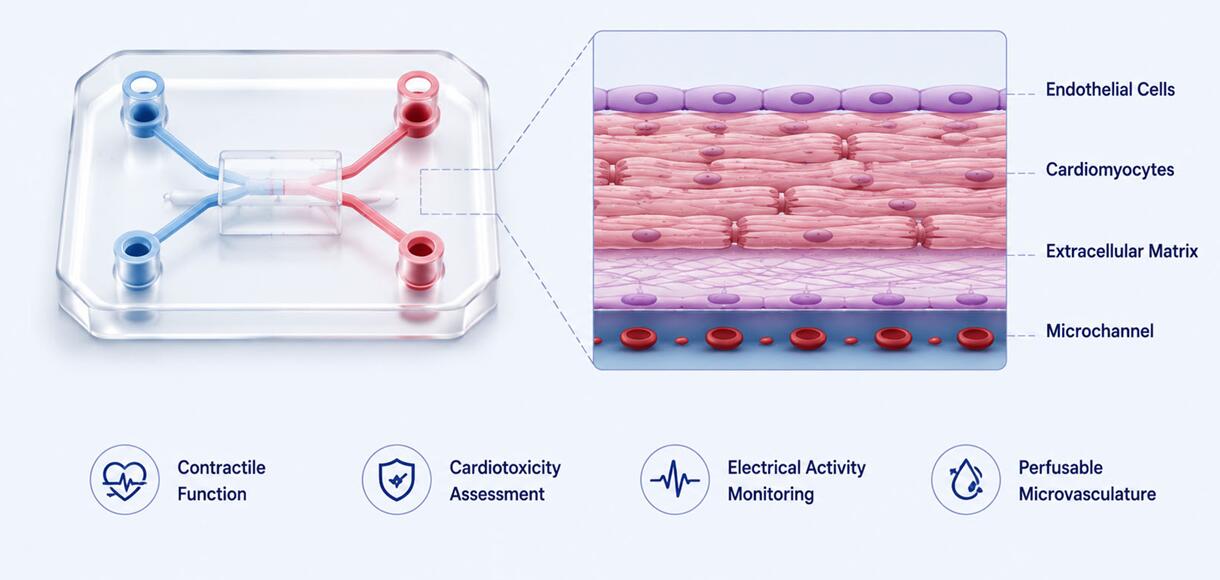
A dynamic microphysiological cardiac model designed to support cardiotoxicity testing, contractility analysis, electrophysiology-related studies, cardiac disease modeling, and cardiovascular drug evaluation under controlled culture conditions.
- Overview
- Details
- Advantages
- FAQs
Overview
The heart is a mechanically active and electrically coordinated organ whose function depends on cardiomyocytes, cardiac fibroblasts, endothelial cells, extracellular matrix, metabolic status, and electromechanical coupling. Drug-induced cardiac effects may involve changes in cell viability, beating pattern, contraction strength, ion channel-related activity, mitochondrial function, or inflammatory signaling.
Conventional static cardiac cell cultures are useful for early screening, but they often provide limited control over tissue organization, perfusion, mechanical microenvironment, and repeated compound exposure. Heart-on-Chip offers a controlled in vitro platform for evaluating cardiac function and drug responses in a more physiologically relevant microenvironment.
What Is Heart-on-Chip?
Cardiac-on-Chip is a microfluidic cell culture platform that supports cardiac-relevant cells in engineered microenvironments. Depending on the design, the system can be used to study beating behavior, contractility, electrophysiology-related responses, cardiotoxicity, and cardiac disease mechanisms.
This chip-based cardiac model can support the study of:
- Cardiomyocyte viability, maturation-related features, and structural organization
- Beating frequency, rhythm regularity, and contraction-related responses
- Drug-induced cardiotoxicity and safety pharmacology-related endpoints
- Cardiac fibroblast interaction, fibrosis-related signaling, and remodeling
- Endothelial-cardiac interactions and vascularized cardiac microenvironments
- Disease-relevant cardiac responses using donor- or iPSC-derived cells
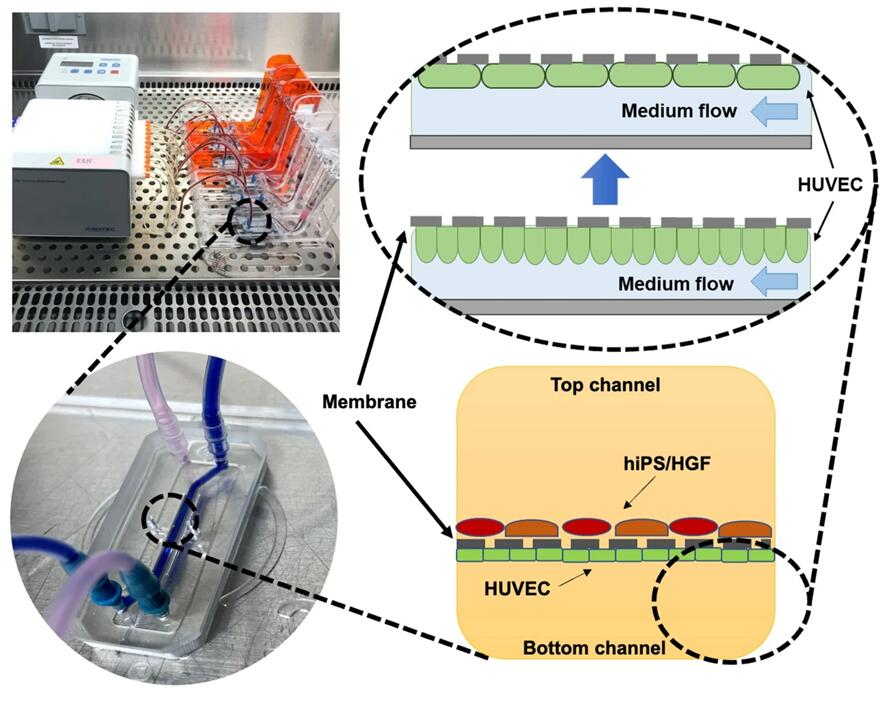 Fig. 1. Perfusion system for the heart-on-a-chip (Liu Y, Kamran R, et al., 2024).
Our Cardiac-on-Chip Platform
Our Cardiac-on-Chip platform provides a customizable cardiac microphysiological model for cardiotoxicity assessment, functional cardiac analysis, disease modeling, and cardiovascular drug response studies.
Key Features
- Cardiac-relevant culture: Supports cardiomyocytes with optional cardiac fibroblasts, endothelial cells, smooth muscle cells, or immune-related components.
- Controlled microenvironment: Enables defined medium flow, compound exposure, nutrient exchange, and longitudinal sampling.
- Functional assessment: Allows analysis of beating behavior, contraction-related changes, cell viability, and stress responses.
- Flexible cell sources: Compatible with iPSC-derived cardiomyocytes, primary cardiac cells where available, donor-specific cells, and selected disease-relevant models.
Validation & Readouts
- Cardiac markers: cTnT, α-actinin, MYH6/MYH7, NKX2.5, connexin 43, and sarcomere organization
- Functional endpoints: Beating rate, rhythm pattern, contraction amplitude, calcium handling-related readouts, and electrophysiology-related analysis when applicable
- Toxicity endpoints: Cell viability, apoptosis, oxidative stress, mitochondrial function, hypertrophy markers, and injury biomarkers
- Downstream analysis: Live imaging, immunostaining, qPCR, ELISA, multiplex assays, RNA-seq, and compound response profiling
Applications
- Cardiotoxicity Testing: Evaluate compound-induced changes in viability, beating behavior, stress signaling, and cardiac injury markers.
- Contractility Analysis: Study beating frequency, contraction strength, rhythm stability, and drug-related functional changes.
- Cardiac Disease Modeling: Model selected aspects of hypertrophy, fibrosis, ischemia-related stress, inflammation, or inherited cardiac conditions.
- Drug Response Evaluation: Support early-stage cardiovascular efficacy, toxicity, and dose-response studies.
- Personalized Cardiac Models: Use iPSC-derived or donor-specific cardiac cells to investigate patient-relevant responses.
Why Choose Our Cardiac-on-Chip
- More physiologically relevant than standard static cardiac cultures for selected functional and toxicity studies
- Designed for cardiac function analysis including beating behavior, contraction-related endpoints, and stress responses
- Supports controlled compound exposure for repeat dosing, time-course monitoring, and dose-response evaluation
- Flexible and customizable for different cardiac cell types, co-culture systems, disease conditions, and assay endpoints
- Compatible with common readouts including live imaging, contractility analysis, immunostaining, biomarker assays, and molecular profiling
- Technical support available for model setup, protocol optimization, assay selection, and customized workflows
FAQs
Q: What cell types can be used in Cardiac-on-Chip?
The platform can support iPSC-derived cardiomyocytes, cardiac fibroblasts, endothelial cells, smooth muscle cells, and selected donor- or disease-relevant cardiac cell sources depending on the study design.
Q: Can Cardiac-on-Chip be used for cardiotoxicity testing?
Yes. It can be used to evaluate drug-induced effects on cardiac cell viability, beating behavior, contraction-related endpoints, oxidative stress, apoptosis, and cardiac injury biomarkers.
Q: Can the platform measure contractile activity?
Yes. Depending on chip configuration and assay setup, beating frequency, rhythm regularity, contraction amplitude, and related functional changes can be monitored by imaging-based or sensor-compatible methods.
Q: Does the chip support dynamic perfusion?
Yes. The chip can be connected to a perfusion system to provide controlled medium flow, compound dosing, nutrient exchange, and longitudinal sampling.
Advance cardiotoxicity testing, cardiac function analysis, and cardiovascular drug evaluation with our Cardiac-on-Chip platform.
Contact us today to request product details, pricing, or customized solutions for your study.
Online Inquiry