
Advance gastrointestinal disease research with patient-derived intestinal organoids and gut-on-a-chip platforms for disease modeling, microbiome studies, drug screening, and translational medicine.
- Overview
- Platform
- Service
- Application
- Workflow
- FAQs
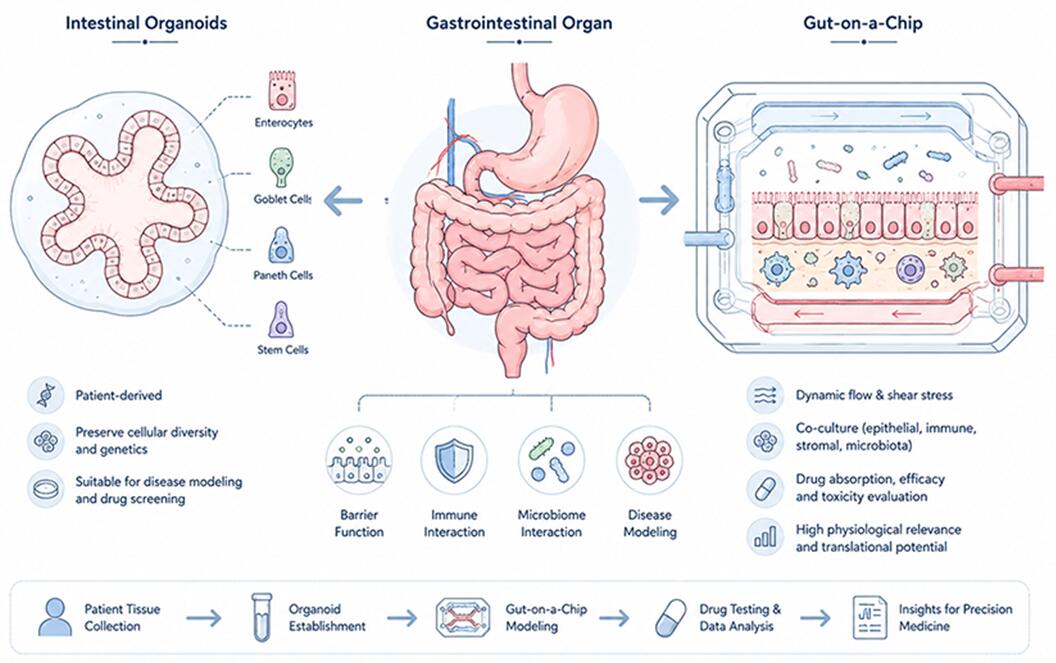
Gastrointestinal (GI) diseases, including inflammatory bowel disease (IBD), colorectal cancer, celiac disease, infectious enteritis, irritable bowel syndrome (IBS), and metabolic-associated gastrointestinal disorders, are characterized by highly complex interactions between intestinal epithelial cells, immune components, microbiota, and the gut microenvironment. Conventional in vitro models and animal systems typically do not recapitulate the anatomical complexity, cellular diversity and physiological dynamics of the human gastrointestinal tract.
Organoids and organ-on-a-chip technologies have evolved as sophisticated human-relevant platforms for modeling gastrointestinal disease and medication discovery. Patient-derived intestinal organoids maintain epithelial architecture, stem cell populations and disease-associated molecular signatures, while gut-on-a-chip systems combine fluid flow, mechanical stimulation, mucus secretion, microbial interactions and immune cell co-culture to recreate physiologically relevant intestinal environments. Combined, these technologies enable more predictive studies of GI aetiology, host-microbiome interactions, barrier function, inflammation, and treatment response.
Comparison of Gastrointestinal Disease Models
| Model Type | Barrier Function Modeling | Microbiome Compatibility | Physiological Relevance | Drug Discovery Utility |
| 2D Intestinal Cell Lines | Limited | Minimal | Low; lacks tissue complexity and cellular diversity. | Suitable for basic screening only. |
| Animal Models | Moderate | Moderate | Limited by species-specific differences. | Useful for systemic studies but low clinical predictability. |
| Transwell Co-culture Systems | Moderate | Low | Partial epithelial polarization and permeability assessment. | Moderate throughput for transport studies. |
| Intestinal Organoids | High | Moderate | Excellent; preserves intestinal cell heterogeneity and stem cell function. | Highly suitable for personalized medicine and disease modeling. |
| Gut-on-a-Chip | Highest | Highest | Superior; incorporates flow, peristalsis-like motion, and host–microbiome interactions. | Ideal for translational and mechanistic GI studies. |
Our Gastrointestinal Organoid and Gut-on-a-Chip Platforms
We provide advanced gastrointestinal organoid and organ-on-a-chip solutions for modeling intestinal physiology, inflammatory diseases, microbiome interactions, infectious diseases, and GI drug responses.
Key Features:
- Patient-derived intestinal and colorectal organoid models
- Physiologically relevant gut-on-a-chip systems with dynamic perfusion
- Support for epithelial, immune, stromal, and microbial co-culture
- Modeling of intestinal barrier integrity and permeability
- Compatibility with microbiome and pathogen infection studies
- Scalable platforms for drug screening and toxicity testing
- Customized assay development for inflammatory and metabolic GI diseases
Gastrointestinal Disease Research Services
Leveraging our gastrointestinal organoid and organ-chip technologies, we offer comprehensive services to support GI disease research, translational medicine, and therapeutic development.
- Inflammatory Bowel Disease (IBD) Modeling
- Gut Barrier Integrity and Permeability Assays
- Host–Microbiome Interaction Studies
- Infectious Disease and Pathogen Challenge Models
- Drug Efficacy and Toxicity Screening
- Precision Medicine and Patient Stratification
- Biomarker Discovery and Mechanistic Studies
- Nutrient Absorption and Metabolism Evaluation
Our gastrointestinal disease platforms are designed to improve translational relevance, accelerate candidate selection, and support next-generation therapeutics targeting intestinal diseases.
Core Applications in Gastrointestinal Disease Research
Intestinal Organoids
- Inflammatory Disease Modeling: Recapitulating epithelial injury, cytokine signaling, and intestinal regeneration associated with Crohn’s disease and ulcerative colitis.
- Precision Medicine: Evaluating patient-specific therapeutic responses and supporting personalized treatment strategies for GI disorders.
- Infectious Disease Research: Studying enteric pathogens, viral infection, and host defense mechanisms in physiologically relevant intestinal tissues.
- Colorectal Cancer Studies: Modeling tumor initiation, progression, and drug resistance using patient-derived colorectal organoids.
Gut-on-a-Chip Systems
- Host–Microbiome Interaction Modeling: Simulating interactions between intestinal epithelium and commensal or pathogenic microorganisms under dynamic flow conditions.
- Intestinal Barrier Function Studies: Assessing epithelial permeability, mucus production, and tight junction integrity in response to drugs or inflammatory stimuli.
- Drug Absorption and ADME Research: Investigating oral drug transport, metabolism, and intestinal toxicity using physiologically relevant microfluidic systems.
- Immune-Mediated GI Disease Modeling: Integrating immune cells and cytokine signaling to study chronic intestinal inflammation and immune dysregulation.
Workflow
Sample Acquisition
Intestinal tissues or patient-derived samples are collected and processed for organoid establishment or chip integration.
Model Establishment
Gastrointestinal organoids or gut-on-a-chip systems are generated under optimized culture conditions.
Functional Characterization
Models are validated for epithelial differentiation, barrier integrity, and disease-relevant biomarkers.
Customized Assays
Drug treatment, microbiome co-culture, inflammation induction, or infection studies are performed based on project goals.
Data Analysis & Reporting
Comprehensive analysis provides mechanistic insights, efficacy evaluation, and biomarker identification.
FAQs
Which gastrointestinal disorders can be modelled by organoids and organ-on-a-chip systems?
Our platforms support a broad range of GI diseases, including:
- Inflammatory bowel disease (IBD)
- Colorectal cancer
- Celiac disease
- Infectious gastrointestinal diseases
- Metabolic and barrier dysfunction disorders
Can we study microbiomes using gut-on-a-chip systems?
Yes. Yes. Our gut-on-a-chip technologies are specifically intended to assist host–microbiome interaction investigations under physiologically appropriate flow conditions, allowing long-term co-culture with commensal or pathogenic microorganisms.
Can these models be used for oral drug absorption and toxicity studies?
Of course. Gut-on-a-chip systems and intestinal organoids are frequently employed in preclinical investigations to assess oral medication absorption, intestinal permeability, metabolism and gastrointestinal toxicity.
Do you provide customized gastrointestinal disease modeling services?
Yes. We offer customized study designs tailored to specific gastrointestinal diseases, therapeutic targets, microbiome applications, and translational research objectives.
Online Inquiry