
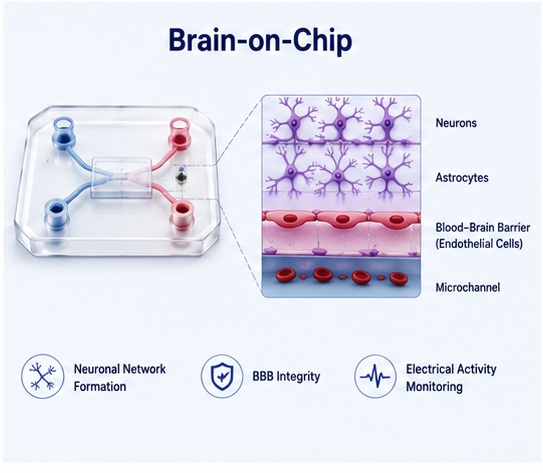
A microphysiological neural model designed to support neurotoxicity testing, blood-brain barrier studies, neuroinflammation research, neurological disease modeling, and CNS drug evaluation under controlled culture and perfusion conditions.
- Overview
- Details
- Advantages
- FAQs
Overview
The brain is a highly specialized organ composed of neurons, astrocytes, microglia, oligodendrocytes, endothelial cells, pericytes, and extracellular matrix components. Neural function and disease progression are influenced by complex cell-cell interactions, biochemical signaling, barrier properties, and microenvironmental conditions.
Conventional static neural cultures are useful for basic studies but often have limited ability to reproduce dynamic features of the brain microenvironment, such as perfusion, compartmentalized organization, blood-brain barrier-like interfaces, and longitudinal sampling. Brain-on-Chip provides a controlled in vitro platform for investigating neural responses, CNS toxicity, neuroinflammation, and drug-related effects in a more physiologically relevant setting.
What Is Brain-on-Chip?
Brain-on-Chip is a microfluidic cell culture platform that supports brain-relevant cells under defined culture and flow conditions. Depending on the model design, it can be configured for neural cell co-culture, blood-brain barrier modeling, neurovascular interaction studies, or disease-related neural microenvironment analysis.
This chip-based brain model can support the study of:
- Neuronal viability, morphology, maturation, and network-related responses
- Astrocyte, microglia, and neuron interactions
- Blood-brain barrier integrity and permeability
- CNS drug transport and neurotoxicity assessment
- Neuroinflammation and immune-related neural responses
- Neurological disease mechanisms and therapeutic evaluation
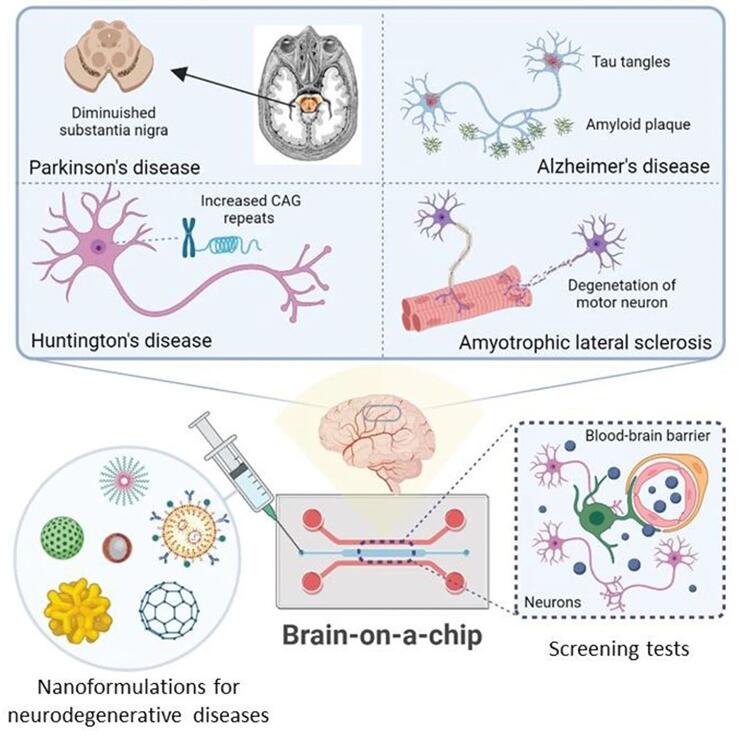 Fig. 1. brain-on-a-chip platforms (Rodrigues RO, Shin SR, et al., 2024)
Our Brain-on-Chip Platform
Our Brain-on-Chip platform provides a customizable neural microphysiological model for neurotoxicity testing, blood-brain barrier analysis, neuroinflammation studies, disease modeling, and CNS drug evaluation.
Key Features
- Brain-relevant cell culture: Supports neurons, astrocytes, microglia, endothelial cells, pericytes, and iPSC-derived neural cell types.
- Controlled microenvironment: Enables defined flow, compound exposure, nutrient exchange, and time-course sampling.
- Compartmentalized design: Allows modeling of neural compartments, neurovascular interfaces, or blood-brain barrier-like structures.
- Customizable formats: Suitable for neurotoxicity, BBB permeability, neuroinflammation, and neurological disease-related studies.
Validation & Readouts
- Neural markers: MAP2, βIII-tubulin, NeuN, GFAP, IBA1, MBP, and synaptic markers
- BBB-related markers: ZO-1, Occludin, Claudin-5, VE-cadherin, GLUT1, P-gp, and permeability analysis
- Functional endpoints: Cell viability, neurite outgrowth, barrier integrity, inflammatory activation, oxidative stress, and apoptosis
- Downstream analysis: Live imaging, immunostaining, qPCR, ELISA, multiplex cytokine assays, RNA-seq, and compound transport analysis
Applications
- Neurotoxicity Testing: Assess compound-induced effects on neural cell viability, morphology, stress responses, and inflammation.
- Blood-Brain Barrier Studies: Evaluate barrier integrity, permeability, transporter activity, and CNS drug penetration.
- Neuroinflammation Research: Study microglial activation, cytokine release, and neuron-glia interactions.
- Neurological Disease Modeling: Model selected aspects of neurodegeneration, neurovascular dysfunction, infection-related responses, or injury-associated mechanisms.
- CNS Drug Evaluation: Support early-stage analysis of drug exposure, toxicity, transport, and therapeutic response.
Why Choose Our Brain-on-Chip
- More physiologically relevant than standard static neural cultures for selected brain-related studies
- Dynamic and controlled conditions for perfusion, compound exposure, and longitudinal sampling
- Supports multiple brain-relevant models including neural co-culture, BBB-like interfaces, and neuroinflammatory conditions
- Flexible and customizable for different cell sources, co-culture formats, flow settings, and assay endpoints
- Compatible with common readouts such as imaging, immunostaining, molecular assays, cytokine analysis, and permeability testing
- Technical support available for model setup, assay design, protocol optimization, and customized workflows
FAQs
Q: What cell types can be used in Brain-on-Chip?
The platform can support neurons, astrocytes, microglia, brain endothelial cells, pericytes, oligodendrocyte-lineage cells, iPSC-derived neural cells, and selected disease-relevant cells depending on the study design.
Q: Can Brain-on-Chip be used for blood-brain barrier studies?
Yes. The platform can be configured to model BBB-like interfaces for barrier integrity, permeability, transporter-related function, and CNS drug penetration studies.
Q: Is the platform suitable for neurotoxicity testing?
Yes. It can be used to evaluate neural cell viability, neurite morphology, oxidative stress, inflammatory responses, apoptosis, and selected biomarker changes after compound exposure.
Q: Does the chip support dynamic perfusion?
Yes. The chip can be connected to a perfusion system for controlled medium flow, compound dosing, nutrient exchange, and time-course sampling.
Q: What assays are compatible with this platform?
Compatible assays include live imaging, immunofluorescence staining, viability assays, permeability assays, qPCR, ELISA, multiplex cytokine analysis, RNA-seq, and compound transport analysis.
Advance neurotoxicity testing, BBB research, and CNS drug evaluation with our Brain-on-Chip platform.
Contact us today to request product details, pricing, or customized solutions for your study.
Online Inquiry