
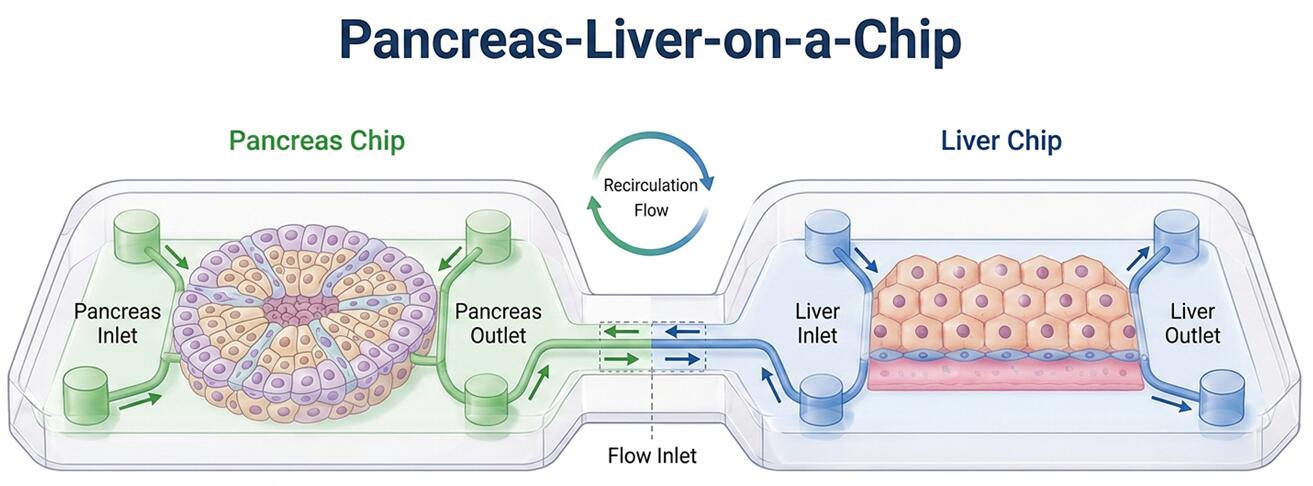
A connected multi-organ microfluidic platform that models pancreas-liver metabolic crosstalk for diabetes research, glucose homeostasis, insulin response, hepatic metabolism, and metabolic disease modeling.
- Overview
- Platform
- Advantages
- FAQs
Overview
The pancreas and liver are central regulators of human metabolic homeostasis. Pancreatic islets secrete hormones such as insulin and glucagon in response to glucose fluctuation, while the liver controls glucose storage, glycogen synthesis, gluconeogenesis, lipid metabolism, and detoxification. The dynamic communication between these two organs is essential for maintaining systemic energy balance.
Conventional in vitro models often study pancreatic islets or hepatocytes separately, limiting their ability to capture endocrine-hepatic feedback, glucose-dependent insulin signaling, and liver metabolic adaptation. Animal models provide systemic complexity but may not accurately reproduce human-specific islet function, hepatic metabolism, insulin sensitivity, or metabolic disease progression.
Pancreas-Liver-on-a-chip is a multi-organ microphysiological system designed to recreate pancreas-liver interaction under controlled microfluidic conditions. By connecting a pancreatic compartment with a liver compartment, the platform enables researchers to study hormone secretion, hepatic glucose handling, metabolic stress, drug response, and disease-associated organ-organ communication in one human-relevant system.
What Is Pancreas-Liver-on-a-chip?
Pancreas-Liver-on-a-chip is a microengineered multi-organ platform that links pancreatic endocrine models with hepatic models through controlled fluid flow. The system is designed to mimic key features of metabolic organ communication, including:
- Compartmentalized pancreatic and hepatic culture chambers
- Microfluidic circulation for controlled hormone and metabolite exchange
- Glucose-responsive pancreatic endocrine function
- Functional hepatic glucose and lipid metabolism
- Dynamic crosstalk through insulin, glucagon, glucose, fatty acids, cytokines, and drug-derived metabolites
This connected system provides a more physiologically relevant approach for studying diabetes, insulin resistance, metabolic syndrome, NAFLD/NASH-related mechanisms, pancreatic endocrine dysfunction, and metabolism-related drug effects.
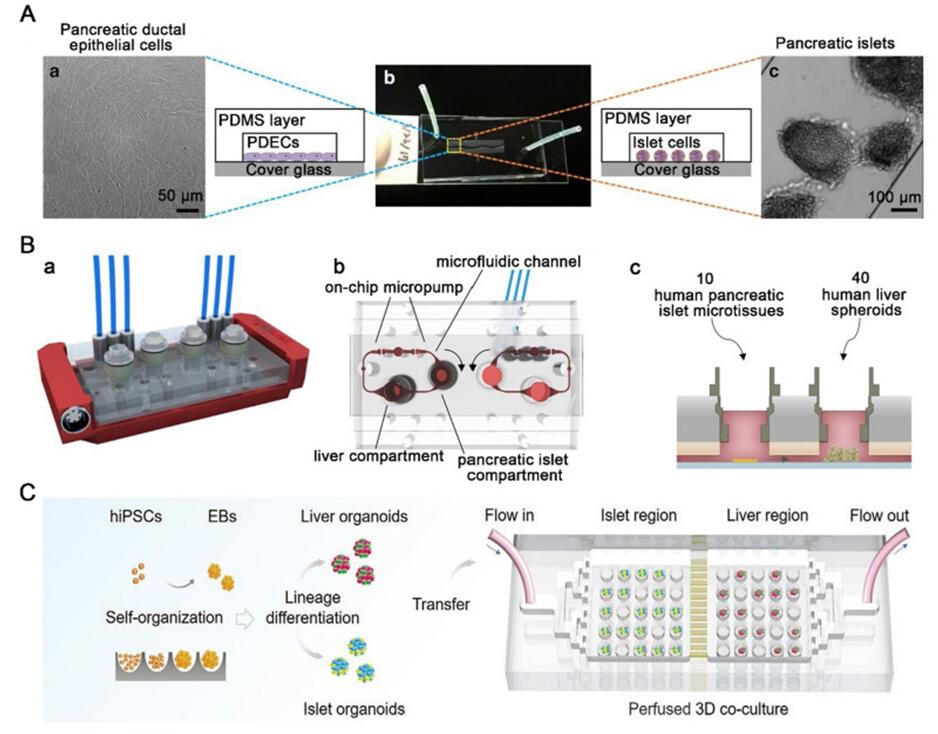 Fig. 1. The microfluidic multiorganoid system for the interaction of liver and islet
organoids in normal and disease states (Yin J, Meng H, et al., 2022).
Fig. 1. The microfluidic multiorganoid system for the interaction of liver and islet
organoids in normal and disease states (Yin J, Meng H, et al., 2022).
Our Pancreas-Liver-on-a-chip Platform
Our Pancreas-Liver-on-a-chip platform integrates human pancreatic and hepatic models in a connected microfluidic device, enabling dynamic analysis of endocrine signaling, hepatic metabolic response, and disease-related organ crosstalk.
Key Features
- Multi-organ integration: Connects pancreatic and liver compartments to model metabolic communication.
- Dynamic hormone transport: Enables controlled exchange of insulin, glucagon, glucose, lipids, and soluble mediators.
- Glucose-responsive pancreas module: Supports analysis of insulin and glucagon secretion under changing glucose conditions.
- Functional hepatic module: Enables assessment of glucose uptake, glycogen storage, lipid metabolism, and drug metabolism.
- Metabolic disease modeling: Suitable for studying insulin resistance, beta-cell stress, and liver metabolic dysfunction.
System Design & Validation
Our Pancreas-Liver-on-a-chip system is designed to model endocrine pancreas signaling and downstream hepatic metabolic response within one connected platform.
- Pancreatic endocrine module: Supports pancreatic islets, beta-cell models, or iPSC-derived pancreatic cells for glucose-stimulated hormone secretion studies.
- Glucose challenge response: Evaluates insulin and glucagon release under low-, normal-, and high-glucose stimulation.
- Pancreas-to-liver signaling: Tracks hormone-mediated effects on hepatic glucose handling, glycogen storage, and metabolic gene expression.
- Hepatic metabolic readouts: Assesses albumin secretion, urea production, CYP activity, glucose uptake, glycogen accumulation, and lipid-related stress markers.
- Disease-relevant endpoints: Measures beta-cell stress, insulin resistance markers, inflammatory cytokines, oxidative stress, and steatosis-related responses.
Applications
Our Pancreas-Liver-on-a-chip platform supports metabolic disease research and compound evaluation studies:
- Diabetes modeling: Study beta-cell dysfunction, impaired insulin secretion, and hepatic insulin resistance.
- Glucose homeostasis research: Analyze pancreatic hormone release and liver glucose metabolism in a connected system.
- NAFLD/NASH-related studies: Investigate the link between endocrine dysfunction, lipid accumulation, and hepatic stress.
- Drug efficacy testing: Evaluate anti-diabetic and metabolic disease therapeutics using human-relevant readouts.
- Metabolism and toxicity assessment: Study hepatic drug metabolism and metabolism-related organ responses.
- Inflammatory metabolic crosstalk: Explore cytokine-mediated communication between pancreatic stress and liver dysfunction.
Why Choose Our Pancreas-Liver-on-a-chip
- Connected metabolic organ model for studying pancreas-liver communication.
- Human-relevant glucose regulation with pancreatic hormone and hepatic metabolic readouts.
- Dynamic microfluidic environment for hormone, nutrient, and metabolite exchange.
- Flexible configuration compatible with islets, beta-cell models, iPSC-derived cells, hepatocytes, or liver organoid-derived models.
- Customizable endpoints for diabetes, insulin resistance, NAFLD/NASH, drug response, and metabolic toxicity studies.
FAQs
Q: What makes Pancreas-Liver-on-a-chip different from separate pancreas and liver cultures?
The key advantage is connected endocrine-hepatic communication. Pancreatic hormones and metabolic signals can be transferred to the liver compartment through controlled microfluidic flow, allowing researchers to evaluate how pancreatic function directly influences hepatic glucose metabolism, lipid handling, and stress responses.
Q: Can this platform be used for diabetes research?
Yes. The platform is well suited for diabetes-related studies, including glucose-stimulated insulin secretion, beta-cell stress, glucagon response, hepatic insulin sensitivity, insulin resistance modeling, and evaluation of anti-diabetic drug candidates.
Q: What cell types can be incorporated into the chip?
The system can be configured with pancreatic islets, beta-cell lines, iPSC-derived pancreatic endocrine cells, pancreatic organoid-derived cells, primary hepatocytes, iPSC-derived hepatocyte-like cells, liver organoids, or supporting non-parenchymal liver cells depending on the study design.
Q: Can the chip model insulin resistance or fatty liver-related mechanisms?
Yes. The platform can be adapted with high-glucose, high-insulin, free fatty acid, inflammatory cytokine, or disease-specific cell conditions to model insulin resistance, hepatic steatosis, metabolic stress, and NAFLD/NASH-related organ crosstalk.
Q: What endpoints can be measured using this chip?
Common endpoints include insulin secretion, glucagon release, glucose uptake, glycogen storage, lipid accumulation, albumin secretion, urea production, CYP activity, metabolic gene expression, inflammatory cytokines, oxidative stress markers, cell viability, and toxicity biomarkers.
Advance your diabetes, metabolic disease, and endocrine-hepatic crosstalk research with a connected human-relevant multi-organ chip platform.
Contact us today to discuss Pancreas-Liver-on-a-chip configurations, metabolic assay design, validation options, and customized study solutions.
Online Inquiry