
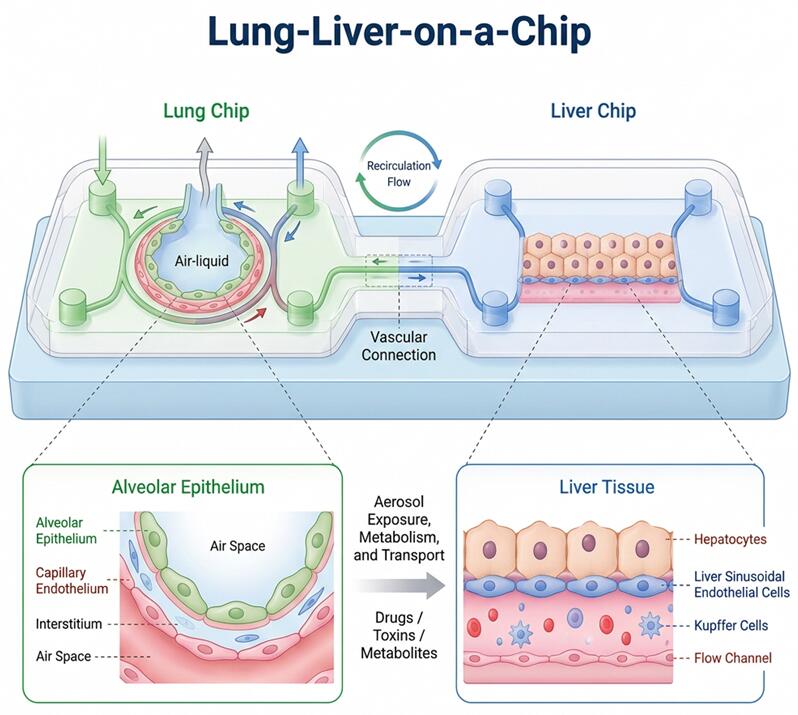
A physiologically connected multi-organ microfluidic platform that recreates lung-liver interaction for inhalation toxicity, systemic exposure, drug metabolism, inflammation, and organ-organ crosstalk studies.
- Overview
- Platform
- Advantages
- FAQs
Overview
The lung and liver are closely connected in the human body through systemic circulation. Inhaled drugs, airborne pollutants, aerosols, nanoparticles, and toxicants first interact with the respiratory epithelium and may subsequently enter circulation, where they can be distributed to the liver for metabolism, detoxification, or toxicity-related responses. At the same time, liver-derived metabolites and inflammatory mediators can influence pulmonary responses, creating a dynamic bidirectional organ-organ relationship.
Traditional in vitro respiratory models and liver models are often evaluated independently, which limits their ability to reflect systemic exposure, metabolism-dependent toxicity, and inflammatory crosstalk. Animal models provide whole-body complexity but frequently fail to predict human-specific inhalation responses, hepatic metabolism, immune signaling, and species-specific toxicological outcomes.
Lung-Liver-on-a-chip is an advanced multi-organ microphysiological system designed to model respiratory-hepatic interaction under controlled microfluidic conditions. By integrating a lung compartment with a liver compartment in one connected platform, this system enables researchers to evaluate pulmonary barrier response, compound translocation, hepatic metabolism, systemic toxicity, and inflammatory signaling in a more human-relevant experimental model.
What Is Lung-Liver-on-a-chip?
Lung-Liver-on-a-chip is a microengineered multi-organ platform that connects a lung module with a hepatic module through controlled fluid flow. The system is designed to mimic key aspects of lung-liver communication, including:
- Compartmentalized lung and liver culture chambers
- Microfluidic circulation for controlled inter-organ molecular exchange
- Air-liquid interface-compatible lung epithelial culture for inhalation-related studies
- Functional liver compartment capable of metabolic and detoxification activities
- Dynamic transport of drugs, particles, metabolites, cytokines, and soluble mediators between organ compartments
Compared with static single-organ cultures, the multi-organ chip allows researchers to study how pulmonary exposure may lead to downstream hepatic responses, and how liver metabolism may alter systemic toxicity or inflammatory outcomes. This makes the platform highly valuable for inhaled drug development, respiratory toxicology, environmental exposure assessment, nanomaterial safety, and systemic inflammation research.
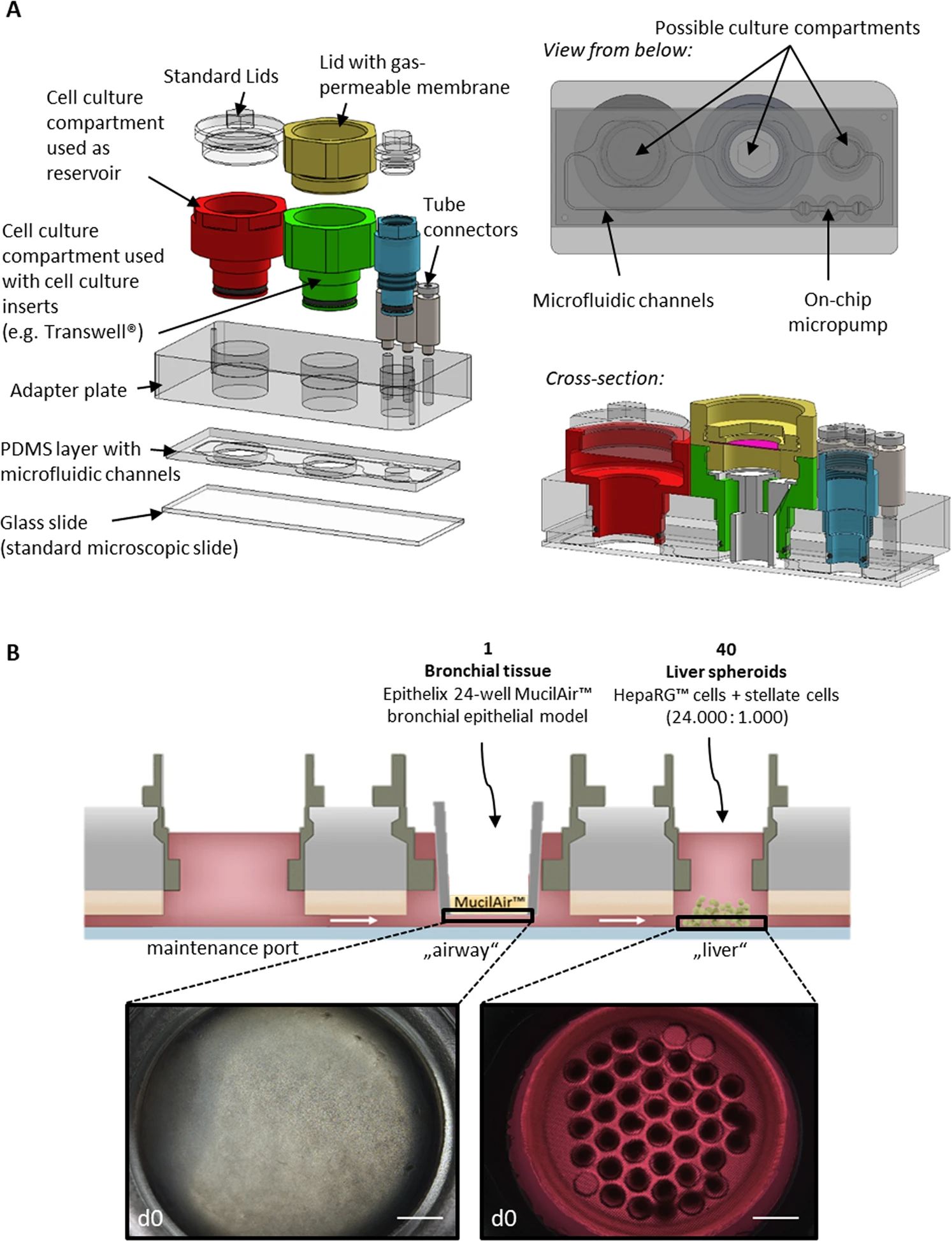 Fig. 1. The multi-organ chip platform and experimental setup (Schimek K, Frentzel S,
et al., 2020).
Fig. 1. The multi-organ chip platform and experimental setup (Schimek K, Frentzel S,
et al., 2020).
Our Lung-Liver-on-a-chip Platform
Our Lung-Liver-on-a-chip platform integrates human lung and hepatic models in a connected microfluidic device, enabling controlled pulmonary exposure, systemic transport, liver metabolism, and multi-organ toxicity analysis.
Key Features
- Multi-organ integration: Connects respiratory and hepatic compartments in one microphysiological system.
- Dynamic microfluidic flow: Enables controlled exchange of compounds, metabolites, nutrients, and inflammatory mediators.
- Lung barrier modeling: Supports epithelial barrier formation and air-liquid interface-compatible exposure designs.
- Functional liver compartment: Enables metabolism, detoxification, and hepatotoxicity assessment.
- Systemic toxicity evaluation: Links pulmonary exposure with downstream hepatic and inflammatory responses.
System Design & Validation
Our Lung-Liver-on-a-chip system is designed to model pulmonary exposure, lung-to-liver transport, and hepatic response within one connected platform.
- Inhalation-relevant lung module: Supports airway or alveolar epithelial culture with air-liquid interface, aerosol, vapor, or particle exposure options.
- Pulmonary barrier validation: Assesses epithelial morphology, tight junction markers, mucus response when applicable, and exposure-induced permeability changes.
- Lung-to-liver transfer: Tracks movement of inhaled compounds, particles, soluble mediators, or metabolites to the hepatic compartment.
- Hepatic response analysis: Evaluates CYP activity, metabolite formation, albumin secretion, urea production, and liver stress markers after pulmonary exposure.
- Inflammatory crosstalk: Measures cytokines, oxidative stress markers, and injury-associated biomarkers to study respiratory-hepatic interaction.
Applications
Our Lung-Liver-on-a-chip platform supports a range of respiratory-hepatic interaction and systemic safety studies:
- Inhaled drug development: Evaluate pulmonary absorption, systemic distribution, liver metabolism, and safety profiles.
- Respiratory toxicology: Assess the effects of aerosols, pollutants, smoke components, and airborne chemicals on lung and liver responses.
- Nanomaterial safety: Study particle translocation, inflammatory signaling, oxidative stress, and downstream hepatic impact.
- Metabolism-dependent toxicity: Investigate how liver metabolism alters compound toxicity after pulmonary exposure.
- Inflammation and immune signaling: Model cytokine-mediated crosstalk between lung injury and hepatic stress responses.
- Disease modeling: Support studies related to respiratory inflammation, fibrosis-related signaling, systemic toxicity, and infection-associated organ interaction.
Why Choose Our Lung-Liver-on-a-chip
- Connected multi-organ model for direct analysis of lung-liver communication.
- Inhalation-relevant exposure design with lung barrier and air-liquid interface-compatible configurations.
- Dynamic microfluidic environment for physiologically relevant systemic transport and metabolism studies.
- Functional hepatic readouts for evaluating metabolism-dependent toxicity and detoxification responses.
- Flexible configuration compatible with primary cells, iPSC-derived cells, organoid-derived cells, and disease-specific models.
- Customizable endpoints for permeability, metabolism, inflammation, oxidative stress, and multi-organ toxicity assessment.
FAQs
Q: What makes Lung-Liver-on-a-chip different from separate lung and liver culture models?
The key advantage is multi-organ connectivity. In this platform, compounds, particles, metabolites, and inflammatory mediators can move between the lung and liver compartments through controlled microfluidic flow, enabling integrated analysis of pulmonary exposure, hepatic metabolism, systemic toxicity, and organ-organ communication.
Q: Can this platform be used for inhaled drug or aerosol testing?
Yes. The lung compartment can be configured for inhalation-relevant studies, including air-liquid interface-compatible designs. Test compounds may be applied to the lung side, followed by assessment of transport, systemic exposure, liver metabolism, and downstream toxicity or inflammatory responses.
Q: What cell types can be incorporated into the chip?
The platform can be configured with lung epithelial cells, primary airway or alveolar cells, iPSC-derived lung cells, lung organoid-derived cells, hepatocytes, hepatic stellate cells, Kupffer-like cells, liver organoids, or iPSC-derived hepatic cells depending on the research objective.
Q: Is the system suitable for inflammation or toxicity modeling?
Yes. The platform can be adapted to model inflammatory cytokine exposure, oxidative stress, particle-induced toxicity, respiratory barrier disruption, metabolism-dependent hepatotoxicity, and systemic inflammatory responses. Additional immune or stromal cell components may be incorporated for customized studies.
Q: What endpoints can be measured using this chip?
Common endpoints include lung barrier integrity, permeability, compound or particle transport, metabolite formation, albumin secretion, urea production, CYP activity, cell viability, oxidative stress markers, inflammatory cytokines, gene expression, immunostaining, and toxicity biomarkers such as ALT, AST, or LDH.
Advance your inhalation safety, systemic toxicity, and respiratory-hepatic crosstalk research with a connected human-relevant multi-organ chip platform.
Contact us today to discuss Lung-Liver-on-a-chip configurations, exposure design, validation options, and customized study solutions.
Online Inquiry