
Accelerate your neurotherapeutic research with Creative Bioarray's Blood-Brain Barrier (BBB) Models. Recreating the complex Neurovascular Unit (NVU) under fluidic flow, our platform achieves physiological tight junctions and high TEER values, providing the ultimate solution for assessing CNS drug penetration, transcytosis of biologics, and targeted LNP delivery.
- Introduction
- Service Details
- Workflow
- Features
- FAQs
Breaching the Barrier: High-Fidelity NVU Models
The Blood-Brain Barrier represents the most significant obstacle in Central Nervous System (CNS) drug development. Standard in vitro transwell models often suffer from unnaturally "leaky" tight junctions (low TEER values) and lack the intricate cellular crosstalk required to simulate true BBB physiology, leading to false positives in permeability screens.
Creative Bioarray circumvents these issues by co-culturing primary human Brain Microvascular Endothelial Cells (BMECs) with astrocytes and pericytes in a dynamic microfluidic environment. This 3D architecture successfully mimics the Neurovascular Unit (NVU), enforcing restricted paracellular transport and maintaining robust expression of efflux pumps (like P-gp) and transcytosis receptors (like TfR), allowing for unparalleled accuracy in predicting brain penetrance.
CNS Drug Delivery Services
1. Small Molecule BBB Permeability
- High-precision calculation of apparent permeability (Papp) and brain-to-plasma concentration ratios (Kp,uu,brain).
- Evaluation of P-gp and BCRP efflux ratios to identify CNS-excluded compounds.
- Optimization of lipophilicity and molecular weight characteristics for neuro-active leads.
| Model Type | Cell Composition | Key Applications |
| Static Co-Culture Transwell | BMECs + Astrocytes | High-throughput small molecule screening |
| Dynamic NVU Chip | BMECs + Astrocytes + Pericytes | Biologics transcytosis, LNP targeting, High TEER studies |
| Disease BBB | Patient iPSC-derived cells | Neuroinflammation, altered barrier integrity studies |
2. Receptor-Mediated Transcytosis (RMT) of Biologics
- Assessment of brain entry for monoclonal antibodies, bispecifics, and fusion proteins.
- Validation of specific receptor targeting platforms, including Transferrin Receptor (TfR) and Insulin Receptor shuttles.
- Real-time visualization of endosomal trafficking and abluminal exocytosis.
3. Nanoparticle and LNP Brain Delivery
- Evaluate the targeting efficiency and translocation of Lipid Nanoparticles (LNPs) and viral vectors (AAVs).
- Assess barrier disruption or neurotoxicity induced by novel delivery vehicles.
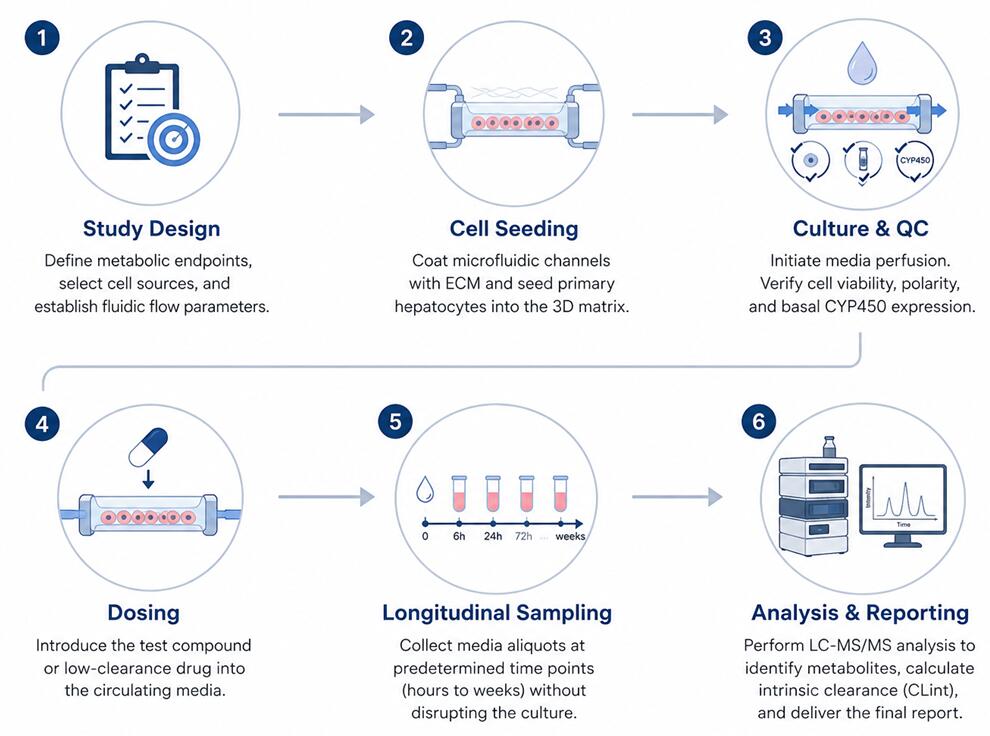
Service Workflow
Why Choose Our BBB Models
- Physiological TEER values (>1500 Ω·cm²) ensuring a strict paracellular barrier.
- Complex tri-culture NVU configuration replicating true astrocytic and pericytic crosstalk.
- Hemodynamic flow aligns endothelial cells, critical for proper transcytosis receptor presentation.
- Customizable for neurodegenerative disease modeling to study "leaky" barrier states.
FAQs
What TEER values do you typically achieve?
By utilizing dynamic fluidic flow and tri-culture methods, our chips consistently achieve physiological TEER values ranging from 1,000 to over 2,500 Ω·cm², far exceeding standard static models.
Can you test large molecules like antibodies?
Yes, the tight paracellular barrier ensures that large molecules only pass through active Receptor-Mediated Transcytosis (RMT), making this model ideal for testing brain-shuttle antibodies.
Are human primary cells or stem cells used?
We utilize both primary human BMECs/Astrocytes and iPSC-derived cells, depending on the client's need for reproducibility versus specific genetic backgrounds (e.g., APOE4 variants).
Cross the Blood-Brain Barrier Successfully
Stop guessing your CNS drug's penetrance. Let our NVU models provide actionable, human-relevant data. Reach out to our experts today.
Online Inquiry