
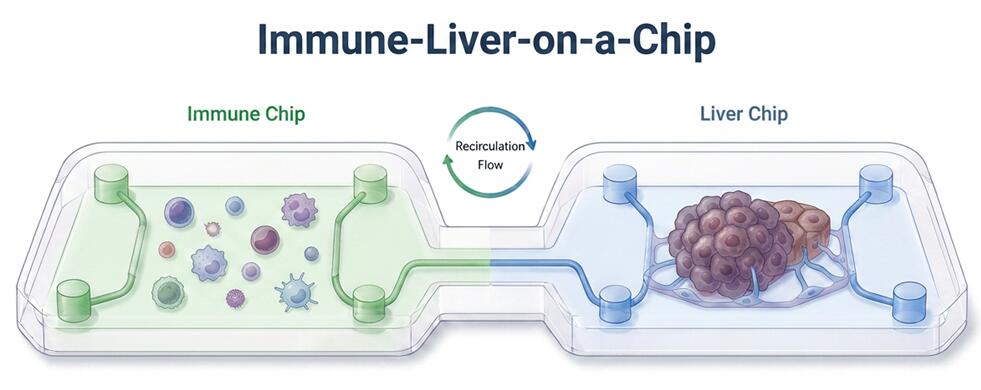
A customizable microphysiological platform that connects immune components with liver models to study inflammation-associated liver injury, immune-mediated drug responses, cytokine signaling, and immune-liver crosstalk under controlled microfluidic conditions.
- Overview
- Platform
- Advantages
- FAQs
Overview
The liver is not only a central metabolic organ but also an immunologically active tissue. It contains resident immune cells, such as Kupffer cells, and interacts continuously with circulating immune cells, inflammatory mediators, microbial products, drugs, and metabolites. This immune-regulatory environment contributes to host defense, immune tolerance, inflammation resolution, and liver injury responses.
Immune-liver interactions are highly relevant to drug-induced liver injury, inflammatory liver diseases, infection-related responses, biologic drug evaluation, cytokine-mediated toxicity, and immune-mediated adverse events. In many cases, liver injury is influenced by the combined effects of hepatocyte stress, innate immune activation, cytokine release, oxidative stress, and interactions among hepatic parenchymal and non-parenchymal cells.
Traditional in vitro liver models often focus on hepatocyte metabolism and toxicity endpoints but may lack immune components. Immune cell assays, on the other hand, usually do not include liver-specific tissue context. Animal models provide systemic immune complexity, but species differences in immune signaling, hepatic metabolism, and inflammatory mechanisms can limit human translation.
Immune-Liver-on-a-Chip is a custom microphysiological system designed to integrate liver tissue models with selected immune components under controlled microfluidic flow. This approach enables researchers to investigate immune-mediated liver responses, inflammatory signaling, immune cell recruitment or activation-related endpoints, and drug- or cytokine-associated hepatotoxicity in a more integrated human-relevant experimental system.
What Is Immune-Liver-on-a-Chip?
Immune-Liver-on-a-Chip is a microengineered platform that links hepatic cell models with immune cell populations or immune-associated compartments. Depending on the research question, the system can be configured with hepatocytes, liver non-parenchymal cells, Kupffer-like cells, liver sinusoidal endothelial cells, hepatic stellate cells, peripheral blood mononuclear cells, monocytes, macrophages, T cells, or other selected immune cell types.
The platform is designed to reproduce selected aspects of immune-liver communication, including:
- Compartmentalized hepatic and immune-associated culture regions
- Controlled exposure to drugs, metabolites, cytokines, endotoxin-related stimuli, or inflammatory mediators
- Immune cell activation, adhesion, migration, or cytokine secretion-related endpoints depending on chip design
- Hepatic viability, metabolic function, stress response, and liver injury-related readouts
- Dynamic exchange of soluble factors between liver and immune compartments
- Optional incorporation of resident liver immune cells or circulating immune cells for customized studies
This platform is suitable for mechanistic studies of inflammation-associated hepatotoxicity, immune-mediated drug responses, biologic or immunomodulatory compound evaluation, and liver disease-associated inflammatory modeling. As with other organ-on-chip systems, it represents selected biological features and should be interpreted together with complementary experimental and clinical evidence where applicable.
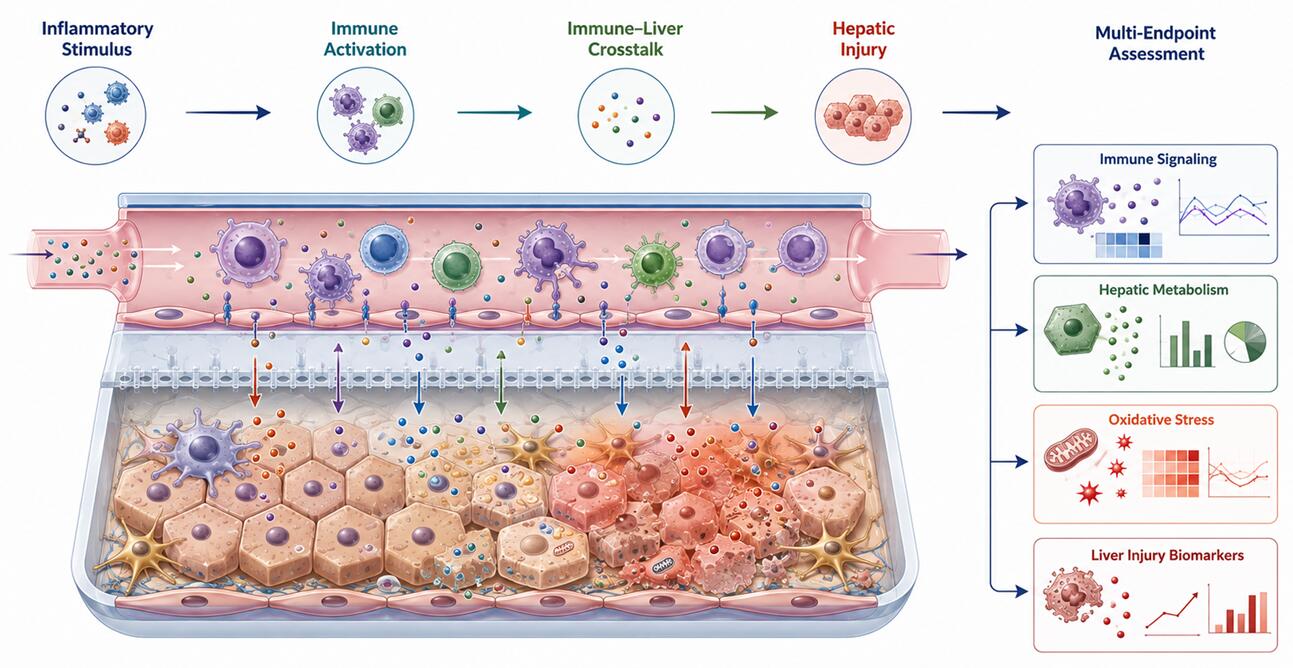 Fig. 1. Schematic design of a custom Immune-Liver-on-a-Chip platform for immune-mediated
liver response and inflammatory toxicity assessment.
Fig. 1. Schematic design of a custom Immune-Liver-on-a-Chip platform for immune-mediated
liver response and inflammatory toxicity assessment.
Our Immune-Liver-on-a-Chip Platform
Our custom Immune-Liver-on-a-Chip platform integrates liver models with selected immune components in a controlled microfluidic system, supporting studies of inflammatory signaling, immune-mediated liver injury, and liver-immune crosstalk.
Key Features
- Custom immune-liver design: Supports co-culture, compartmentalized, or perfusion-based immune-liver configurations.
- Controlled inflammatory exposure: Compatible with defined cytokine, drug, immune modulator, or endotoxin-related stimulation.
- Functional liver module: Enables assessment of hepatic viability, metabolism, and liver injury-related biomarkers.
- Immune response readouts: Supports cytokine release, immune activation, adhesion, migration, and phenotype-related analysis depending on model design.
- Dynamic microfluidic flow: Allows controlled exchange of soluble mediators and time-course sampling.
System Design & Validation
The system is customized according to the immune cell type, liver model, stimulation strategy, and required endpoints.
- Liver module: Evaluated for morphology, viability, albumin secretion, urea production, and metabolic activity.
- Immune module: Assessed for cell viability, activation status, cytokine secretion, and surface marker expression.
- Interaction design: Adapted for soluble factor exchange, immune cell perfusion, or immune-liver co-culture.
- Quality control: Includes sterility, chip integrity, leakage testing, flow stability, and endpoint-specific assay checks.
Applications
The platform can be tailored for immune-liver interaction and inflammatory toxicity studies, including:
- Immune-mediated liver injury: Study how immune activation or cytokine signaling contributes to hepatotoxicity-related responses.
- Cytokine-associated liver stress: Evaluate hepatic responses to inflammatory mediators or immune modulators.
- Biologics and immunomodulatory compound testing: Assess liver-relevant effects in the presence of selected immune components.
- Innate immune-liver crosstalk: Investigate interactions among hepatocytes, macrophage-like cells, Kupffer-like cells, or monocytes.
- Mechanistic toxicology: Analyze links among inflammation, metabolism, oxidative stress, and liver injury biomarkers.
Why Choose Our Immune-Liver-on-a-Chip
- Integrated immune-liver model for studying inflammatory signaling together with liver function and injury-related endpoints.
- Customizable immune complexity with resident liver immune cells, circulating immune cells, macrophage-like cells, PBMCs, T cells, or selected immune co-cultures.
- Controlled microfluidic exposure enabling defined timing, concentration, and transfer of drugs, cytokines, metabolites, and soluble mediators.
- Flexible liver model options including primary hepatocytes, hepatic cell lines, iPSC-derived hepatic cells, liver organoids, and liver non-parenchymal cell co-cultures.
- Adaptable endpoints for cytokine release, immune activation markers, hepatic metabolism, oxidative stress, inflammation, and liver injury biomarkers.
- Mechanism-oriented study design for exploring selected immune-mediated hepatotoxicity pathways without over-relying on single-cell-type assays.
FAQs
Q: What immune components can be incorporated into the platform?
The system can be configured with Kupffer-like cells, monocytes, macrophages, PBMCs, T cells, liver sinusoidal endothelial cells, or selected immune-associated co-cultures. The choice depends on whether the study focuses on innate immune activation, cytokine signaling, immune cell adhesion, circulating immune cell exposure, or drug-related immune modulation.
Q: Can this platform model idiosyncratic drug-induced liver injury?
The platform can be used to investigate selected mechanisms associated with immune-mediated or inflammation-enhanced liver injury, such as cytokine priming, macrophage activation, and hepatocyte stress. However, idiosyncratic drug-induced liver injury is complex and patient-specific, so the model should be viewed as a mechanistic research tool rather than a complete predictor of clinical idiosyncratic risk.
Q: How are immune activation and liver injury measured together?
Immune activation can be assessed by cytokine secretion, chemokine levels, surface marker expression, immune cell viability, and phenotype-related assays. Liver responses can be measured through hepatocyte viability, albumin secretion, urea production, CYP activity, oxidative stress markers, inflammatory gene expression, and injury-related biomarkers such as ALT, AST, or LDH where appropriate.
Q: Can circulating immune cells be perfused through the chip?
Yes, circulating immune cell perfusion can be incorporated in selected designs. This may support studies of immune cell exposure to liver-derived signals, adhesion-related behavior, or inflammatory recruitment-related endpoints. Flow rate, shear conditions, cell concentration, and assay duration require optimization for each study.
Q: Is the platform suitable for testing biologics or immunomodulatory compounds?
Yes. The system can be adapted for biologics, cytokines, immune modulators, antibody-based agents, or small molecules that influence immune signaling. Assay design should consider species compatibility, target expression, immune cell source, dosing schedule, and whether the compound requires hepatic metabolism.
Q: What are the main design considerations for immune-liver co-culture?
Important considerations include immune cell source, donor variability, basal activation state, liver cell maturity, medium compatibility, cytokine background, flow conditions, exposure duration, and endpoint timing. These factors are reviewed during custom platform design to match the system to the research objective.
Advance immune-mediated liver response and inflammatory toxicity studies with a customized Immune-Liver-on-a-Chip platform.
Contact us today to discuss immune cell selection, liver model configuration, inflammatory stimulation design, analytical endpoints, and tailored study solutions.
Online Inquiry