
Creative Bioarray offers specialized Gastrointestinal Toxicity Research Services, employing advanced organ-on-a-chip and organoid technologies to evaluate the safety and efficacy of drug candidates on the gastrointestinal system. Our innovative models provide insights into drug-induced gastrointestinal toxicity, helping to identify potential risks early in the drug development process.
- Introduction
- Service Details
- Workflow
- Features
- FAQs
Understanding Gastrointestinal Toxicity
Gastrointestinal toxicity can lead to significant complications during drug development, influencing the safety profile and therapeutic effectiveness of new compounds. Traditional animal models may not accurately reflect human gastrointestinal responses, making it essential to utilize more relevant human-based systems. Drug-induced gastrointestinal toxicity can manifest through various mechanisms, including inflammation, mucosal injury, and alterations in gut microbiota.
Our organ-on-a-chip and organoid technologies replicate the complex physiology of the gastrointestinal tract, enabling researchers to assess drug effects on intestinal cells in a controlled environment. By utilizing human-derived cells in our models, we can provide a more accurate prediction of potential gastrointestinal risks and explore the mechanisms underlying toxicity, thereby facilitating safer drug development.
Targeted Gastrointestinal Toxicity Solutions
Our Gastrointestinal Toxicity Research Services are structured around the critical physiological functions of the human gut, allowing for a highly targeted evaluation of how your drug candidates interact with the gastrointestinal system:
1. Intestinal Barrier Integrity and Permeability
- Evaluate the impact of drug candidates on epithelial tight junctions and overall mucosal barrier function.
- Continuous monitoring of barrier integrity using Transendothelial Electrical Resistance (TEER) and fluorescent tracer permeability assays.
- Identify early signs of drug-induced enteropathy, "leaky gut" syndrome, and cellular damage before they progress to severe toxicity.
2. Drug Absorption and Local Metabolism (ADME)
- Model oral drug absorption processes to determine how compounds traverse the intestinal epithelium and their localized toxic effects during transit.
- Assess the function of key efflux and uptake transporters (e.g., P-gp, BCRP) and their potential interactions with drug candidates.
- Evaluate first-pass intestinal metabolism by measuring local enzyme activity (e.g., CYP3A4) to accurately predict oral bioavailability and localized toxicity.
3. Gut Inflammation and Immune Responses
- Incorporate immune cell co-cultures to study drug-induced inflammatory responses within the gastrointestinal tract.
- Quantify the release of pro-inflammatory cytokines and chemokines to assess the risk of gastrointestinal irritation or immune-mediated toxicity.
- Explore host-microbiome interactions by introducing specific microbial communities to evaluate how drug candidates alter gut flora or how flora impacts drug toxicity.
Technical Platform and Analytical Approaches
We employ advanced technologies to ensure reliable data:
Instrumentation:
- Microfluidic organ-on-a-chip systems
- Automated high-throughput screening platforms
- Live-cell imaging for dynamic analysis
Key Reagents:
- Specialized culture media for intestinal cells
- Standardized ECM components ensuring consistent results
- Validated biomarker panels to assess gastrointestinal health
Analysis Techniques:
- Functional assays to evaluate gastrointestinal responses
- Biomarker quantification using ELISA and qPCR
- High-Content imaging for cellular profiling
Our Efficient Service Workflow
We follow a straightforward process to deliver high-quality results:
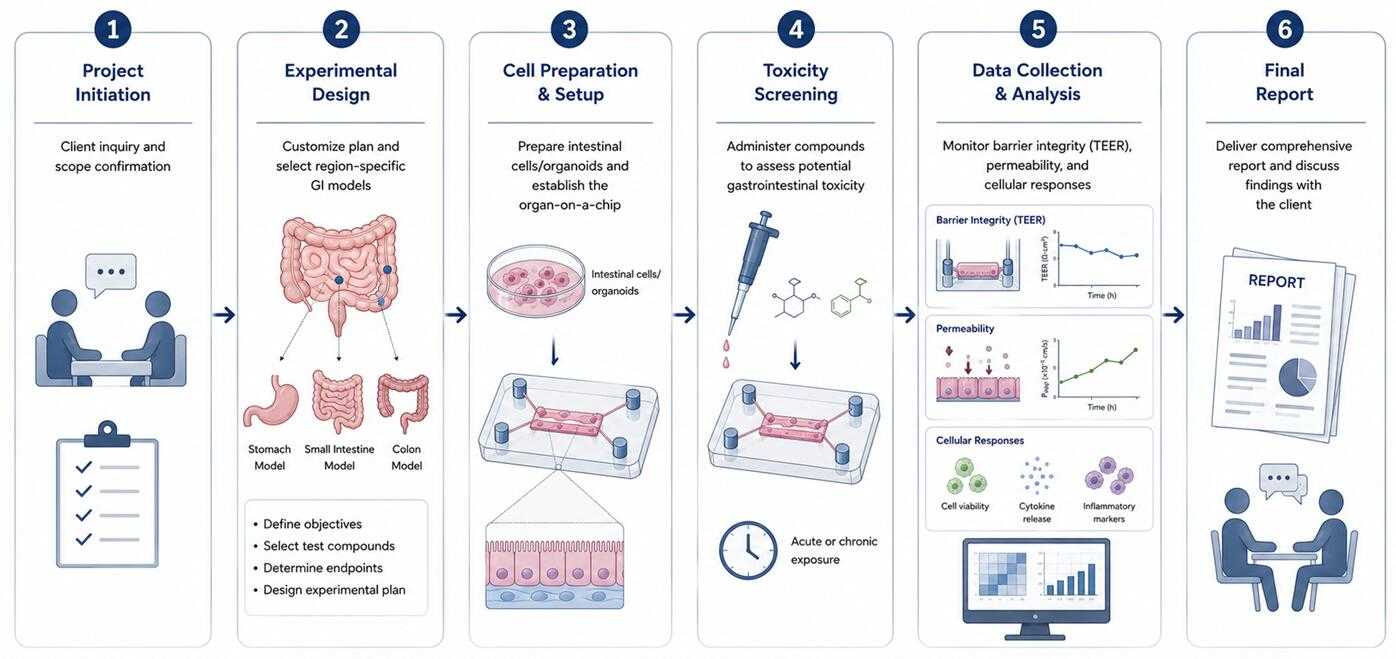 Throughout each phase, we implement quality checks and gather client feedback to align our
work with your objectives.
Throughout each phase, we implement quality checks and gather client feedback to align our
work with your objectives.
Why Choose Creative Bioarray for Gastrointestinal Toxicity Research?
- Innovative models that authentically replicate human gastrointestinal physiology for accurate assessments
- Established methodologies ensuring reproducibility in research
- Adaptive service tailored to your specific needs
- Timely communication and updates throughout the project
Ready to Advance Your Gastrointestinal Toxicity Research? Contact Us!
At Creative Bioarray, we are committed to supporting your gastrointestinal toxicity research initiatives. Our team is here to help you design effective experiments to achieve your research goals. Let's collaborate to enhance drug safety through innovative science.
FAQs
Do your models utilize traditional cell lines like Caco-2, or primary human cells?
While we offer validated Caco-2 models for standard permeability screening, our advanced platforms utilize primary human intestinal organoids. This ensures the presence of diverse intestinal cell types—such as goblet, Paneth, and enteroendocrine cells—providing a much closer representation of in vivo human physiology and toxicity responses.
Can your platforms model the mucus layer and host-microbiome interactions?
Yes. The dynamic fluid flow in our organ-on-a-chip systems stimulates epithelial cells to produce a physiological mucus layer, which is often missing in static cultures. Furthermore, we can safely co-culture commensal bacteria or specific microbial consortia to study how the microbiome influences drug toxicity and metabolism.
How exactly do you measure drug-induced barrier damage in these systems?
We employ a combination of non-destructive, real-time readouts like Transendothelial Electrical Resistance (TEER) alongside apparent permeability (Papp) assays using fluorescent tracers. This allows us to track barrier integrity continuously over the course of drug exposure, often pairing it with cytokine profiling to detect underlying inflammation.
Are these models suitable for studying specific regions of the GI tract?
Absolutely. Because we use region-specific primary cells (e.g., from the duodenum, jejunum, ileum, or colon), we can simulate the distinct microenvironments of different GI segments. This is particularly valuable for evaluating targeted oral formulations and localized toxicity.
Transform Your Gastrointestinal Toxicity Research Today
Our dedicated team at Creative Bioarray is ready to assist you in advancing your gastrointestinal toxicity research. Reach out for a consultation, and let’s work together to ensure safer drug development.
Online Inquiry