Accelerate oncology drug development with patient-derived tumor organoids and organ-on-a-chip platforms for efficacy testing, biomarker discovery, and translational research.
- Overview
- Platform
- Service
- Application
- Workflow
- FAQs
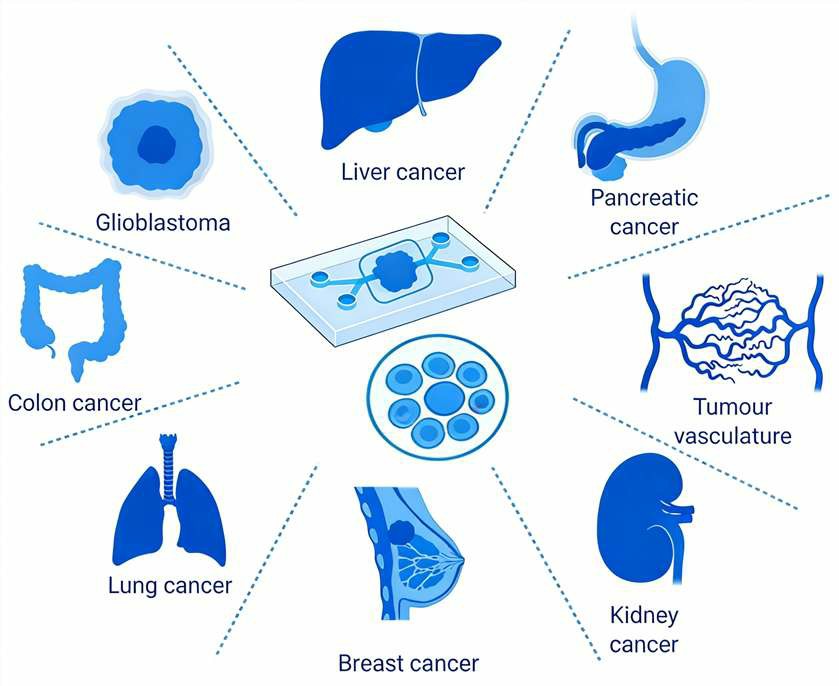
Precision oncology has established cancer as a highly heterogeneous and evolving disease that is influenced by myriad genetic changes, tumor microenvironment (TME), and patient-specific factors and ultimately determine response to therapy and clinical outcome. Traditional cancer models such as 2D cell lines and animal models have been indispensable in the study of oncology; however, they have a long history of not fully recapitulating the hallmarks of human tumor biology, drug response, and clinical response.
Organoids and organ-on-a-chip are next-generation, human relevant cancer models that are overcoming the limitations of traditional cancer models. Tumor organoids are derived directly from patient tissues, which preserve the genetic makeup, histopathology and the functional heterogeneity that exists in the primary tumor. Organ-on-a-chip systems can further enhance physiological relevance by introducing dynamic perfusion, mechanical cues, and multi-cellular interactions to more precisely model tumor-stroma, tumor-immune, and tumor-vascular interfaces.
Comparison of Oncology Models
| Model Type | Recapitulation of TME | Human Consistency | Throughput | Physiological Relevance |
| 2D Cell Culture | Minimal | High | Very High | Low; lacks 3D structure and cell-cell signaling. |
| Subcutaneous CDX/PDX | Moderate | Low (Murine host) | Low | Limited; missing tissue-specific microenvironment. |
| Orthotopic Models | High | Low (Murine host) | Very Low | High; reflects organ-specific tumor behavior. |
| Metastatic Models | High | Low (Murine host) | Very Low | Essential for systemic studies but slow and costly. |
| Tumor Organoids | High | Highest | High | Excellent; maintains patient-specific genetics/3D architecture. |
| Organ-on-a-Chip | Highest | Highest | Medium | Superior; incorporates perfusion, shear stress, and immune flux. |
Our Patient-Derived Tumor Organoids and Oncology Organ-on-a-Chip Platforms
We provide a comprehensive portfolio of patient-derived tumor organoids (PDTOs) and oncology-focused organ-on-a-chip systems, designed to support translational research and drug development.
Key Features:
- Broad tumor coverage (e.g., colorectal, lung, breast, liver, pancreatic, gastric, ovarian)
- High genetic and phenotypic fidelity to original patient tumors
- Retention of intra-tumoral heterogeneity
- Customizable co-culture options (immune cells, CAFs, endothelial cells)
- Scalable formats compatible with medium- to high-throughput screening
- Reproducible and standardized quality control
Oncology Drug Discovery and Research Services
Building on our organoid and organ-chip platforms, we offer end-to-end oncology research services, including:
- Target Validation and Mechanism-of-Action Studies
- High-Content Drug Screening and Lead Optimization
- Combination Therapy Evaluation
- Immuno-oncology Assays (tumor-immune co-culture)
- Biomarker Identification and Translational Studies
- Preclinical Efficacy and Toxicity Assessment
Our services are designed to improve clinical predictability, reduce late-stage failure risk, and accelerate the development of next-generation cancer therapeutics.
Core Applications in Modern Oncology
Patient-Derived Organoids (PDOs)
- Precision Medicine & Therapy Prediction: PDOs serve as "patient avatars" to predict the efficacy of neoadjuvant and adjuvant therapies, allowing for personalized treatment selection before clinical administration.
- Tumor Vaccine Research: Providing a robust platform for identifying neoantigens and testing the immunogenicity of personalized cancer vaccines.
- High-Throughput Drug Screening: Rapidly identifying potent lead compounds from vast chemical libraries using patient-specific genetic backgrounds.
Organ-on-a-Chip Systems
- Immune-Oncology (I-O) Profiling: Simulating the recruitment and infiltration of T-cells or CAR-T cells into the tumor stroma under physiological flow conditions.
- Metastasis-on-a-Chip: Modeling the "seed and soil" hypothesis by connecting different organ compartments to study intravasation, circulation, and organ-specific colonization.
- Angiogenesis & Vasculature Studies: Observing how tumors induce blood vessel growth and testing anti-angiogenic drug candidates in a dynamic environment.
Workflow
Sample Collection
Patient tumor tissues are collected and processed to preserve viability and heterogeneity.
Organoid Generation
Cells are cultured in 3D conditions to establish stable patient-derived tumor organoids (PDTOs).
Model Validation
Organoids are characterized to confirm consistency with the original tumor (morphology, genetics).
Assay Setup
Customized assays are designed, including drug screening, immuno-oncology, or co-culture systems.
Data & Reporting
Data analysis delivers insights on drug response, efficacy, and potential biomarkers.
FAQs
Do tumor organoids retain the characteristics of the original tumor?
Yes. Our organoids preserve key features of the parental tumor, including:
- Genetic mutations
- Histopathological structure
- Intra-tumoral heterogeneity
This makes them highly predictive for translational research.
Can organ-on-a-chip systems replace animal models?
Organ-on-a-chip systems significantly improve human relevance and can complement or reduce reliance on animal models, but they are typically used alongside in vivo studies for comprehensive evaluation.
Do you support immune co-culture systems for immuno-oncology studies?
Yes. We offer advanced tumor–immune co-culture platforms, including:
- T cell and CAR-T cell assays
- Tumor-infiltrating lymphocyte (TIL) models
- Immune checkpoint inhibitor evaluation
What types of cancer models are available?
We support a wide range of tumor types, including:
- Colorectal, lung, breast, liver, pancreatic
- Gastric, ovarian, and other solid tumors
Custom model development is also available upon request.
Can you design customized studies based on our pipeline?
Absolutely. We provide fully customizable study designs, tailored to your targets, drug modalities, and development stage.
Online Inquiry