
Evaluate hepatic drug metabolism and clearance using fluidic liver-on-a-chip systems. By applying continuous media perfusion, these in vitro models support prolonged primary hepatocyte viability and stable CYP450 expression, facilitating metabolic profiling for low-clearance compounds.
- Introduction
- Service Details
- Workflow
- Features
- FAQs
Microphysiological Hepatic Models for ADME Studies
Standard 2D hepatocyte cultures typically exhibit a rapid decline in CYP450 enzyme activity within 48 to 72 hours, limiting their utility for assessing slowly metabolized compounds. Furthermore, animal models present inherent species-specific differences in metabolic pathways.
Creative Bioarray provides microfluidic Liver-on-a-Chip platforms designed to recapitulate the human hepatic sinusoid. The introduction of controlled fluidic flow allows primary human hepatocytes, Kupffer cells, and hepatic stellate cells to maintain specific zonal functions, cellular polarity, and functional bile canaliculi networks for up to 28 days. This environment supports the generation of clinically relevant pharmacokinetic data.
Liver Metabolism Services
1. Low-Clearance Drug Evaluation Services
- Utilization of 14- to 28-day culture windows to calculate intrinsic clearance (CLint) for slowly metabolized drugs.
- Determination of compound half-life (t1/2) in a functionally stable enzymatic environment.
| Model Type | Cellular Composition | Target Applications |
| Hepatic Monoculture | Primary Human Hepatocytes (PHH) | CYP activity, intrinsic clearance, phase I/II metabolism |
| Hepatic Co-culture | PHH + Kupffer + Stellate Cells | Immune-mediated DDI, fibrosis models, inflammatory metabolism |
2. Metabolite Profiling & CYP Interaction Services
- Identification of human-specific circulating and reactive metabolites via LC-MS/MS.
- Drug-Drug Interaction (DDI) assessment focusing on CYP450 induction and time-dependent inhibition.
- Analysis of Phase II metabolizing enzymes (e.g., UGTs, SULTs) under continuous flow conditions.
3. Disease-State Metabolism Modeling Services
- Induction of steatosis and fibrotic phenotypes to observe metabolic shifts in diseased states (e.g., NASH/MASLD).
- Measurement of altered drug transporter expression (e.g., OATP, NTCP) during hepatic inflammation.
Analytical Endpoints and Platform Specifications
Instrumentation:
- Microfluidic perfusion controllers
- LC-MS/MS systems
Cell Types & Matrices:
- Cryopreserved human PHH
- Extracellular matrix (ECM) scaffolds
Readouts:
- CYP/UGT functional assays
- Biliary efflux quantification
- Albumin/Urea secretion
Service Workflow
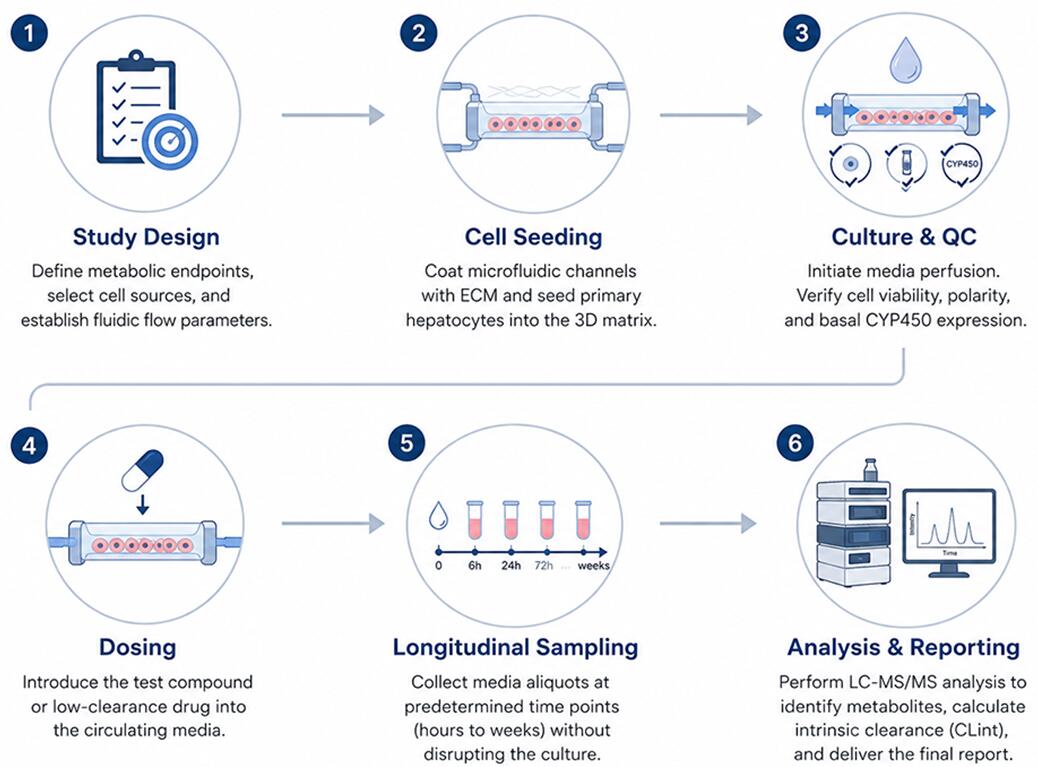 Baseline metabolic activities are verified prior to compound administration.
Scientific Advantages of the Platform
- Maintenance of basal CYP450 expression for >14 days without artificial inducers.
- Spontaneous formation of functional bile canaliculi networks for biliary excretion measurement.
- Inclusion of non-parenchymal cells to study immune-mediated metabolic variations.
FAQs
How is basal CYP activity maintained over time?
Continuous perfusion provides a steady nutrient supply and mechanical stimuli, which prevents hepatocyte dedifferentiation and sustains basal CYP1A2, 2B6, and 3A4 mRNA and protein levels for up to 4 weeks.
Can this model assess biliary efflux?
Yes, hepatocytes cultured in a 3D fluidic environment regain cellular polarity, spontaneously forming bile canaliculi structures that express key efflux transporters like MRP2 and BSEP.
What cell sources are utilized in your liver models?
We utilize cryopreserved primary human hepatocytes (PHH). Depending on the study requirements, we can use pooled donor cells to represent average population metabolism or single-donor cells for specific genotype profiling.
Are these models suitable for high-throughput screening?
Our microfluidic platforms are optimized for medium-throughput assays. They prioritize physiological relevance, long-term viability, and complex metabolic data (e.g., low-clearance) over rapid, high-throughput primary screening.
Initiate Your Hepatic ADME Study
Discuss your specific metabolic profiling requirements, flow parameters, and analytical endpoints with our scientific team. We provide structured protocols tailored to your study design.
Online Inquiry