
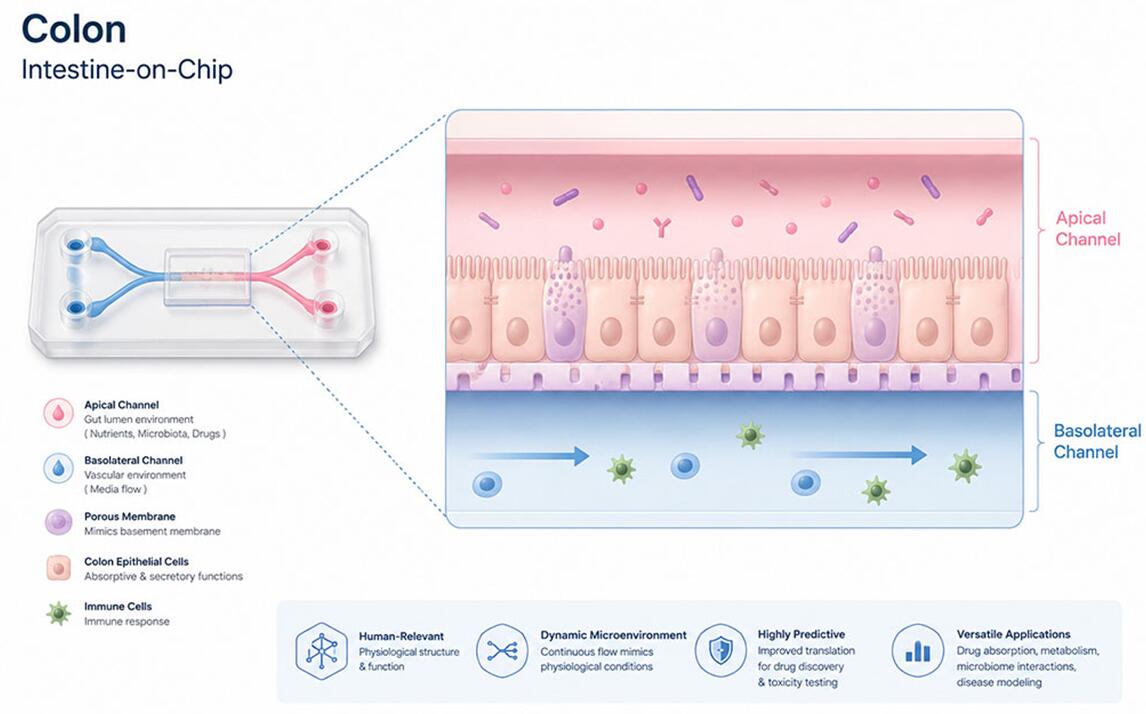
A microphysiological intestinal model designed to simulate key features of the human colon for drug absorption, barrier function, inflammation, toxicity, and microbiome research.
- Overview
- Details
- Advantages
- FAQs
Overview
The human colon is essential for intestinal barrier protection, water absorption, immune regulation, and host-microbiome balance. Traditional 2D cultures and animal models often fail to fully capture human-specific intestinal physiology, dynamic flow, and epithelial barrier responses.
Colon Intestine-on-Chip technology provides an advanced microphysiological platform for building more human-relevant intestinal models. By integrating microfluidic perfusion, controlled shear stress, extracellular matrix support, and compartmentalized cell culture, the chip can recreate key aspects of the colonic microenvironment and support real-time monitoring of intestinal physiology and response to external stimuli.
Our Colon Intestine-on-Chip platform is designed for researchers working on intestinal barrier function, drug permeability, inflammatory bowel disease, intestinal toxicity, host-microbiome interactions, and personalized intestinal disease modeling.
What Is Colon Intestine-on-Chip?
Colon Intestine-on-Chip is a microfluidic device that mimics key structural and functional aspects of the human colon. It typically includes separated apical and basal channels, allowing intestinal epithelial cells to form a polarized barrier under dynamic flow conditions.
This platform can reproduce important intestinal features, including:
- Polarized intestinal epithelial barrier formation
- Apical-basal compartmentalization
- Controlled fluid flow and shear stress
- Drug transport and permeability assessment
- Inflammatory and microbial stimulation
- Real-time imaging and downstream analysis
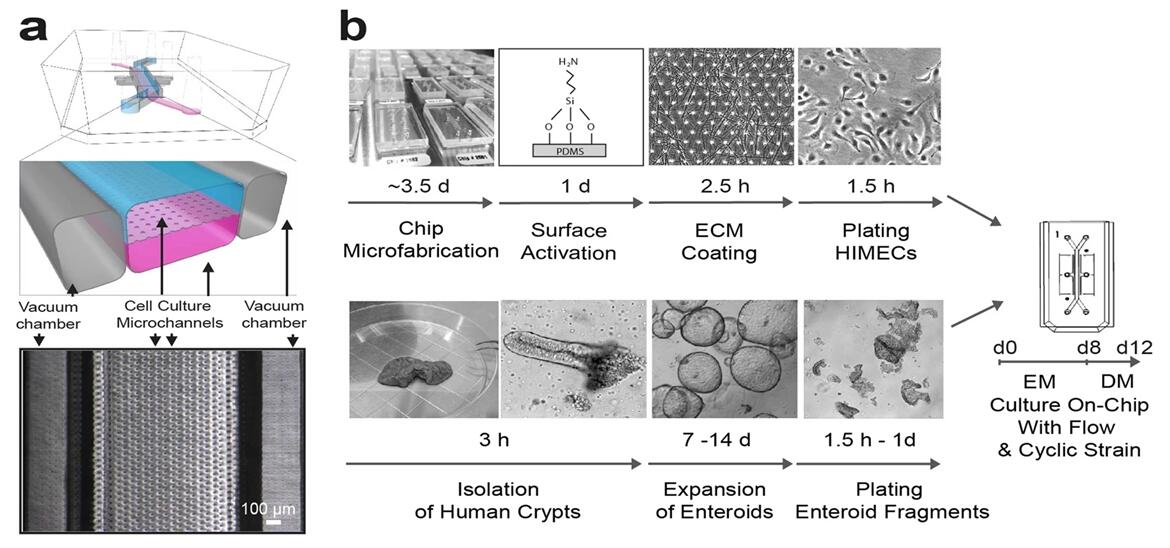 Fig. 1. Fabrication of the primary human Intestine Chip (Kasendra M, Tovaglieri A,
et al., 2018).
Fig. 1. Fabrication of the primary human Intestine Chip (Kasendra M, Tovaglieri A,
et al., 2018).
Our Colon Intestine-on-Chip Platform
Our Colon Intestine-on-Chip platform is designed to help researchers build reliable intestinal models for drug development, disease modeling, toxicity testing, and microbiome-related studies.
Key Features
- Human-relevant intestinal barrier: Supports epithelial polarization and tight junction formation.
- Dynamic perfusion: Provides controlled flow to better mimic the intestinal microenvironment.
- Compartmentalized design: Enables apical dosing, basal sampling, and directional transport studies.
- Flexible cell compatibility: Supports intestinal cell lines, primary cells, iPSC-derived cells, and organoid-derived cells.
- Co-culture capability: Can be adapted for epithelial, endothelial, immune, stromal, or microbial studies.
Validation & Readouts
The model can be characterized using structural, functional, and molecular assays.
- Barrier integrity: FITC-dextran permeability assay and TEER-related measurement
- Tight junction markers: ZO-1, Occludin, Claudin family proteins
- Cell morphology: Brightfield and fluorescence imaging
- Inflammatory response: Cytokine detection such as IL-6, IL-8, and TNF-α
- Downstream analysis: qPCR, immunostaining, ELISA, RNA-seq, and LC-MS/MS
Applications
- Drug Absorption & Permeability: Evaluate oral drug transport and intestinal permeability.
- Intestinal Barrier Research: Study barrier formation, disruption, and recovery.
- Inflammatory Bowel Disease Modeling: Model inflammation-associated epithelial damage and cytokine responses.
- Microbiome-Host Interaction: Study probiotics, pathogens, microbial metabolites, or bacterial components.
- Intestinal Toxicity Testing: Assess compound-induced epithelial toxicity and barrier impairment.
- Personalized Disease Models: Use patient-derived, iPSC-derived, or organoid-derived cells for individualized studies.
Why Choose Our Colon Intestine-on-Chip
- More physiologically relevant than static 2D intestinal cultures
- Dynamic flow environment for improved intestinal barrier modeling
- Flexible and customizable for different cells, assays, and applications
- Compatible with multiple readouts including imaging, permeability, molecular, and biochemical assays
- Suitable for drug discovery, toxicity testing, IBD modeling, and microbiome research
- Technical support available for chip setup, assay design, and custom solutions
FAQs
Q: What cell types can be used in Colon Intestine-on-Chip?
The platform can support commonly used intestinal epithelial cell lines such as Caco-2, HT-29, HCT116, and NCM460, as well as primary intestinal epithelial cells, iPSC-derived intestinal epithelial cells, and organoid-derived epithelial cells depending on the experimental design.
Q: Can the chip be used for intestinal barrier function studies?
Yes. Colon Intestine-on-Chip is well suited for intestinal barrier studies. Barrier integrity can be assessed using permeability assays, tight junction marker staining, epithelial morphology analysis, and TEER-related measurements depending on the device and system configuration.
Q: Does the platform support dynamic perfusion culture?
Yes. The chip can be connected to a perfusion system to provide controlled fluid flow and shear stress. Dynamic culture helps improve nutrient supply, waste removal, and physiological relevance compared with static culture conditions.
Q: Can Colon Intestine-on-Chip be used for drug absorption and permeability testing?
Yes. The compartmentalized design allows compounds to be introduced from the apical intestinal lumen side while samples can be collected from the basal side, making it useful for studying intestinal permeability, directional transport, and barrier-related drug responses.
Q: Can I model intestinal inflammation or IBD-like conditions on the chip?
Yes. Inflammatory intestinal models can be established by introducing inflammatory cytokines, bacterial components, chemical stimuli, or immune cells. These models can be used to evaluate epithelial barrier disruption, cytokine release, immune response, and therapeutic intervention effects.
Q: Is the platform suitable for microbiome-host interaction research?
Yes. The chip can be adapted for studies involving probiotics, pathogenic bacteria, microbial metabolites, or defined microbial components. Experimental conditions such as oxygen level, microbial exposure time, and medium compatibility should be optimized according to the specific study design.
Advance your intestinal research with our human-relevant Colon Intestine-on-Chip platform.
Contact us today to request product details, pricing, or customized solutions for your study.
Online Inquiry