
Advanced organoid and organ-on-a-chip platforms for cell therapy assessment, supporting functional evaluation of CAR-T, TCR-T, NK cell, stem cell, and regenerative medicine therapies in physiologically relevant human models.
- Overview
- Platform
- Service
- Application
- Workflow
- FAQs
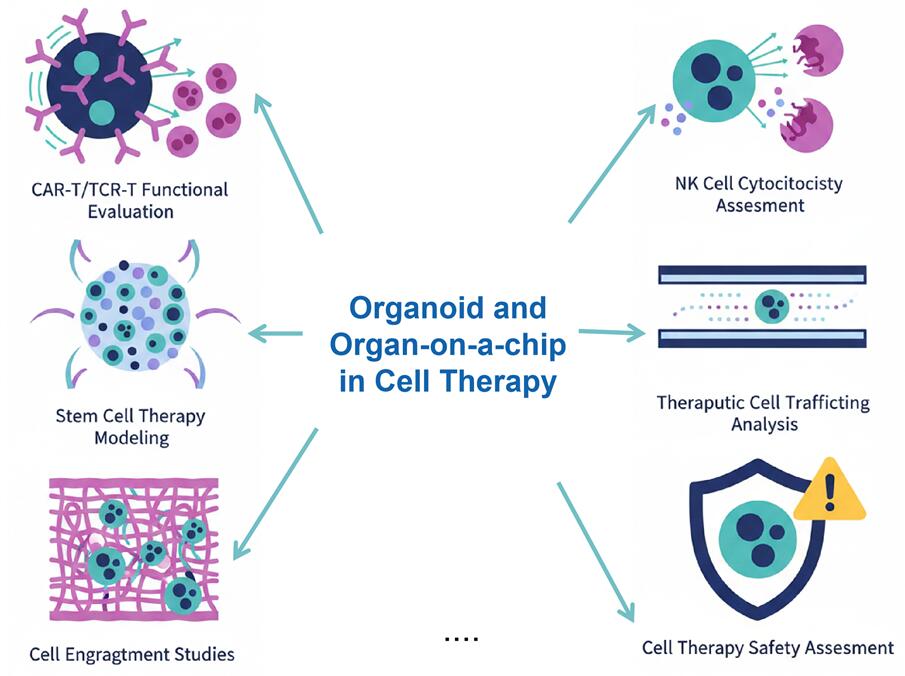
Cellular therapy is a major treatment method that has arisen in oncology, regenerative medicine, autoimmune diseases, and tissue repair. CAR-T and TCR-T therapies, NK cell therapies, mesenchymal stem cell (MSC)-based therapeutics and induced pluripotent stem cell (iPSC)-derived products all require reliable preclinical systems to assess therapeutic potency, persistence, trafficking, safety and tissue-specific responses.
Conventional in vitro assays and animal models often lack the ability to accurately reproduce human tissue architecture, multicellular interactions, and patient-specific variability. Organoids and organ-on-a-chip technologies provide next-generation, human-relevant platforms for testing cell therapies. Patient-derived organoids maintain properties of natural tissue, while organ-on-a-chip technologies allow for dynamic perfusion, immune cell migration and tissue-level functional investigation under physiologically realistic settings.
These platforms enable the evaluation of therapeutic cell infiltration, target recognition, cytotoxic activity, engraftment, cytokine release and off-target effects, therefore facilitating the acceleration of translational research and next generation cell therapy development.
Comparison of Cell Therapy Evaluation Models
| Model Type | Human Relevance | Dynamic Cell Interaction | Microenvironment Complexity | Suitability for Cell Therapy Studies |
| 2D Cell Culture | Moderate | Limited | Low | Suitable for preliminary potency and viability assays. |
| Animal Models | Limited by species differences | Moderate | High | Commonly used but may not fully predict human therapeutic response. |
| Spheroid Co-culture Models | Moderate | Moderate | Moderate | Useful for short-term cell killing and infiltration studies. |
| Patient-Derived Organoids | High | High | High | Supports patient-specific cell therapy response evaluation. |
| Organ-on-a-Chip | High | Very High | Very High | Enables dynamic analysis of therapeutic cell trafficking, engraftment, and tissue interaction. |
Our Cell Therapy Assessment Platforms
We provide organoid and organ-on-a-chip platforms designed for functional characterization of therapeutic cells and evaluation of cell therapy efficacy, persistence, and safety.
Key Features:
- Co-culture systems supporting CAR-T, TCR-T, NK cells, MSCs, and iPSC-derived therapeutic cells
- Microfluidic organ-on-a-chip platforms for dynamic cell trafficking and perfusion studies
- Real-time analysis of therapeutic cell infiltration and target cell killing
- Evaluation of cell persistence, viability, and tissue engraftment
- Multiparametric assessment of cytokine release and functional activation
- Scalable workflows suitable for translational research and preclinical screening
Cell Therapy Research Services
Leveraging advanced organoid and organ-on-a-chip technologies, we provide integrated services for cell therapy assessment, mechanism studies, and translational validation.
- CAR-T and TCR-T Functional Potency Assays
- NK Cell Cytotoxicity and Infiltration Studies
- Stem Cell Viability and Differentiation Analysis
- Therapeutic Cell Migration and Trafficking Evaluation
- Cell Engraftment and Tissue Interaction Studies
- Cytokine Release and Immune Activation Profiling
- Off-target Toxicity and Safety Assessment
- Biomarker Discovery and Translational Research Support
These services support mechanism-of-action studies, candidate prioritization, and development of next-generation cell-based therapeutics.
Core Applications in Cell Therapy Assessment
Patient-Derived Organoids
- Therapeutic Cell-Tissue Interaction Studies: Investigating target recognition, infiltration, and cytotoxic activity in native-like tissue environments.
- Stem Cell Functional Assessment: Supporting evaluation of differentiation potential, tissue repair capability, and regenerative response.
- Resistance and Persistence Analysis: Studying therapeutic cell exhaustion, limited persistence, and resistance-associated mechanisms.
Organ-on-a-Chip Systems
- Dynamic Therapeutic Cell Trafficking Models: Reproducing circulation, adhesion, migration, and tissue infiltration under flow conditions.
- Cell Therapy Safety Evaluation: Assessing cytokine-related toxicity and off-target tissue responses.
- Regenerative Medicine Modeling: Supporting analysis of tissue repair, vascularization, and cell engraftment processes.
- Combination Therapy Studies: Evaluating synergistic effects between cell therapies and biologics, chemotherapy, or targeted therapies.
Workflow
Sample Collection
Patient-derived tissues, tumor samples, or therapeutic cells are collected and prepared for downstream studies.
Model Establishment
Organoid or organ-on-a-chip models are generated to recapitulate human tissue architecture and microenvironmental features.
Therapeutic Cell Integration
Therapeutic cells are introduced into the system for functional interaction and response analysis.
Functional Evaluation
Cytotoxicity, migration, cytokine release, persistence, and tissue responses are quantitatively monitored.
Data Interpretation
Experimental data are integrated to support efficacy evaluation, safety profiling, and translational decision-making.
FAQs
Which types of cell therapies can be evaluated?
Our platforms support evaluation of CAR-T, TCR-T, NK cell therapies, stem cell therapies, MSC-based therapeutics, and iPSC-derived cell products.
What advantages do organ-on-a-chip systems provide?
Organ-on-a-chip platforms enable dynamic perfusion, therapeutic cell trafficking, and physiologically relevant tissue interactions that are difficult to reproduce in static culture systems.
Can these platforms support safety assessment?
Yes. These systems support evaluation of cytokine-related toxicity, off-target responses, and tissue-specific adverse effects during preclinical assessment.
Do you provide customized study designs?
Yes. We provide customized workflows based on therapeutic modality, disease indication, cell type, and translational research objectives.
Online Inquiry