Creative Bioarray offers a comprehensive suite of Analytical and Readout Services specifically optimized for complex 3D microphysiological systems and organoids. Extracting actionable, translationally relevant insights from dense 3D tissue architectures requires highly specialized methodologies. Our team integrates advanced imaging, functional assays, and multi-omics to decode the multifaceted data generated by your in vitro models.
- Introduction
- Analytical Suites
- Bioinformatics
- Workflow
- FAQs
Decoding the Complexity of 3D Tissue Models
Microphysiological systems and organoids accurately recapitulate human tissue architecture, cellular crosstalk, and dynamic microenvironments. Consequently, they generate highly complex, multi-dimensional datasets. Unlike planar cell cultures, assessing spatial gradients, temporal biomarker release, and deep-tissue morphological changes in 3D structures poses unique technical hurdles.
Standard benchtop assays are often insufficient to capture the depth of information these models offer. Tissues must be carefully cleared for imaging, biomarkers need to be longitudinally sampled without disrupting fluidic dynamics, and heterogeneous cell populations require high-resolution single-cell profiling. Creative Bioarray has engineered robust analytical pipelines designed exclusively for these advanced models, ensuring that no critical piece of biological data is lost, and providing you with a rigorous foundation for your therapeutic decision-making.
Comprehensive Analytical Suites
Our specialized readout modules are designed to capture every dimension of cellular response, from immediate functional changes to long-term genetic shifts:
1. High-Content 3D Spatial Imaging & Morphology
- Deep Tissue Imaging: Utilization of advanced tissue clearing techniques and confocal microscopy to penetrate dense organoids and chip-based microtissues without sectioning artifacts.
- Spatial Profiling: Mapping cellular localization, target engagement, and immune cell infiltration within the 3D matrix.
- Morphometric Analysis: Automated quantification of structural changes, such as tubulogenesis, cyst formation, or tumor organoid volumetric reduction over time.
2. Real-Time Functional & Biophysical Assays
- Barrier Integrity: Continuous, non-destructive monitoring of endothelial and epithelial tight junctions using Transendothelial Electrical Resistance (TEER) and apparent permeability (Papp) assays.
- Electrophysiology: Integration with Multi-Electrode Arrays (MEA) to capture dynamic action potentials, contractility, and conduction velocities in cardiac or neural organoid models.
- Longitudinal Sampling: Micro-volume sampling of chip effluents to track temporal metabolite consumption and dynamic enzymatic activity without disrupting the culture environment.
3. Molecular Profiling & Secretome Analysis
- Multiplex Secretome Profiling: High-throughput quantification of cytokines, chemokines, and growth factors using Meso Scale Discovery (MSD) platforms from limited microfluidic effluent volumes.
- Transcriptomics: RNA sequencing optimized for 3D ECM-embedded cultures, ensuring high-quality RNA extraction and revealing heterogeneous cell-state transitions.
- Proteomics: Unbiased mass spectrometry to identify novel drug-induced protein expressions and post-translational modifications within the tissue models.
Integrated Bioinformatics & Data Interpretation
Generating raw data from complex 3D models is only the first step. Translating that data into actionable insights is where the true value lies. Our in-house bioinformatics team specializes in handling the unique datasets produced by microphysiological systems.
Image Informatics:
- 3D volumetric reconstruction
- Automated cell segmentation
- Spatial colocalization analysis
Omics Analysis:
- Differential gene expression
- Pathway enrichment analysis
- Single-cell clustering/trajectory
Systems Biology:
- Multi-omics data integration
- Biomarker signature discovery
- Pharmacodynamic modeling
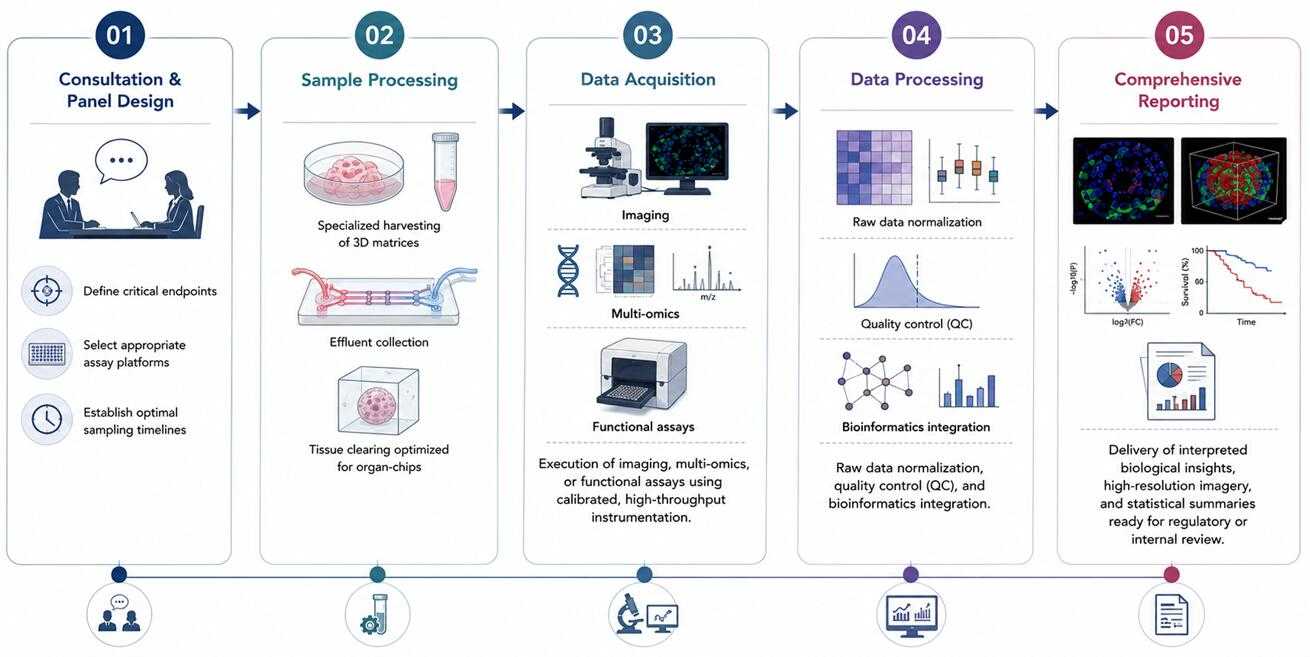
Streamlined Analytical Workflow
Whether you run the models in your facility and send us the samples, or we conduct the entire study end-to-end, our workflow ensures data integrity and precise execution:
Maximize the Value of Your 3D Assays
Don't let valuable data remain hidden within your complex biological models. Our scientific team is ready to design a tailored readout strategy that aligns perfectly with your drug development milestones, ensuring you capture the full depth of biological response.
FAQs
Can you perform analysis on organoid samples cultured in our own lab?
Yes. We offer both end-to-end services (where we culture and analyze the models) and standalone analytical services. You can securely ship your fixed organoids, frozen lysates, or culture media to our facility for specialized downstream readout and bioinformatics analysis.
How do you image deep into 3D organoids without destroying their structure?
We utilize proprietary and optimized tissue clearing protocols that render the dense extracellular matrix and cellular layers transparent. This allows our confocal microscopes to penetrate deeply into the intact 3D structure, preserving critical spatial relationships without the need for mechanical sectioning.
What volume of effluent is required for your multiplex cytokine panels?
Microfluidic chips often produce very limited media volumes. We utilize highly sensitive multiplexing platforms, such as MSD, which can quantify dozens of cytokines and biomarkers from sample volumes as low as 15 to 25 microliters.
Do you provide just raw data, or fully interpreted reports?
We provide comprehensive, tailored reporting. While you will receive all raw data files for your records, our standard deliverable includes normalized data sets, statistical analyses, high-resolution annotated images, and a biologically interpreted summary aligned with your research questions.
Unlock the Full Potential of Your In Vitro Models
Ensure that your sophisticated 3D models yield the high-quality, actionable data your program demands. Reach out today to discuss your analytical needs, and let our experts design a comprehensive readout strategy for your next pivotal study.
Online Inquiry