Advance infectious disease research with human-relevant organoids and organ-on-a-chip models to study host-pathogen interactions, viral replication, and rapid antimicrobial drug screening.
- Overview
- Platform
- Service
- Application
- Workflow
- FAQs
Infectious diseases remain a global health challenge, requiring models that accurately reflect human-specific responses to viruses, bacteria, and parasites. Traditional 2D cultures lack the structural complexity of human organs, while animal models often fail to replicate human-specific pathogen entry receptors and immune signaling pathways (e.g., SARS-CoV-2 entry via human ACE2).
Organoids and organ-on-a-chip systems provide high-fidelity platforms to study the infection cycle. Organoids recapitulate the diverse cell types of target organs (e.g. , lung alveolar cells or intestinal enterocytes), while organ-on-a-chip platforms introduce physiological blood flow, mechanical breathing/peristalsis, and immune cell recruitment, allowing researchers to observe real-time pathogen dissemination and tissue damage.
Comparison of Infectious Disease Models
| Model Type | Host Receptor Fidelity | Pathogen Tropism | Barrier Breach & Flux | Immune & Microbial Co-culture |
| 2D Cell Lines | High (Human-derived) | Limited; lacks multi-cellular diversity. | None; no physiological flow. | Low; simple co-culture only. |
| Animal Models | Low; significant species barriers (e.g. , ACE2/TMPRSS2). | Variable; often requires viral adaptation. | High; systemic but non-human. | High; but involves murine immune responses. |
| Infection Organoids | Highest; expresses natural human entry receptors. | High; recapitulates tissue-specific cell targeting. | Moderate; enables study of luminal infection. | High; supports complex host-pathogen interactions. |
| Infectious Organ-on-a-Chip | Highest; maintains polarized epithelial phenotype. | Highest; includes vascular and interstitial compartments. | Highest; simulates fluid shear stress and barrier translocation. | Superior; integrates dynamic immune cell recruitment & microbiota. |
Our Infectious Disease Modeling Platforms
We provide standardized and customizable microphysiological systems to simulate infections across various human barriers.
Key Features:
- Respiratory Models: Air-liquid interface (ALI) lung chips for studying respiratory viruses (e.g. , Influenza, RSV).
- Enteric Models: Gut-on-a-chip with anaerobic chambers for modeling microbiota-pathogen competition.
- Blood-Brain Barrier (BBB) Chips: To study neurotropic infections and pathogen translocation into the CNS.
- Immune Cell Dynamics: Simulation of neutrophil and macrophage recruitment via vascular perfusion.
- Real-time Imaging: Compatibility with high-resolution microscopy for visualizing pathogen movement.
Infectious Disease Research Services
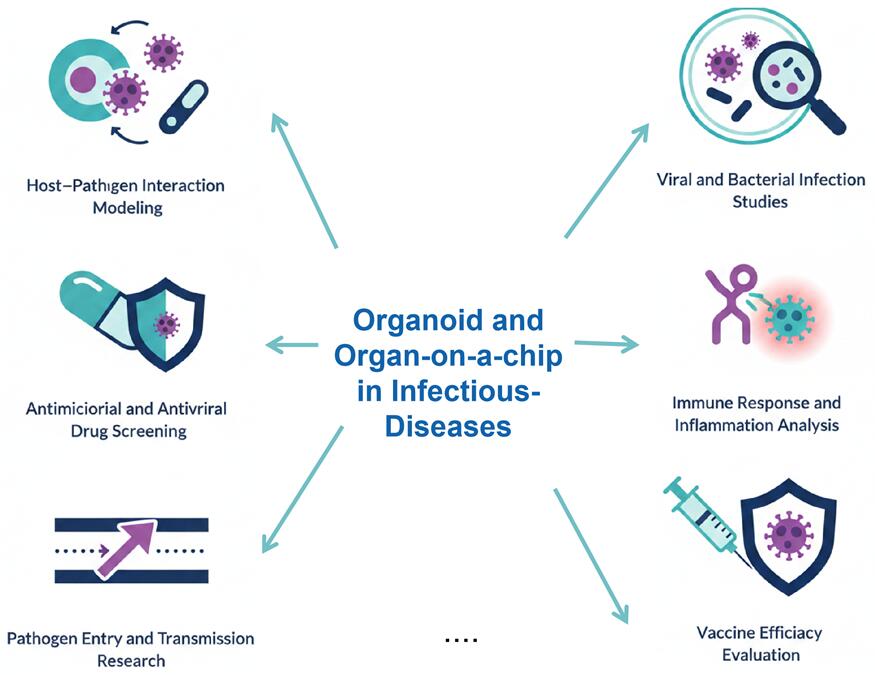
Our platforms support a wide range of assays to accelerate the development of vaccines and anti-infectives:
- Pathogen Tropism & Entry Assays: Identifying which specific cell types are targeted by a pathogen.
- Antiviral/Antibiotic Efficacy Testing: Evaluating drug potency in a multi-cellular 3D environment.
- Barrier Permeability Analysis: Measuring the breakdown of epithelial integrity during infection.
- Cytokine Storm & Inflammation Monitoring: Quantifying host inflammatory responses post-infection.
- Vaccine Candidate Evaluation: Testing neutralizing antibody efficacy and immune cell activation.
Core Applications in Infectious Diseases
Organoid Infection Models
- Viral Tropism: Studying SARS-CoV-2 or Norovirus infection in human gut and lung organoids where animal models are unsuitable.
- Pathogen Reservoirs: Identifying cellular niches where viruses may persist (e.g. , HBV in liver organoids).
- Genetic Susceptibility: Using patient-derived organoids to study why certain individuals are more prone to severe infection.
Organ-on-a-Chip Systems
- Multi-organ Cross-talk: Connecting lung and liver chips to study systemic drug metabolism and viral dissemination.
- Host-Microbiome-Pathogen Axis: Modeling the protective role of commensal bacteria against enteric pathogens.
- Aerosol Transmission: Simulating the inhalation of pathogens and their deposition on the alveolar-capillary interface.
Workflow
Model Setup
Establishment of human organoids or chip-based tissue barriers.
Inoculation
Controlled introduction of viruses, bacteria, or fungi into the system.
Infection Monitoring
Tracking replication kinetics, cell death, and barrier disruption.
Drug Intervention
Administration of candidate therapies to assess neutralization or clearance.
Data Delivery
Comprehensive analysis of viral load, cytokine profiles, and morphology.
FAQs
How do you simulate the immune response in an infection chip?
We introduce circulating immune cells (such as neutrophils or T cells) through the vascular channel, allowing them to migrate toward the site of infection in response to biochemical gradients.
Can organoids model complex viral life cycles?
Yes. Human organoids allow for the study of the entire cycle, from viral entry and genome replication to assembly and egress, within a physiologically relevant cell population.
Online Inquiry