
Advance gene therapy development with human-relevant organoids and organ-on-a-chip platforms for vector evaluation, delivery optimization, efficacy assessment, and translational studies.
- Overview
- Platform
- Service
- Application
- Workflow
- FAQs
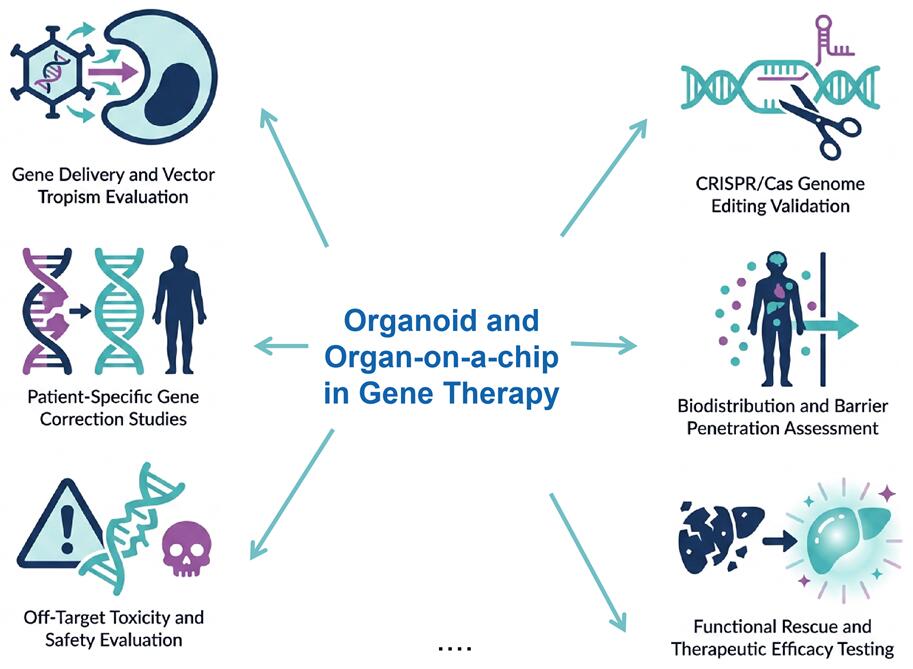
Gene therapy has become a revolutionary treatment strategy for the treatment of hereditary diseases, malignancies and complicated disorders to achieve precise genetic modification, gene replacement or gene silence. However, successful translation of gene therapy requires physiologically realistic pre-clinical models, which can reliably predict vector tropism, delivery efficiency, transgene expression, safety and long-term therapeutic benefits. Traditional 2D cultures and animal models generally fail to recapitulate the human tissue architecture, cellular diversity, and species-specific responses to viral and non-viral delivery mechanisms.
Organoid and organ-on-a-chip technologies serve as sophisticated, human-relevant platforms for gene therapy research and development. Patient-derived organoids maintain native tissue complexity, disease-associated phenotypes, and clinically relevant genetic backgrounds, whereas organ-on-a-chip systems use dynamic perfusion, tissue-tissue interactions, and biomechanical cues to better mimic in vivo microenvironments. Collectively, these technologies support better predictive assessment of vector delivery, genome editing efficiency, therapeutic efficacy, biodistribution, and safety profiles across various kinds of therapeutic applications.
Comparison of Gene Therapy Research Models
| Model Type | Human Relevance | Vector Evaluation | Throughput | Physiological Relevance |
| 2D Cell Culture | Moderate | Basic transduction assessment | Very High | Low; lacks tissue architecture and multicellular complexity. |
| Animal Models | Limited (Species differences) | In vivo biodistribution studies | Low | Moderate; limited prediction of human-specific responses. |
| Primary Cell Models | High | Useful for short-term validation | Medium | Limited lifespan and donor variability. |
| Disease Organoids | Highest | Excellent for patient-specific transduction and editing studies | High | Recapitulates native tissue organization and disease phenotypes. |
| Organ-on-a-Chip | Highest | Dynamic delivery and tissue interaction studies | Medium | Incorporates perfusion, barrier function, and mechanical stimulation. |
Our Organoid and Organ-on-a-Chip Platforms for Gene Therapy Research
We provide advanced organoid and organ-on-a-chip platforms to support gene therapy development, genome editing research, and vector optimization across multiple disease areas.
Key Features:
- Support for viral and non-viral delivery systems (AAV, lentivirus, adenovirus, LNPs)
- Patient-derived and disease-specific organoid models
- Physiologically relevant tissue architecture and cellular heterogeneity
- Dynamic perfusion systems for delivery and biodistribution studies
- Scalable and reproducible assay formats for translational research
Gene Therapy Development and Evaluation Services
Leveraging our advanced organoid and organ-chip platforms, we offer comprehensive services for gene therapy research and preclinical evaluation, including:
- Vector Tropism and Transduction Efficiency Assessment
- Genome Editing Validation and Functional Analysis
- Gene Delivery Optimization Studies
- Off-Target and Safety Assessment
- Longitudinal Efficacy and Biomarker Analysis
Our integrated platforms are designed to improve translational predictability, support candidate selection, and accelerate the development of safer and more effective gene therapies.
Core Applications in Gene Therapy Research
Organoid-Based Applications
- Patient-Specific Gene Correction: Evaluating therapeutic genome editing strategies in organoids derived from patients with inherited diseases.
- Vector Screening & Optimization: Comparing viral serotypes and delivery systems for efficient transgene delivery and expression.
- Disease Modeling & Functional Rescue: Assessing restoration of cellular function following gene replacement or editing therapies.
Organ-on-a-Chip Applications
- Biodistribution & Barrier Transport Studies: Investigating vector transport across physiological barriers under dynamic flow conditions.
- Multi-Organ Toxicity Assessment: Evaluating off-target effects and systemic safety using interconnected tissue-chip systems.
- Microenvironment-Responsive Delivery: Studying how tissue mechanics and microenvironmental factors influence gene delivery and therapeutic efficacy.
Workflow
Sample Preparation
Patient-derived tissues or engineered cell sources are prepared for organoid establishment or chip integration.
Model Establishment
Organoids or organ-chip systems are generated to recapitulate tissue-specific structure and function.
Gene Delivery
Gene therapy vectors or genome editing systems are introduced under optimized experimental conditions.
Functional Evaluation
Transduction efficiency, editing outcomes, safety, and therapeutic responses are comprehensively analyzed.
Data & Reporting
Detailed reports provide actionable insights for vector optimization and translational decision-making.
FAQs
What gene delivery systems can be evaluated using your platforms?
We support a broad range of delivery technologies, including:
- AAV vectors
- Lentiviral and adenoviral vectors
- Lipid nanoparticles (LNPs)
Can patient-derived organoids be used for personalized gene therapy studies?
Yes. Patient-derived organoids preserve disease-relevant mutations and phenotypes, enabling personalized evaluation of gene correction strategies and therapeutic responsiveness.
Do organ-on-a-chip systems support dynamic delivery studies?
Yes. Organ-on-a-chip platforms incorporate physiological flow and tissue interfaces, allowing more realistic assessment of vector transport, biodistribution, and tissue-specific delivery.
Can you evaluate genome editing outcomes and off-target effects?
Absolutely. We provide comprehensive analyses including editing efficiency, functional rescue, genomic validation, and off-target assessment using advanced molecular and imaging techniques.
Do you offer customized study designs for specific therapeutic programs?
Yes. Our team can design tailored workflows based on your therapeutic modality, target tissue, delivery system, and development objectives.
Online Inquiry