
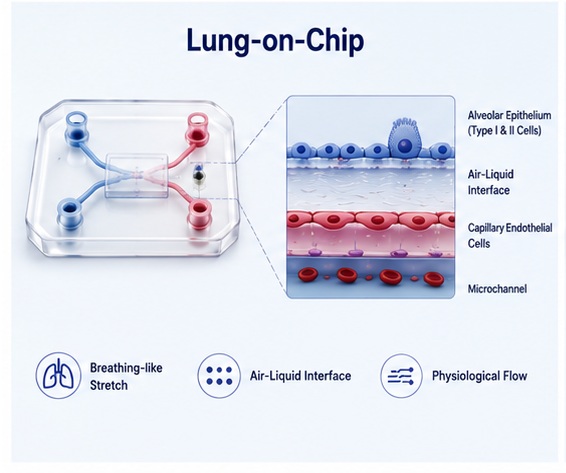
A dynamic microphysiological lung model designed to simulate the human airway or alveolar microenvironment for respiratory toxicity, inflammation, infection, and drug evaluation studies.
- Overview
- Details
- Advantages
- FAQs
Overview
The lung is continuously exposed to inhaled particles, pollutants, pathogens, allergens, and therapeutic aerosols. Its biological responses are shaped by air-liquid interface exposure, epithelial-endothelial interactions, immune signaling, and mechanical breathing-like cues, making respiratory modeling highly dependent on microenvironmental control.
Lung-on-Chip provides a perfusable and compartmentalized in vitro model that helps recreate key features of the human respiratory barrier. The platform enables researchers to study airway or alveolar responses to drugs, toxins, inflammatory stimuli, infectious agents, and inhaled compounds under more physiologically relevant conditions.
What Is Lung-on-Chip?
Lung-on-Chip is a microfluidic cell culture device designed to model important structural and functional characteristics of the human lung. It can support lung epithelial cells, endothelial cells, immune cells, or stromal cells in a controlled chip environment, enabling the formation of respiratory barrier models with dynamic perfusion and optional air-liquid interface culture.
This chip-based lung model can support the study of:
- Airway or alveolar epithelial barrier formation
- Air-liquid interface exposure and inhaled compound testing
- Epithelial-endothelial and immune cell interactions
- Respiratory inflammation and cytokine responses
- Infection modeling and host-pathogen interactions
- Real-time imaging and downstream molecular analysis
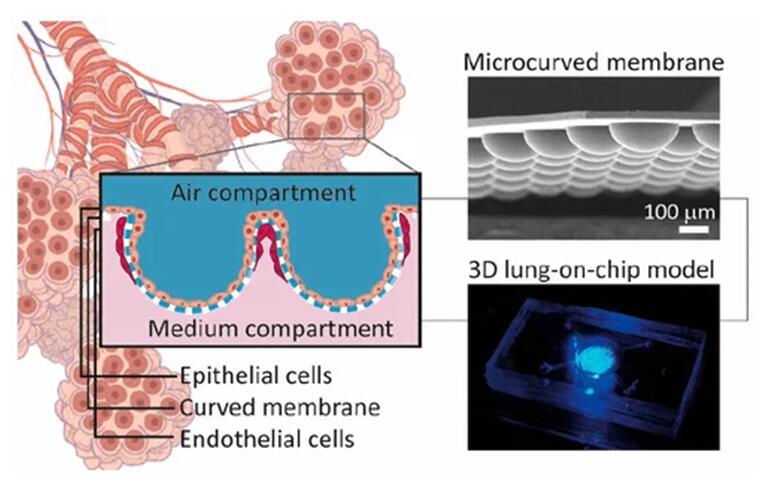 Fig. 1. Schematic representation of a Lung-on-Chip model (Baptista D, Teixeira L,et al., 2022).
Our Lung-on-Chip Platform
Our Lung-on-Chip platform provides a dynamic respiratory model for studying inhalation toxicity, lung inflammation, infection, barrier function, and pulmonary drug responses.
Key Features
- Respiratory-relevant barrier: Supports airway or alveolar epithelial barrier formation.
- Dynamic perfusion: Enables vascular-like flow and continuous sampling.
- Air-liquid interface compatibility: Supports exposure to aerosols, gases, particles, or inhaled compounds.
- Flexible cell options: Compatible with lung epithelial cells, endothelial cells, immune cells, primary cells, and iPSC-derived cells.
- Co-culture adaptable: Enables epithelial-endothelial, epithelial-immune, or disease-specific lung models.
Validation & Readouts
- Barrier integrity: Permeability assays and tight junction marker analysis.
- Lung markers: Epithelial markers, surfactant-related markers, cilia-associated markers, or endothelial markers depending on model type.
- Inflammatory response: Cytokine analysis such as IL-6, IL-8, TNF-α, and other immune mediators.
- Toxicity readouts: Cell viability, oxidative stress, epithelial damage, and barrier disruption.
- Downstream analysis: Live imaging, immunostaining, qPCR, ELISA, RNA-seq, and compound analysis.
Applications
- Inhalation Toxicity Testing: Evaluate pulmonary responses to particles, chemicals, pollutants, or aerosols.
- Respiratory Drug Evaluation: Study efficacy, permeability, and safety of inhaled or systemic therapeutics.
- Lung Inflammation Modeling: Model inflammatory responses induced by cytokines, allergens, irritants, or immune cells.
- Infection Research: Investigate host responses to respiratory viruses, bacteria, or pathogen-associated components.
- Barrier Function Studies: Analyze epithelial integrity, permeability, and injury-repair processes.
- Disease Modeling: Build models relevant to asthma, COPD, pulmonary fibrosis, or acute lung injury.
Why Choose Our Lung-on-Chip
- More physiologically relevant than conventional static lung cell culture models
- Supports air-liquid interface for inhaled compound, aerosol, and particle exposure studies
- Dynamic perfusion environment for improved respiratory barrier and endothelial interaction modeling
- Flexible and customizable for airway, alveolar, inflammatory, infectious, or disease-specific models
- Compatible with multiple readouts including imaging, permeability, cytokine, molecular, and toxicity assays
- Technical support available for chip setup, cell selection, model development, and assay optimization
FAQs
Q: What cell types can be used in Lung-on-Chip?
The platform can support airway epithelial cells, alveolar epithelial cells, lung endothelial cells, immune cells, primary lung cells, iPSC-derived lung cells, and disease-relevant cell sources depending on the study design.
Q: Can Lung-on-Chip support air-liquid interface culture?
Yes. The platform can be configured for air-liquid interface culture, enabling exposure to aerosols, gases, particles, pathogens, or inhaled compounds.
Q: Is the platform suitable for inhalation toxicity testing?
Yes. Lung-on-Chip can be used to assess epithelial toxicity, barrier disruption, oxidative stress, inflammatory responses, and cellular injury caused by inhaled substances or environmental exposures.
Q: Can it be used for lung inflammation or infection models?
Yes. The platform can be adapted for inflammatory stimulation, immune cell co-culture, or host-pathogen interaction studies using respiratory viruses, bacteria, or pathogen-associated components.
Q: What assays are compatible with this model?
Compatible assays include live imaging, immunofluorescence staining, permeability testing, cell viability assays, cytokine analysis, qPCR, RNA-seq, ELISA, and toxicity marker detection.
Advance respiratory research and inhalation safety assessment with our human-relevant Lung-on-Chip platform.
Contact us today to request product details, pricing, or customized solutions for your study.
Online Inquiry