A dynamic microphysiological kidney model designed to support nephrotoxicity testing, renal transport studies, kidney disease modeling, and drug development under controlled flow conditions.
- Overview
- Details
- Advantages
- FAQs
Overview
As a major organ for drug elimination and fluid homeostasis, the kidney continuously processes large volumes of filtrate while selectively recovering valuable solutes and removing waste products. Within this system, renal tubular cells are frequently exposed to concentrated drugs, metabolites, and endogenous compounds, making them highly relevant for evaluating renal transport, accumulation, and toxicity.
Accurate kidney modeling requires more than simple cell viability testing, as renal responses are shaped by tubular flow, polarized transporters, epithelial organization, and repeated compound exposure. Kidney-on-Chip offers a perfusable and compartmentalized in vitro model that allows researchers to investigate renal epithelial function, nephrotoxic mechanisms, and drug handling under defined microphysiological conditions.
What Is Kidney-on-Chip?
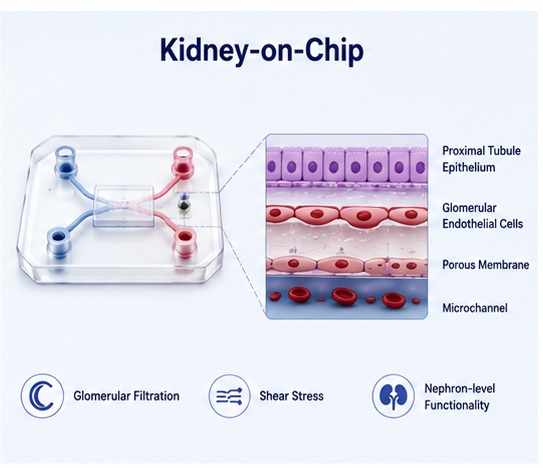
Kidney-on-Chip is a microfluidic cell culture device that models important structural and functional features of renal tissue. The platform can support renal epithelial cells under dynamic perfusion, allowing them to form polarized barriers and exhibit transporter-related functions.
This chip-based kidney model can support the study of:
- Renal epithelial barrier formation and polarization
- Drug-induced nephrotoxicity and renal safety assessment
- Active transport, secretion, and reabsorption processes
- Flow-dependent renal epithelial responses
- Kidney disease mechanisms and injury modeling
- Real-time imaging and downstream molecular analysis
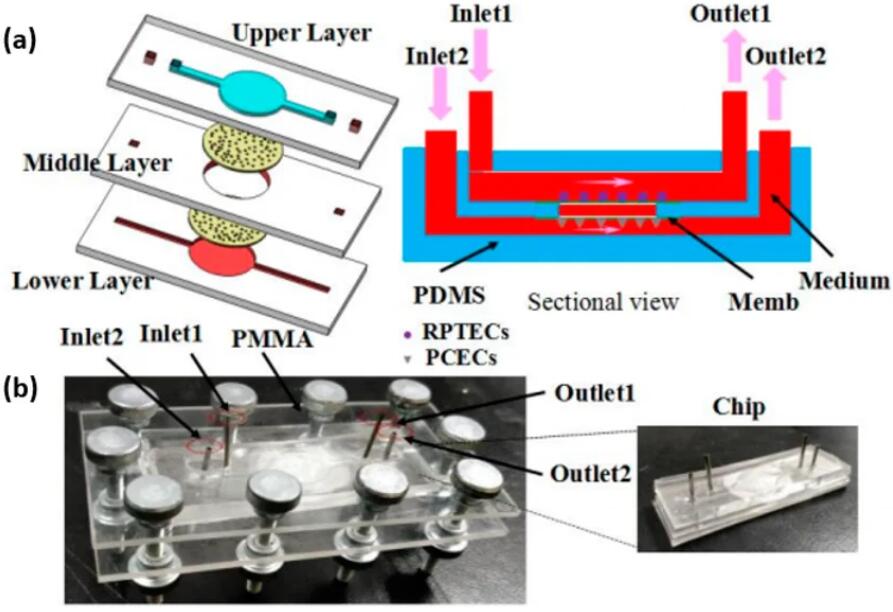 Fig. 1. Kidney-on-a-chip microfluidic device (Niculescu A G, Chircov C, et al.,
2021).
Fig. 1. Kidney-on-a-chip microfluidic device (Niculescu A G, Chircov C, et al.,
2021).
Our Kidney-on-Chip Platform
Our Kidney-on-Chip platform provides a dynamic renal model for studying nephrotoxicity, renal transport, kidney injury, and disease mechanisms under controlled perfusion conditions.
Key Features
- Renal-relevant model: Supports epithelial polarization, barrier formation, and kidney-specific responses.
- Dynamic perfusion: Mimics renal tubular flow and shear stress.
- Compartmentalized design: Enables directional dosing, sampling, and transport analysis.
- Flexible cell options: Compatible with proximal tubule cells, primary kidney cells, and iPSC-derived renal cells.
- Co-culture adaptable: Supports epithelial-endothelial or injury-related model development.
Validation & Readouts
- Renal markers: AQP1, LRP2/Megalin, SLC transporters, and tubular markers
- Barrier assessment: ZO-1, Occludin, Claudin proteins, and permeability analysis
- Transporter function: Uptake, secretion, and compound handling assays
- Injury biomarkers: KIM-1, NGAL, oxidative stress, and inflammatory markers
- Downstream analysis: Imaging, immunostaining, qPCR, ELISA, RNA-seq, and LC-MS/MS
Applications
- Nephrotoxicity Testing: Evaluate drug-induced renal injury and safety risks.
- Renal Drug Transport: Study uptake, secretion, and transporter-mediated mechanisms.
- Kidney Injury Modeling: Model acute injury, chronic injury, inflammation, or fibrosis-related responses.
- Renal Barrier Function: Analyze epithelial integrity, polarity, and flow-dependent responses.
- Personalized Kidney Models: Use patient-derived or iPSC-derived renal cells for individualized studies.
Why Choose Our Kidney-on-Chip
- More physiologically relevant than conventional static renal cell culture models
- Dynamic flow environment for improved modeling of renal tubular function
- Designed for nephrotoxicity studies, renal transport analysis, and kidney disease modeling
- Flexible and customizable for different renal cell types, co-culture formats, flow conditions, and assay endpoints
- Compatible with multiple readouts including imaging, biomarker analysis, molecular assays, and compound transport detection
- Technical support available for chip setup, model optimization, assay design, and customized workflows
FAQs
Q: What cell types can be used in Kidney-on-Chip?
The platform can support renal proximal tubule epithelial cells, primary kidney cells, iPSC-derived renal cells, and other kidney-relevant cell types depending on your research needs.
Q: Can Kidney-on-Chip be used for nephrotoxicity testing?
Yes. The model is suitable for evaluating drug-induced kidney injury, epithelial toxicity, biomarker expression, and renal functional changes under controlled exposure conditions.
Q: Does the chip support dynamic perfusion?
Yes. The chip can be connected to a perfusion system to provide controlled fluid flow, which helps mimic renal tubular shear stress and improves physiological relevance.
Q: Can the platform be used for renal transporter studies?
Yes. The platform can be used to investigate renal uptake, secretion, transporter-mediated compound handling, and drug-drug interaction-related mechanisms.
Q: What assays are compatible with this platform?
Compatible assays include live imaging, immunofluorescence staining, cell viability assays, qPCR, ELISA, RNA-seq, injury biomarker detection, and LC-MS/MS-based compound analysis.
Q: Do you provide customized solutions?
Yes. We can support customized chip design, renal cell selection, co-culture setup, flow conditions, toxicity protocols, and endpoint assays based on your project goals.
Advance renal research and safety assessment with our human-relevant Kidney-on-Chip platform.
Contact us today to request product details, pricing, or customized solutions for your study.
Online Inquiry