
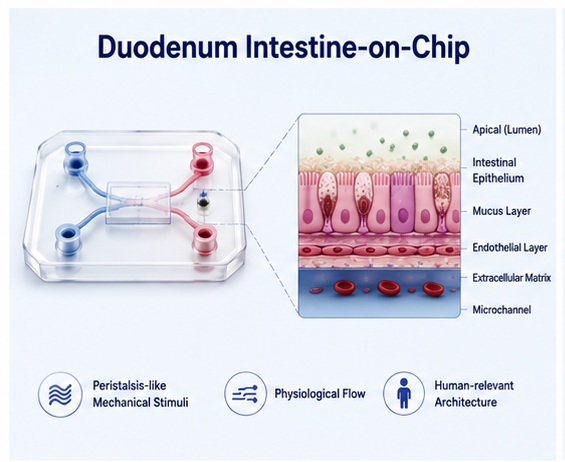
A dynamic microphysiological duodenum model designed to simulate key features of the human small intestine for drug absorption, nutrient transport, barrier function, toxicity, and disease research.
- Overview
- Details
- Advantages
- FAQs
Overview
Located immediately downstream of the stomach, the duodenum is a highly active region where gastric contents mix with bile, pancreatic enzymes, nutrients, and orally administered compounds. This unique exposure environment makes the duodenum a critical site for early intestinal absorption, epithelial transport, digestive response, and local toxicity evaluation.
Because duodenal function is shaped by continuous luminal stimulation, directional transport, and flow-dependent epithelial responses, it can be difficult to study accurately using simple static cultures. Duodenum Intestine-on-Chip provides a compartmentalized and perfusable in vitro model that allows researchers to better control luminal exposure, monitor barrier behavior, and evaluate duodenum-relevant responses to drugs, nutrients, inflammatory factors, or digestive components.
What Is Duodenum Intestine-on-Chip?
Duodenum Intestine-on-Chip is a microfluidic cell culture device that mimics key structural and functional characteristics of the human duodenum. The platform typically includes separated apical and basal channels, enabling intestinal epithelial cells to form a polarized barrier under controlled flow conditions.
This chip-based model can support the study of important duodenal functions, including:
- Polarized epithelial barrier formation
- Drug absorption and intestinal permeability
- Nutrient transport and metabolism-related responses
- Dynamic exposure to luminal compounds
- Inflammatory, toxic, or digestive factor stimulation
- Real-time imaging and downstream molecular analysis
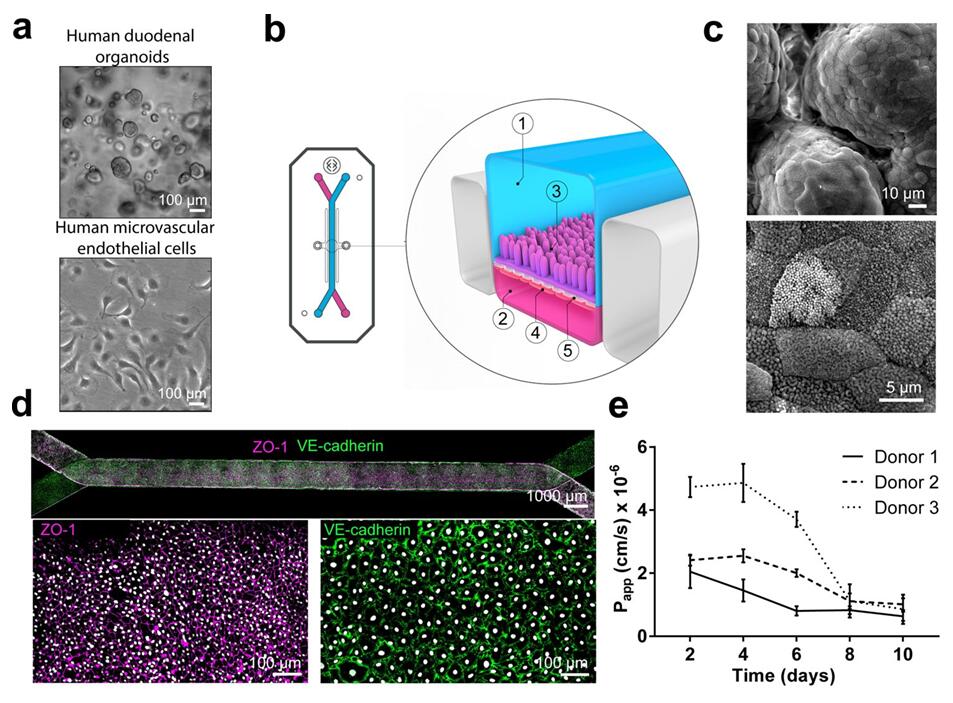 Fig. 1. Duodenum Intestine-Chip: a microengineered model of the human duodenum (Kasendra
M,Luc R,et al., 2020).
Fig. 1. Duodenum Intestine-Chip: a microengineered model of the human duodenum (Kasendra
M,Luc R,et al., 2020).
Our Duodenum Intestine-on-Chip Platform
Our Duodenum Intestine-on-Chip platform is designed for researchers studying oral drug absorption, duodenal barrier function, nutrient transport, intestinal toxicity, and small intestinal disease mechanisms under dynamic microphysiological conditions.
Key Features
- Human-relevant duodenal barrier: Supports epithelial polarization, tight junction formation, and barrier integrity assessment.
- Dynamic perfusion: Provides controlled fluid flow to better mimic the small intestinal microenvironment.
- Apical-basal compartmentalization: Enables luminal dosing, basal sampling, and directional transport analysis.
- Flexible cell compatibility: Supports intestinal cell lines, primary duodenal epithelial cells, iPSC-derived cells, and organoid-derived epithelial cells.
- Co-culture capability: Can be adapted for epithelial-endothelial, epithelial-immune, stromal, or microbiome-related studies.
Validation & Readouts
The model can be evaluated through functional, molecular, and imaging-based assays to confirm physiological relevance and reproducibility.
- Barrier integrity: FITC-dextran permeability assay and TEER-related measurement
- Tight junction markers: ZO-1, Occludin, Claudin family proteins
- Duodenal epithelial markers: Villin, CDX2, MUC2, and relevant transporter expression
- Cell morphology: Brightfield and fluorescence imaging
- Inflammatory response: Cytokine detection such as IL-6, IL-8, and TNF-α
- Downstream analysis: qPCR, immunostaining, ELISA, RNA-seq, and LC-MS/MS
Applications
- Oral Drug Absorption: Evaluate compound permeability, transport, and intestinal uptake in a duodenum-relevant model.
- Nutrient Transport Research: Study absorption and epithelial responses to nutrients, food-derived compounds, and metabolites.
- Intestinal Barrier Function: Analyze epithelial barrier formation, disruption, and recovery under controlled conditions.
- Duodenal Toxicity Testing: Assess compound-induced epithelial damage, inflammation, and barrier impairment.
- Inflammation & Disease Modeling: Model inflammation-associated epithelial responses relevant to small intestinal disorders.
- Microbiome and Digestive Factor Studies: Investigate responses to microbial components, bile acids, digestive enzymes, or luminal stimuli.
Why Choose Our Duodenum Intestine-on-Chip
- More physiologically relevant than static intestinal 2D culture models
- Dynamic flow environment for improved small intestinal barrier modeling
- Designed for oral drug research, including permeability and transport studies
- Flexible and customizable for different cells, compounds, stimulation conditions, and assay endpoints
- Compatible with multiple readouts including imaging, permeability, cytokine, molecular, and biochemical assays
- Technical support available for chip setup, model development, assay design, and custom solutions
FAQs
Q: What cell types can be used in Duodenum Intestine-on-Chip?
The platform can support intestinal epithelial cell lines, primary duodenal epithelial cells, iPSC-derived intestinal cells, and organoid-derived epithelial cells depending on your study requirements.
Q: Can it be used for oral drug absorption studies?
Yes. The apical-basal chip design enables directional compound exposure and sample collection, making it suitable for studying oral drug permeability, transport, and epithelial response.
Q: Does the chip support dynamic perfusion culture?
Yes. The chip can be connected to a perfusion system to provide controlled flow and shear stress, supporting more physiologically relevant intestinal culture conditions.
Q: Can duodenal barrier function be measured on the chip?
Yes. Barrier integrity can be evaluated using permeability assays, tight junction marker analysis, imaging, and TEER-related measurements depending on the chip configuration.
Q: Is the platform suitable for nutrient or digestive factor studies?
Yes. The model can be used to study epithelial responses to nutrients, food-derived compounds, bile acids, digestive enzymes, metabolites, or other luminal stimuli.
Q: Do you provide customized solutions?
Yes. We can support customized chip design, cell selection, co-culture setup, flow conditions, stimulation protocols, and endpoint assays based on your project goals.
Advance your small intestinal research with our human-relevant Duodenum Intestine-on-Chip platform.
Contact us today to request product details, pricing, or customized solutions for your study.
Online Inquiry